Who They Are:
Save Our Greenbelt is a grassroots movement in Conisbrough, South Yorkshire (~12,000 residents), opposing the Whitestone Solar Farm, a 750 MW solar project with Battery Energy Storage System (BESS), spanning Green Belt land across Rotherham and Doncaster.
Separate from the Wales and Kiveton group (focused on Whitestone’s southern sites and the 40 MW Kiveton BESS),
Save Our Greenbelt protects Conisbrough Parks, a historic Green Belt near Clifton (~3,500), Micklebring (~200), Ravenfield, and Braithwell. The group includes residents, councillors, MP Jake Richards, and mayoral candidates Ros Jones (Labour), Nick Fletcher (Conservative), and Reform’s Alexander Jones.Their Slogan: “Preserve Our Greenbelt, Protect Our Heritage!
”Their Mission: Save Our Greenbelt aims to stop Whitestone, arguing it threatens Best and Most Versatile (BMV) farmland, Anglo-Saxon heritage, and community safety due to fire risks, weak regulations, and grid instability. They use technical terms to rally support, demand robust Environmental Impact Assessments (EIAs), and push for rooftop or brownfield solar.
Wales and Kiveton Group: This separate group in Kiveton Park (~7,500) and Wales (~7,000) opposes Whitestone’s sites near Harthill and the Kiveton BESS (Harmony Energy, near Hard Lane). They cite fire risks, a 13th-century mill, and wildlife, with 139 objections by April 5, 2025.
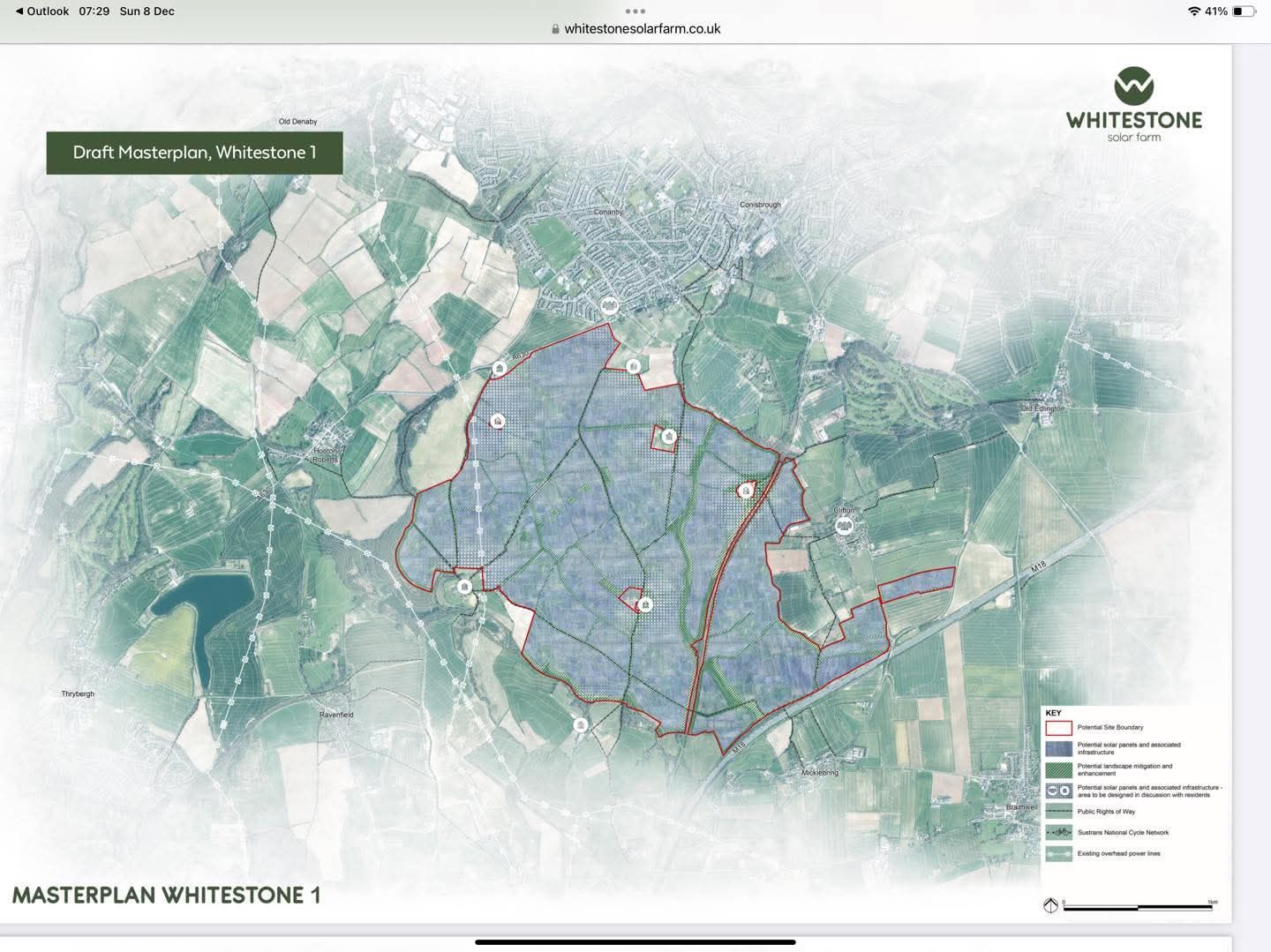
Whitestone Solar Farm: Developed by Green Nation, this Nationally Significant Infrastructure Project (NSIP) could power 250,000 homes but covers 1,000+ acres of Green Belt, including Conisbrough Parks and areas near Bramley, Wickersley, Ulley, Aston, Kiveton Park, Harthill, and Hooton Roberts (some ex-HS2 land).
It connects to Brinsworth Substation, needing approval from Energy Secretary Ed Miliband.
The first consultation (702 attendees, 940 responses) closed January 31, 2025. Green Nation reduced the site by 279 hectares (April 2025), adding buffers, but MP Jake Richards called it “short.” A second consultation is set for late 2025, with an application due summer 2026.‽web:0,7,9,19,23
Why Chosen and Proximity to Brinsworth:
Green Nation selected sites due to available grid capacity at Brinsworth Substation, a remnant of South Yorkshire’s steel industry, and proximity to open land suitable for solar. The substation’s capacity allowed a grid connection agreement, with underground cables planned to link Whitestone’s 750 MW output. ‽web:4,9,12
Kiveton BESS: Harmony Energy’s 40 MW project, powering 130,000 homes for two hours, uses 2 acres of low-grade Green Belt near Kiveton Park Substation. It claims 5,500 tonnes of CO2 savings and a £400,000 community fund. Consultation closed April 4, 2025, with no South Yorkshire Fire Service report. ‽web:0,6,8,17
Add-Ons: Piper Lane Solar Farm (31 hectares, 50,700 PV panels, BESS, Aston, ~15,000 residents) and Firsby Lane Solar Farm (25 MVA, 21 hectares, Hooton Roberts, ~200 residents) face Green Belt objections, with deadlines of February 5 and March 27, 2025. ‽web:18
Campaign Activity:
Save Our Greenbelt’s April 14, 2025, Ivanhoe Centre meeting (300+ attendees) and January 24, 2025, protest opposed Whitestone’s heritage and BMV impacts. The Wales and Kiveton group’s March 24, 2025, meeting spurred 139 Kiveton BESS objections. ‽web:0,7,17,23
Spain/Portugal Outages: A massive April 29, 2025, blackout in Spain and Portugal, affecting 60 million people, exposed grid vulnerabilities. Spain’s grid operator, REE, identified two solar plant failures in the southwest, causing a 60% demand drop in five seconds. Heavy renewable reliance (56% in 2024, with solar at 53% during the outage) and aging infrastructure were blamed, not cyberattacks. ‽web:14,18,20,23
Why Unsuitable:
Conisbrough: Whitestone’s Conisbrough Parks hosts Anglo-Saxon hunting grounds and 13th-century pottery, per archaeologist Jo Ferris: “Hugely important land.” Save Our Greenbelt argues the EIA (due 2026) downplays heritage and wildlife (barn owls, deer). GHI-driven site selection near Brinsworth Substation prioritizes profits over history, and SCADA won’t track harm. Villages like Clifton and Micklebring face disruption. ‽web:7,23
Wales and Kiveton:
Kiveton BESS, near a 13th-century mill (1605 maps), and Whitestone’s Harthill sites threaten prehistoric to Roman remains. The Wales and Kiveton group’s 139 objections cite EIA neglect of newts and sparrowhawks. ‽web:0,17
Add-Ons:
Piper Lane and Firsby Lane’s Green Belt farmland risks cumulative heritage and ecological loss, per objections. ‽web:18
Their Argument: Historic sites (Anglo-Saxon, medieval) and wildlife make these locations unfit. GHI ignores heritage, and EIAs are rushed. Rooftop solar in urban Rotherham avoids disruption near villages. ‽web:10
Their Tactic: Save Our Greenbelt shares pottery photos at January 24, 2025, protests, demanding independent EIAs. The Wales and Kiveton group’s March 24 meeting highlighted mill history. ‽web:7,17
Why These Areas Should Never Have Been Considered
Save Our Greenbelt (Conisbrough) and the Wales and Kiveton group argue that their areas, plus add-ons (Piper Lane, Firsby Lane), are unsuitable for solar and BESS projects due to location, land grading (ALC/BMV), Green Belt status, proximity to population, and new concerns about grid instability (post-Spain/Portugal outages) and DC/AC grid and equipment limitations. Below, I’ll explain their objections, define jargon, and integrate fire prevention, safety guidelines, government regulations, and environmental impacts.
1. Location:
Historic and Ecologically SensitiveJargon Used:EIA (Environmental Impact Assessment): A study checking impacts on nature, heritage, and communities.
GHI (Global Horizontal Irradiance): A measure of sunlight for solar site selection.
SCADA (Supervisory Control and Data Acquisition): Tech monitoring equipment, not wildlife or history.
Layman Explanation: An EIA is like a safety check for nature and history.
GHI shows how sunny a spot is for panels.
SCADA is a computer system for machines, not old sites or animals.
2. Land Grading:
Loss of BMV FarmlandJargon Used:
BMV (Best and Most Versatile): Top-quality farmland (Grades 1, 2, 3a in the ALC—Agricultural Land Classification).
ALC: Grades land from 1 (best) to 5 (worst) for farming.RPS (Renewable Portfolio Standard): Rules pushing green energy, sometimes taking farmland.
Layman Explanation: BMV is the best soil for crops.
ALC scores land for farming.
RPS is a government push for clean energy, but it can take farms.
Why Unsuitable:Conisbrough:
Whitestone’s Conisbrough Parks and Ravenfield/Braithwell sites likely include BMV (Grade 3a, per ALC data), vital for food. A resident warned: “100 years without local food” (60-year project + 40-year recovery).
RPS drives Green Nation to use fertile land. ‽web:6,23Wales and Kiveton: Kiveton BESS uses low-grade land (Grade 4/5), but Whitestone’s Kiveton Park/Harthill sites are suspected BMV. The Wales and Kiveton group fears add-ons like Piper Lane (31 hectares, likely Grade 3a). ‽web:0
Add-Ons:
Piper Lane and Firsby Lane’s likely BMV farmland risks food production for 40 years. ‽web:18Their Argument: BMV land near farming communities is too valuable for panels. RPS can be met with rooftop solar (e.g., Germany’s 70% rooftop PV). ‽web:10Their Tactic: Save Our Greenbelt shares ALC maps at April 14, 2025, Ivanhoe Centre meeting, with signs like “No Panels on Our Food!” The Wales and Kiveton group agrees for Whitestone’s southern sites. ‽web:23
3. Green Belt Status:
Violating Protected Land
Jargon Used:NSIP: Large projects like Whitestone, approved by the government, not councils.
PPA (Power Purchase Agreement): A contract to sell power, rushing projects.
NEM (Net Energy Metering): Credits for extra power, encouraging haste.
Layman Explanation: NSIP skips local councils for government approval.
PPA is a deal to sell electricity, sometimes rushing safety.
NEM pays for extra power, speeding things up.
Why Unsuitable:Conisbrough:
Conisbrough Parks’ Green Belt status protects against urban sprawl, preserving wildlife and recreation. Save Our Greenbelt argues Whitestone’s NSIP status bypasses councils, undermining laws. PPAs and NEM prioritize profits over Green Belt, despite grazing claims. ‽web:2,7,23
Wales and Kiveton: Kiveton BESS (3.69 hectares) and Whitestone’s Harthill sites are Green Belt, home to badgers.
The Wales and Kiveton group’s 400+ petition signatures oppose loss, fearing NSIP trends. ‽web:0,17
Add-Ons: Piper Lane and Firsby Lane’s Green Belt status is threatened, with Piper Lane’s 17% biodiversity gain insufficient. ‽web:18
Their Argument: Green Belt is protected for nature, not solar/BESS. NSIP and PPAs erode this near populated areas. Rooftop solar avoids harm. ‽web:15Their Tactic: Save Our Greenbelt protests (January 24, 2025) with “Save Our Greenbelt!” signs, demanding NSIP reform. The Wales and Kiveton group’s 139 objections agree. ‽web:7,17
4. Proximity to Population:
Fire and Disruption Risks
Jargon Used:BESS: Big batteries storing solar power.UL 9540: A safety standard for BESS fire risks.NFPA 855:
Fire safety rules for BESS placement.Li-ion (Lithium-ion): Flammable BESS battery type.BMS (Battery Management System):
Electronics monitoring battery safety.FCA (Frequency Control Ancillary Services): Grid tasks stressing batteries.
Layman Explanation:
BESS is a giant battery. UL 9540 and NFPA 855 aim to stop battery fires. Li-ion batteries can burn if damaged.
BMS monitors safety.
FCA is a grid job that might overwork batteries, risking fires.
Why Unsuitable:
Conisbrough: Whitestone’s BESS, near Conisbrough (~12,000), Clifton, and Micklebring, risks Li-ion fires (e.g., 2020 Liverpool incident). UL 9540 and NFPA 855 may not stop “thermal runaway” (uncontrollable fires) if BMS fails or FCA stresses batteries.
Noise and traffic disrupt populated areas. ‽web:6,23
Wales and Kiveton: Kiveton BESS, 400 meters from homes, endangers ~7,500 residents, per 139 objections. No South Yorkshire Fire Service report fuels fears of BMS/FCA issues. Whitestone’s nearby sites add risks. ‽web:0,6,17
Add-Ons: Piper Lane’s BESS, near Aston (~15,000), is an “eyesore,” with fire concerns. Firsby Lane risks Hooton Roberts (~200). ‽web:18
Their Argument: BESS near populated areas risks fires, and UL 9540/NFPA 855 are inadequate. Brownfield sites are safer. ‽web:5
Their Tactic: Save Our Greenbelt shares fire videos at April 14, 2025, meeting, demanding setbacks. The Wales and Kiveton group’s March 24 meeting pushed fire training. ‽web:17,23
5. Why Whitestone Was Chosen and Proximity to Brinsworth Substation
Jargon Used:T&D (Transmission and Distribution): The grid’s power lines and substations.
GHI: Sunlight strength for solar sites.PV (Photovoltaic): Solar panels converting sunlight to electricity.Layman Explanation:
T&D is the grid’s wiring to carry power.
GHI checks if a place is sunny enough for panels. PV is the tech in solar panels.
Why Chosen: Green Nation chose Whitestone’s sites due to Brinsworth Substation’s available T&D capacity, a legacy of South Yorkshire’s steel industry. A grid connection agreement was secured, leveraging proximity to open Green Belt land suitable for PV panels (high GHI). Underground cables will link Whitestone’s 750 MW to Brinsworth, minimizing new infrastructure. The substation’s location near Rotherham and Doncaster made Conisbrough, Kiveton, and add-on sites ideal, per developers. ‽web:4,9,12
Why Unsuitable:Conisbrough:
Save Our Greenbelt argues Brinsworth’s capacity doesn’t justify sacrificing Conisbrough Parks’ heritage and BMV land. T&D readiness is unproven for 750 MW, risking outages near 12,000 residents. ‽web:23
Wales and Kiveton: The Wales and Kiveton group notes Kiveton BESS and Whitestone’s southern sites rely on Brinsworth, but T&D strain could affect ~7,500 residents, per 139 objections. ‽web:0,17
Add-Ons: Piper Lane and Firsby Lane’s PV and BESS add T&D pressure, unstudied near Aston’s 15,000 residents. ‽web:18
Their Argument: Brinsworth’s proximity drove a profit-focused choice, ignoring heritage and BMV. T&D capacity needs scrutiny, and rooftop solar avoids Green Belt harm. ‽web:12
Their Tactic: Save Our Greenbelt demands T&D assessments at April 14, 2025, meeting. The Wales and Kiveton group echoes this. ‽web:17,23
6. Grid Instability: Lessons from Spain/Portugal Outages
Jargon Used:T&D: Grid infrastructure for power delivery.
EMS (Energy Management System): Software controlling BESS and grid flow.
FCA: Grid tasks that might destabilize systems.
Layman Explanation: T&D is the grid’s power lines.
EMS is a smart controller for batteries and grids.
FCA is a grid job that can stress systems.
Why Unsuitable:Spain/Portugal Outages (April 29, 2025): A blackout hit 60 million people, with Spain’s grid operator, REE, citing two solar plant failures in the southwest, dropping 60% of demand in five seconds. Solar (53% of production) and renewables (56% in 2024) overwhelmed aging T&D, lacking load-shedding relays to handle frequency swings. Spain’s isolation from Europe’s grid worsened the cascade. ‽web:14,18,20,23
Conisbrough: Save Our Greenbelt warns Whitestone’s 750 MW, reliant on Brinsworth’s T&D, could strain South Yorkshire’s grid, untested for such scale. EMS may not handle FCA demands, risking outages for 12,000 residents, similar to Spain. ‽web:23
Wales and Kiveton: Kiveton BESS and Whitestone’s sites add T&D pressure, with no EMS reliability data, per 139 objections. ‽web:0,17
Add-Ons: Piper Lane and Firsby Lane’s BESS increase T&D risks near populated areas. ‽web:18
Their Argument: Spain’s outages show renewable-heavy grids fail without robust T&D and EMS. Brinsworth’s capacity is unproven, risking blackouts near communities. ‽web:20
Their Tactic: Save Our Greenbelt cites Spain at April 14, 2025, meeting, demanding T&D upgrades. The Wales and Kiveton group agrees. ‽web:17,23
7. DC/AC Grids and Technological Equipment Limitations
Jargon Used:DC (Direct Current): Electricity from solar panels/BESS, needing conversion.AC (Alternating Current):
Grid-compatible electricity for homes.PCS (Power Conversion System): Equipment converting DC to AC, prone to faults.RTE (Round-Trip Efficiency): Energy kept after charging, with heat losses.
Layman Explanation: DC is raw power from panels or batteries. AC is what your home uses. PCS converts DC to AC, but can fail. RTE is energy lost as heat during conversion.
Why Unsuitable:DC/AC Grid Issues: Solar panels and BESS produce DC, requiring PCS to convert to AC for Brinsworth’s T&D. Spain’s outages showed PCS and grid relays struggle with high renewable loads, causing instability. Whitestone’s 750 MW and Kiveton BESS’s 40 MW add similar risks, with RTE losses (heat) stressing equipment. ‽web:14,24
Equipment Readiness: Current PCS and EMS tech isn’t advanced enough for large-scale solar/BESS integration, per Spain’s lessons (aging relays, no load-shedding). UK grids, including Brinsworth, lack smart grid upgrades to isolate failures, risking outages near populated areas. ‽web:18,23
Conisbrough: Save Our Greenbelt fears Whitestone’s PCS could fail under FCA stress, with low RTE causing heat buildup near 12,000 residents. ‽web:23
Wales and Kiveton: Kiveton BESS’s PCS and EMS are untested 400 meters from 7,500 residents, per objections. ‽web:0,17
Add-Ons: Piper Lane and Firsby Lane’s PCS add instability risks near Aston and Hooton Roberts. ‽web:18
Their Argument: DC to AC conversion and outdated PCS/EMS tech aren’t ready for Brinsworth’s load, risking outages like Spain’s. Brownfield sites reduce community exposure. ‽web:20
Their Tactic: Save Our Greenbelt demands smart grid upgrades at protests. The Wales and Kiveton group pushes PCS reliability tests. ‽web:17,23
8. Fire Prevention Measures Are Inadequate
Jargon Used:UL 9540: Safety standard for BESS fire risks.
NFPA 855: Fire safety rules for BESS placement.
Layman Explanation: UL 9540 and NFPA 855 are rules to prevent battery fires.
Why Unsuitable:Conisbrough:
Whitestone’s BESS lacks detailed fire plans, and UL 9540/NFPA 855 may not stop Li-ion “thermal runaway” near 12,000 residents. ‽web:23
Wales and Kiveton: Kiveton BESS, 400 meters from homes, has no fire service report, risking 7,500 residents. ‽web:6,17
Add-Ons: Piper Lane’s BESS lacks robust fire plans near Aston. ‽web:18
Their Argument: NFPA 855 isn’t enough near populations; sprinklers and fire crews are needed. ‽web:16
Their Tactic: Save Our Greenbelt demands foam suppressors at April 14, 2025, meeting. The Wales and Kiveton group pushes fire stations. ‽web:17,23
9. Safety Guidelines and Government Regulations
Jargon Used:ISO 45001: Safety framework for projects.
EPC (Engineering, Procurement, and Construction): Contract model rushing projects.
Layman Explanation: ISO 45001 is a safety rulebook.
EPC is a build plan prioritizing speed.
Why Unsuitable:Conisbrough:
Whitestone’s ISO 45001 lacks BESS-specific rules, and EPC rushes safety near 12,000 residents. NSIP bypasses councils, ignoring T&D limits. ‽web:2,9
Wales and Kiveton: Kiveton BESS’s ISO 45001 gaps and EPC haste risk 7,500 residents. ‽web:0
Add-Ons: Piper Lane and Firsby Lane face similar EPC rush. ‽web:18
Their Argument: ISO 45001 and NSIP favor developers, risking populated areas. ‽web:12
Their Tactic: Save Our Greenbelt demands NSIP reform. The Wales and Kiveton group agrees. ‽web:17,23
10. Environmental and Waste Risks
Jargon Used:LCOE (Levelized Cost of Energy):
Total power cost, often ignoring cleanup.
DOD (Depth of Discharge): Battery capacity used, affecting lifespan.
Layman Explanation:
LCOE is the full price of electricity, skipping recycling.
DOD is how much you drain a battery, wearing it out faster.
Why Unsuitable:Conisbrough:
Whitestone’s PV panels and BESS create waste after 40–60 years (panels) or 10–15 years (Li-ion). LCOE ignores disposal, and high DOD risks pollution near 12,000 residents. ‽web:23
Wales and Kiveton: Kiveton BESS and Whitestone’s panels threaten soil, per 139 objections. ‽web:0
Add-Ons: Piper Lane and Firsby Lane add waste risks. ‽web:18
Their Argument: Li-ion waste risks pollution in populated Green Belt areas. Recycling is needed. ‽web:19
Their Tactic: Save Our Greenbelt shows battery dump images, demanding recycling funds. The Wales and Kiveton group agrees. ‽web:17,23
Campaign in Action
Save Our Greenbelt (Conisbrough):April 14, 2025, Ivanhoe Centre: 300+ residents, MP Jake Richards, and mayoral candidates demanded rooftop solar and EIA transparency. ‽web:23
January 24, 2025, Protest: Highlighted Anglo-Saxon heritage, per Jennifer Gaimster. ‽web:7
Consultation: Mobilized objections by January 31, 2025, via whitestonesolarfarm.co.uk. ‽web:9
Wales and Kiveton Group:March 24, 2025, Kiveton: Spurred 139 Kiveton BESS objections, citing fire and heritage. ‽web:0,17
Petition: 400+ signatures against Kiveton BESS. ‽web:0
Updates: Green Nation’s 279-hectare reduction (April 2025) was “short,” per Richards. Kiveton BESS’s green batteries claim 41.18% biodiversity gain, but no fire report persists. Piper Lane and Firsby Lane face objections. ‽web:9,17,18
Key Takeaways
Save Our Greenbelt (Conisbrough) and Wales and Kiveton group oppose Whitestone and Kiveton BESS, citing BMV, Green Belt, heritage, and fire/grid risks.Unsuitable Sites:
Historic locations (Anglo-Saxon, medieval), BMV (Grade 3a), Green Belt, and proximity to populations (Conisbrough’s 12,000, Kiveton’s 7,500).
Brinsworth Choice: Driven by T&D capacity and GHI, but risks untested grid strain.Spain/Portugal Outages: Show renewable-heavy grids fail without robust T&D/EMS, a risk for Brinsworth.
DC/AC and Tech: Current PCS/EMS aren’t ready, risking outages near communities.Solution: Rooftop or brownfield solar, not Green Belt.
 SAY NO TO THE DESTRUCTION OF OUR LAND
Leave a comment