Critical Analysis:
Why Whitestone Should Not Proceed
Exacerbation of Flood Risk Involving Key Brooks and Regional Vulnerability:
Recent Flood Context: The Dearne and Rother Valleys are highly vulnerable to flooding, as seen in November 2019 and October 2023 (Storm Babet). The 2019 floods saw the River Don reach record levels, necessitating boat rescues at Parkgate Retail Park, while Storm Babet’s 85mm rainfall in 24 hours caused the River Rother to exceed 2007 levels, flooding Parkgate and Catcliffe and isolating Old Denaby via roads like Denaby Lane.
Doncaster Council’s £29m investment in flood defenses for Rotherham, prompted by a 2023 review questioning runoff from developments like Waverley, underscores the region’s critical flood risk.
Role of Kearsley, Ulley, and Firsby Brooks:
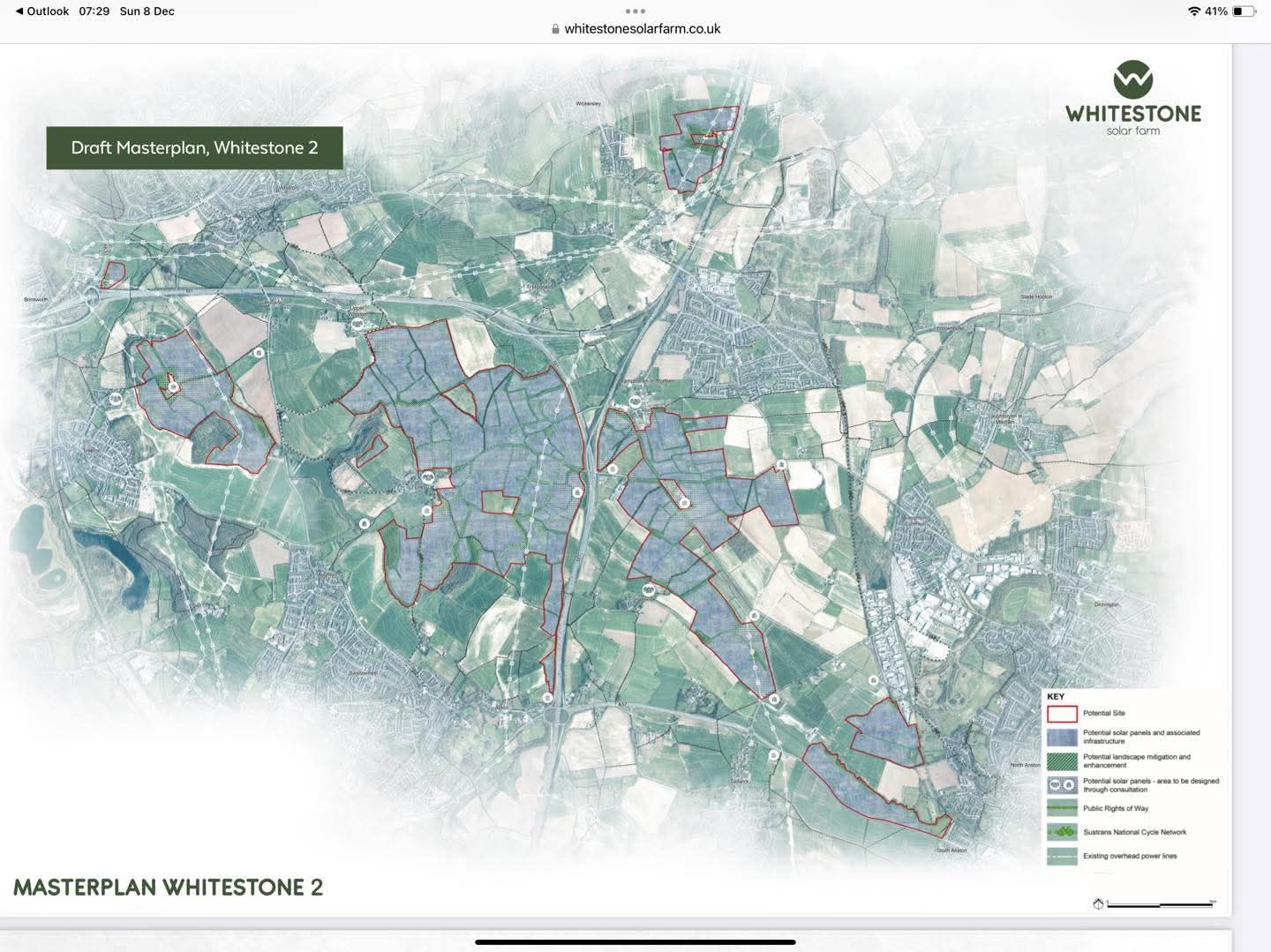
The Whitestone site, now clarified as 3,500 acres, encompasses areas draining into Kearsley Brook (near Conisbrough), Ulley Brook (near Ulley and Aston), and Firsby Brook (near Firsby Hall Farm). These brooks feed into the Don and Rother catchments, amplifying flood risks. Kearsley Brook’s proximity to Conisbrough’s Flood Zone 3 areas, Ulley Brook’s history of overflow during 2007 and 2023 floods, and Firsby Brook’s role in local drainage make them critical to flood dynamics.
Soil compaction from construction and runoff from solar panels could increase peak flows in these brooks, worsening downstream flooding at Parkgate or isolating Old Denaby, as seen in 2023.
Whitestone’s Impact: The 3,500-acre project risks increasing runoff by 10–20% on clay soils, prevalent in Conisbrough Parks, channeling water into Kearsley, Ulley, and Firsby Brooks.
The loss of absorbent Green Belt land, designated as Doncaster’s ASLV and Rotherham’s AHLV, exacerbates this risk, especially amid Doncaster’s flood defense efforts.
The scoping report’s lack of hydrological modeling for these brooks, deferring specifics to the autumn 2025 consultation, leaves flood risks unquantified.
Critical Risk:
The scoping report’s failure to assess runoff impacts on Kearsley, Ulley, and Firsby Brooks, despite their role in 2023 flooding, risks overwhelming the Don Regulators’ washlands, like Rother Valley Country Park. Proceeding without modeling, especially in Flood Zones 2 and 3, disregards Doncaster’s flood defense investments and threatens communities like Old Denaby and Parkgate.
Violation of Rotherham’s Green Belt and AHLV Protections:
Rotherham’s Green Belt and AHLV:
The Whitestone site includes Rotherham’s Green Belt, with parts designated as an Area of High Landscape Value (AHLV) under Rotherham’s Local Plan. The AHLV, covering areas like Ulley and Treeton, prioritizes landscape preservation, biodiversity, and flood mitigation, aligning with Doncaster’s ASLV for Conisbrough Parks.
Local Plan Policy 30 (Landscape) requires developments to protect AHLV’s character, ensuring no significant adverse impacts on landscape value or flood resilience.
Whitestone’s Conflict:
The 3,500-acre project’s industrial-scale solar arrays and Battery Energy Storage System (BESS) threaten the AHLV’s open, rural character, contravening Policy 30.
The scoping report’s proposed tree buffers and open spaces are insufficient to mitigate the visual and ecological disruption across such a vast area, especially near Ulley Brook and Rother Valley Country Park.
Critical Issue:
Encroaching on Rotherham’s AHLV and Green Belt risks undermining flood-absorbing landscapes, as seen in Catcliffe’s 2023 flooding, and violates Policy 30’s protective intent. The scoping report’s lack of AHLV-specific impact assessments fuels opposition from Save Our Green Belt, risking legal challenges under Local Plan guidelines.
Visual Impacts on Doncaster’s ASLV and Rotherham’s AHLV:
ASLV and AHLV Significance: Doncaster’s ASLV, covering Conisbrough Parks, and Rotherham’s AHLV, spanning Ulley and Treeton, are designated for their scenic beauty, historic landscapes (e.g., Anglo-Saxon hunting grounds), and ecological value.
These areas, visible from public rights of way and villages like Harthill and Woodall, are protected under Local Plan Policy 30 to maintain their aesthetic and functional integrity.
Whitestone’s Visual Impact:
The 3,500-acre site’s solar panels, substations, and cabling will create a stark industrial landscape, clashing with the ASLV’s rolling farmland and AHLV’s wooded vistas.
The scoping report’s visual impact assessments, still preliminary, propose boundary tree buffers, but these are unlikely to screen the vast arrays, especially on elevated areas near Kearsley and Firsby Brooks.
Residents in Conisbrough and Kiveton fear a “blight” on their views, as voiced at the April 2025 Ivanhoe Centre meeting.
Critical Concern:
The visual disruption to ASLV and AHLV areas contravenes Policy 30’s requirement to preserve landscape character, amplifying opposition from 300+ residents. The scoping report’s lack of detailed visual impact studies, pending the autumn 2025 consultation, risks permanent aesthetic harm to protected landscapes.
Unanimous Local Opposition and Community Campaigns:
Kiveton and Wales Campaign:
Kiveton and Wales, with a 16th-century mining heritage, have joined the Save Our Green Belt, Conisbrough Parks campaign, opposing Whitestone’s threat to farmland, archaeology (e.g., medieval pottery at Firsby Hall Farm), and flood resilience near Firsby Brook.
The Kiveton Park & Wales History Society emphasizes cultural significance, unaddressed in the scoping report.
Conisbrough and Broader Opposition:
Over 300 residents from Conisbrough, Micklebring, Braithwell, Ravenfield, and Clifton unanimously opposed the project at the April 14, 2025, Ivanhoe Centre meeting, citing flood risks, heritage loss, and ASLV/AHLV degradation.
The first consultation (November 18, 2024–January 31, 2025) recorded 702 attendees and 940 feedback responses, prompting a 25% scale reduction, but opposition remains strong, as seen in January 2025 Ravenfield protests.
Critical Issue:
Unanimous opposition, fueled by 2019 and 2023 flood traumas and visual/heritage concerns, reflects deep distrust. The scoping report’s preliminary assessments fail to address these, risking unrest, as in Catcliffe’s 2023 backlash. Proceeding ignores democratic principles and flood-affected residents’ experiences.)
Near-Unanimous Mayoral Opposition:
Mayoral Stance: Mayoral candidates Ros Jones (Labour), Nick Fletcher (Conservative), and Alexander Jones (Reform, via statement), plus former MP Alexander Stafford, opposed Whitestone at the April 2025 meeting, prioritizing farmland preservation, flood mitigation, and ASLV/AHLV protection.
Jones advocated rooftop solar, Fletcher criticized Green Belt exploitation, and Jones called for scrapping the project.
Critical Concern:
This cross-party consensus, aligned with Local Plan Policy 30, underscores Whitestone’s misalignment with regional priorities, especially post-2023 floods and Doncaster’s flood defenses. The scoping report’s lack of community benefits risks political fallout, as the NSIP status bypasses local councils.
Procedural Irregularities with Brinsworth Substation Connection:
DEFRA Violation:
Green Nation secured Brinsworth Substation’s grid connection before identifying suitable land, contravening DEFRA’s 2014 guidelines prioritizing brownfield or low-value land.
The 3,500-acre Green Belt site, tied to Brinsworth’s steel industry capacity, ignores DEFRA’s farmland protection stance.
Critical Flaw:
The scoping report does not address this irregularity, risking legal challenges, as in North Devon’s 2025 judicial review. Proceeding prioritizes profit over flood and ASLV/AHLV concerns.
Neglected Heritage in Conisbrough and Kiveton and Wales:
Issue:
The scoping report includes heritage but lacks surveys for Conisbrough Parks (Anglo-Saxon grounds near Kearsley Brook) and Kiveton/Wales (medieval pottery near Firsby Brook), despite NPPF paragraph 187 requirements.
Community concerns, voiced by the Kiveton Park & Wales History Society and Conisbrough’s Jo Ferris, remain unaddressed.
Critical Risk:
Proceeding risks cultural loss, as in Suffolk’s 2025 solar farm concerns, and could spark legal challenges, amplifying opposition.
Vast 3,500-Acre Site Spread Creating Deficiencies:
Issue:
The 3,500-acre site spans Conisbrough, Brinsworth, Harthill, and villages like Ulley and Aston, disrupting bridleways, ecosystems, and drainage into Kearsley, Ulley, and Firsby Brooks.
The scoping report’s preliminary assessments do not address these impacts, despite threats to species like bats and increased runoff risks, as in Old Denaby’s 2023 isolation.
Critical Deficiency:
The sprawling site, labeled “industrial-scale destruction” by Save Our Green Belt, creates unmanageable impacts, violating Policy 30’s landscape protections.
Encirclement of Rother Valley Country Park Contravening Local Guidelines:
Issue:
Sites near Treeton and Aston surround the park, a key flood washland for the Don Regulators, contravening Doncaster and Rotherham guidelines, including Policy 30. The scoping report lacks flood mitigation strategies for the park, risking worse flooding at Parkgate, as in 2023.
Critical Threat:
Encirclement undermines flood resilience and ASLV/AHLV protections, threatening regional flood management.
Inadequate Environmental Assessments and Lack of Rivers Authority Cooperation:
Issue:
The 450-page scoping report outlines methodologies but lacks hydrological modeling for Kearsley, Ulley, and Firsby Brooks, deferring specifics to the autumn 2025 consultation.
No evidence shows collaboration with the Environment Agency’s Don Regulators, despite 2019 and 2023 flood risks.
Critical Gap:
The preliminary report risks repeating Catcliffe’s 2023 flooding failures, endangering Parkgate and Old Denaby. Policy 30 requires robust flood assessments, unmet by the current scoping phase.
Case for Comprehensive Research and Cooperation
Given the scoping report’s preliminary nature and the autumn 2025 consultation, Whitestone must be paused until Green Nation completes:
Detailed Hydrological Modeling:
Need:
Model runoff for the 3,500-acre site, focusing on Kearsley, Ulley, and Firsby Brooks, clay soils, and extreme events (e.g., Storm Babet). Predict impacts on Parkgate, Old Denaby, and Rother Valley Country Park, ensuring no flood risk increase per Policy 30 and NPPF.
Implementation:
Commission hydrologists, sharing results in autumn 2025 via whitestonesolarfarm.co.uk, aligned with Don Regulators.
Soil and Ecological Assessments:
Need:
Test soil permeability and survey species, designing SuDS to prevent runoff into brooks.
Implementation:
Publish EIAs in autumn 2025, incorporating Kiveton and Conisbrough input.
Heritage Surveys:
Need:
Survey Conisbrough and Kiveton/Wales sites near Kearsley and Firsby Brooks per NPPF paragraph 187.Implementation:
Partner with Historic England, sharing findings in autumn 2025.
Environment Agency and Local Authority Collaboration:
Need:
Form a working group to integrate drainage with Don and Rother catchment plans, protecting the park and brooks, per Policy 30.
Implementation:
Co-design SuDS, publishing updates in autumn 2025.
Transparent Engagement:
Need:
Release scoping report findings and models in autumn 2025, hosting forums to address opposition and ASLV/AHLV concerns.
Implementation:
Expand consultations, incorporating feedback from 300+ residents and Save Our Green Belt.
Conclusion
The Whitestone solar farm’s 450-page scoping report, while outlining environmental studies, lacks hydrological modeling for Kearsley, Ulley, and Firsby Brooks, heritage surveys, and Environment Agency collaboration, risking exacerbated flooding in a region scarred by 2019 and 2023 events.
The 3,500-acre project’s violation of Rotherham’s AHLV, visual impacts on Doncaster’s ASLV and AHLV, and contravention of Local Plan Policy 30 amplify concerns.
Unanimous opposition, mayoral rejection, procedural flaws, and Rother Valley Country Park’s encirclement demand a pause until comprehensive assessments are completed in autumn 2025. Transparent EIAs are vital to prevent environmental harm, cultural loss, and flooding. Residents can engage via whitestonesolarfarm.co.uk and contact Jake Richards MP or mayoral candidates for advocacy.
Note: The date is May 16, 2025, and the scoping report’s full details may evolve by autumn 2025. Residents should monitor updates at whitestonesolarfarm.co.uk for the latest consultation materials.
 SAY NO TO THE DESTRUCTION OF OUR LAND
Leave a comment