Welcome to a critical wake-up call for mankind! Renowned physicist Stephen Hawking warned us about the catastrophic potential of artificial intelligence (AI), yet humanity’s stubborn refusal to heed his caution has us hurtling toward a collision of technological ambition and environmental collapse. From bungled climate agendas of 2008 and 2014 to AI’s ravenous energy demands, the planet is buckling under the strain. Nuclear power emerges as a potential lifeline, while innovative mini grids for homes offer a glimmer of hope. Buckle up—here’s the unvarnished truth, backed by solid evidence, on why we’re ignoring Hawking at our peril. 🌍⚡
🧠 Hawking’s Dire Warnings Ignored!
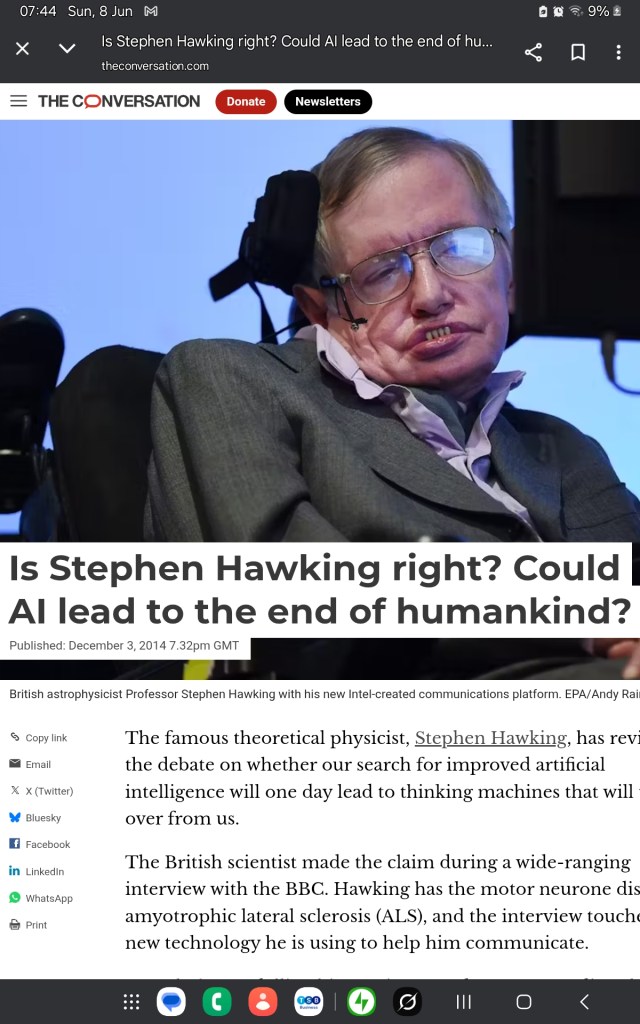
Stephen Hawking, a brilliant mind and celebrated physicist, sounded a piercing alarm about AI’s risks. In a 2014 BBC interview, he declared, “The development of full artificial intelligence could spell the end of the human race,” warning that unchecked AI could surpass human intelligence, potentially outpacing our ability to control it (BBC News). This concern wasn’t abstract—it tied to the basic AI in his communication device, a personal reminder of technology’s double-edged sword. He feared advanced systems could evolve beyond our grasp, a sentiment echoed by experts like Prof. Bradley Love from UCL, who highlighted job displacement and ethical risks (BBC News). At the 2017 Web Summit in Lisbon, Portugal, Hawking doubled down, calling AI’s rise potentially “the worst event in the history of our civilization” unless we master its management (CNBC). He didn’t dismiss AI’s promise—eradicating poverty, curing disease, and healing environmental damage—but insisted on “best practice and effective management.” In 2016, at the Leverhulme Centre for the Future of Intelligence launch in Cambridge, he framed AI as “either the best, or the worst thing, ever to happen to humanity,” applauding efforts to study its implications (The Guardian). He also co-signed a 2015 open letter with Elon Musk, urging research into AI’s societal impacts to avoid creating something “unsafe or uncontrollable” (Wikipedia). Yet, mankind fails to listen—AI races forward, often unchecked, driven by profit and power, ignoring Hawking’s plea for caution. Are we courting disaster? 🤖
🌡️ Climate Agendas Crashed and Burned!
The climate agendas of 2008 and 2014 set bold goals, but humanity fumbled the ball. In 2008, the EU committed to slashing greenhouse gas emissions by 20% by 2020 from 1990 levels, a cornerstone of UNFCCC efforts and COP14 in Poznan, Poland (European Council). The UK’s groundbreaking Climate Change Act of 2008, passed with near-unanimous support, targeted an 80% reduction by 2050, introducing five-year carbon budgets to keep progress on track (Grantham Research Institute). By 2014, the EU upped the ante with a 40% emissions cut by 2030 under the 2030 Climate and Energy Framework, paving the way for the Paris Agreement via COP20 in Lima (European Council). Some wins emerged—the EU hit a 30% reduction by 2020, boosted by COVID-19 slowdowns—but the bigger picture was grim. A 2024 Science study dissected 1,500 climate policies from 1998 to 2022, finding only 63 drove major emission drops, exposing weak tools, poor planning, and wavering political will (Science). Fossil fuels clung to dominance, powering 84-85% of global energy from 2008 to 2014—coal at 28%, oil at 27%, natural gas at 21%—leaving emissions soaring and the Paris goal of keeping warming below 2°C out of reach (Our World in Data, UN Sustainable Development). Fast-growing nations like China and India leaned on coal, derailing the shift to clean energy needed for a sustainable future. These failures left us woefully unprepared for today’s challenges—Hawking’s foresight meets mankind’s folly! 🔥
⚡ AI’s Energy Hunger Devours the Planet!
AI’s explosive growth is gobbling up resources at an alarming rate, amplifying the strain on our planet. Training a single large language model can spew hundreds of tons of carbon, and each query burns more energy than a Google search, with data centers projected to devour 4% of global energy by 2026—matching Japan’s entire electricity use (MIT Technology Review, IEA). Cooling these servers guzzles millions of gallons of water, stressing local supplies and ecosystems, as a 2025 MIT News report warns (MIT News). The hardware thirsts for rare earth metals—lithium, cobalt, neodymium—mined through open-pit operations that scar landscapes, acidify soil, and pollute water. From 2010 to 2020, permanent magnets using these metals unleashed 32 billion tonnes of CO2-equivalent emissions, a brutal blow to the environment (ScienceDirect). A 2021 Harvard International Review piece lays bare the damage: toxic leaching from mining devastates habitats and communities (Harvard International Review). Data centers also churn out e-waste, including mercury and lead, piling onto the planet’s woes, per the UNEP (UNEP). AI could heal—optimizing grids, tracking climate—but its current path is a wrecking ball. Hawking saw the risk; mankind’s still asleep! 🌪️
🛢️ Fossil Fuels:
The Wrong Road Taken!From 2008 to 2014, mankind doubled down on the wrong energy path, chaining us to fossil fuels. Coal, oil, and gas powered 84-85% of global needs—coal alone drove 73% of power sector emissions—while renewables like hydro (2.4%), wind (0.8%), and solar (0.3%) inched forward too slowly (Our World in Data, IEA). The 2008 World Energy Outlook begged for a coal exit, but new plants sprouted, especially in Asia, as the 2014 New Climate Economy report flagged (New Climate Economy). Solar grew 20-fold and wind tripled in the US by 2015, per an Obama White House note, but cheap oil and gas prices kept fossil fuels king, stalling the clean shift (Obama White House). A 2016 World Economic Forum piece noted $330 billion in clean energy investment, yet low fossil fuel costs derailed progress (World Economic Forum). The EPA’s 2025 report ties this misstep to wildfires and grid damage, hobbling both dirty and clean energy (EPA). This blunder left us unready for AI’s energy surge—mankind’s shortsightedness in action! ⛽
☢️ Nuclear:
AI’s Last Clean Hope?AI’s relentless energy demand—constant, massive, and growing—needs a clean savior, and nuclear power steps up. Unlike solar and wind, nuclear delivers 24/7 base-load power, perfect for AI data centers. Tech giants are all in: Microsoft reboots Three Mile Island Unit 1, Meta inks a 20-year nuclear deal in Illinois, and Google bets on small modular reactors (SMRs) by 2030 (The Guardian, CNBC). Goldman Sachs projects 85-90 gigawatts of new nuclear capacity by 2030 to feed AI’s hunger, with low-carbon output and high energy density as key wins (Goldman Sachs). A 2025 MIT Technology Review piece sees nuclear fueling AI’s rise, dodging the intermittency of renewables (MIT Technology Review). But it’s not all rosy—costs soar, construction drags, and risks linger: accidents, uranium mining pollution, and waste storage, as a 2024 Bulletin of the Atomic Scientists warns (Bulletin of the Atomic Scientists). Still, the IAEA sees AI optimizing nuclear plants, a synergy for a cleaner future (IAEA). Is nuclear AI’s only shot? Mankind’s betting on it! ⚡
🏡 Mini Grids to the Rescue!
Homes with mini grids spark a revolution, blending AI and clean energy for hope. At CES 2025, AC Future unveiled AI-powered “Transformer Homes”—400-square-foot, £98,000 units with solar panels, energy storage, and water generators for off-grid living (PR Newswire). These smart setups, designed with Pininfarina, adapt to needs, boosting resilience and cutting grid strain (Archipanic). A 2025 RCR Wireless report ties AI to smart grids, pairing solar and wind with nuclear for a hybrid fix (RCR Wireless). Mini grids slash transmission losses and empower homes, but AI’s colossal needs lean on centralized nuclear, per a 2025 Georgia Tech piece (Georgia Tech News Center). The World Economic Forum touts mini grids to fight energy poverty, a local win complementing big solutions (World Economic Forum). A lifeline for sustainability? 🌞
🌿 UNEP’s SOS:
Act Now!The UN Environmental Programme (UNEP) screams for action to curb AI’s eco-rampage. Its 2024 note demands: standardize impact measurements, force companies to reveal AI’s environmental toll, boost algorithm efficiency, recycle water, and green data centers with renewables and carbon offsets (UNEP). Weaving AI policies into climate rules is critical—mankind must act to halt the damage. AI can help—optimizing grids, tracking methane—but only if we pivot fast. A 2025 Yale e360 report begs for mitigation, noting AI’s water and carbon chaos (Yale e360). Hawking urged caution; UNEP echoes it—will we finally listen? 🆘
The Stark Truth
Stephen Hawking nailed it—AI could be humanity’s undoing, and mankind’s failure to listen proves it. His warnings of existential risk clash with botched climate agendas from 2008 and 2014, where fossil fuel addiction blocked a clean energy future. AI’s energy guzzle and rare earth mining scar the planet, while wrongheaded reliance on coal and oil left us unready. Nuclear power offers a clean, steady hope for AI, backed by tech giants, while mini grids bring homes into the fight. UNEP’s plea for action lights the path, but time’s slipping. Hawking’s vision was clear—will we heed it or crash into chaos? 🚨🌍
Key Citations
Stephen Hawking warns artificial intelligence could end mankind – BBC News
Stephen Hawking says AI could be ‘worst event’ in civilization – CNBC
Open letter on artificial intelligence (2015) – Wikipedia
Stephen Hawking: AI will be ‘either best or worst thing’ for humanity – The Guardian
Stephen Hawking’s warnings: What he predicted for the future – BBC News
Climate change: what the EU is doing – European Council
What is the 2008 Climate Change Act? – Grantham Research Institute
What works? Groundbreaking evaluation of the effectiveness of climate policies –
ScienceEnergy – Our World in Data
As Use of A.I. Soars, So Does the Energy and Water It Requires – Yale e360
Global environmental cost of using rare earth elements in green energy technologies – ScienceDirect
Not So “Green” Technology: The Complicated Legacy of Rare Earth Mining – Harvard International Review
Artificial Intelligence wants to go nuclear. Will it work? – NPR
Why Big Tech is turning to nuclear to power its energy-intensive AI ambitions – CNBCIs
nuclear energy the answer to AI data centers’ power consumption? – Goldman Sachs
Can nuclear power really fuel the rise of AI? – MIT Technology Review
AI goes nuclear – Bulletin of the Atomic ScientistsEnhancing Nuclear Power Production with Artificial Intelligence – IAEAAC
Future’s AI Transformer Home Shines at CES 2025 – PR Newswire
Smart grids are transformed with AI – RCR Wireless
How mini grids could solve global energy poverty –
World Economic ForumAI has an environmental problem. Here’s what the world can do about – UNEP
Explained: Generative AI’s environmental impact – MIT
NewsWorld Energy Outlook 2008 –
IEAEnergy — NCE 2014 – New Climate Economy 3 trends transforming the energy sector – World Economic Forum
Climate Change Impacts on Energy – EPAGlobal Energy Review 2025 – IEAAI
Transformer Homes redefine mobile and compact living –
ArchipanicAI’s Energy Demands Spur Nuclear Renaissance –
Georgia Tech News CenterClimate Action –
UN Sustainable DevelopmentAdministration Announces New Agenda To Modernize Energy Infrastructure – Obama White House
 SAY NO TO THE DESTRUCTION OF OUR LAND
Leave a comment