The UK’s energy policy is a shambles, a £200 billion gamble on renewables that’s left consumers footing the bill for curtailed power and a grid that can’t cope. At the heart of this mess are the Climate Change Committee (CCC), the Department for Energy Security and Net Zero (DESNZ), and Ofgem, whose collective failures mirror the Spalding Western Relief Road Bridge—a £50 million monument to poor planning, sitting useless without connecting roads. Ed Miliband’s zealous push for a 95% decarbonized grid by 2030, with 115 new solar farms and lifted onshore wind bans, ignores the grid’s inability to handle intermittent renewables, threatening 50 Hz stability and driving up costs (e.g., £650 million in 2025 constraint payments). Like the Spalding bridge, this is a system built on ambition, not execution, leaving taxpayers and billpayers stranded. This blog dissects these failures, argues for scrapping the CCC, DESNZ, and Ofgem, and demands a halt to renewables in favor of grid upgrades and reliable, synchronous AC generation from gas and nuclear. 🛑💡
The Spalding Bridge: A Symbol of Systemic Failure
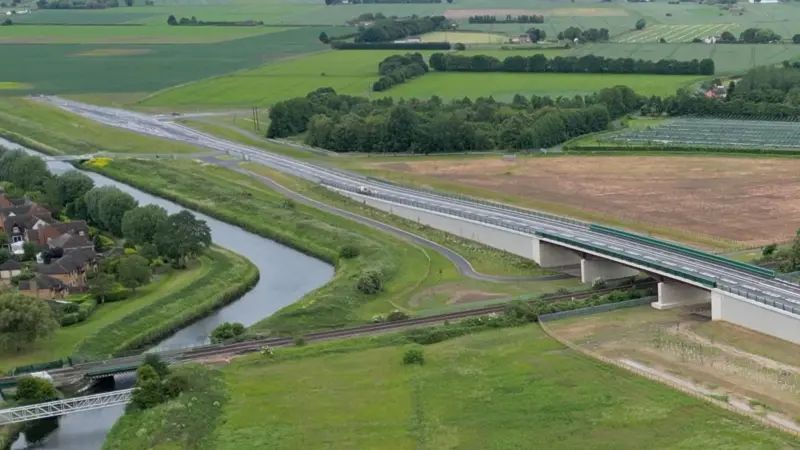
🌉The Spalding Western Relief Road Bridge, costing £50 million, was meant to ease A16 congestion and unlock land for 1,100 homes. Completed in October 2024, it crosses the Lincoln to Peterborough railway but leads nowhere, as the southern and middle road sections remain unfunded (£50-60 million short). Locals call it a “white elephant,” a taxpayer-funded folly stalled until at least 2030, much like the UK’s energy system—overhyped, underdelivered, and burdened by costs.
Here’s why the bridge parallels the energy crisis:
Incomplete Infrastructure: The bridge’s lack of roads mirrors the grid’s inability to handle renewable output, with £200 billion in projects delayed until the 2040s due to a 700+ project backlog. Both are built without enabling systems, wasting resources.🚧Public Burden: The bridge’s £50 million cost, with no immediate benefit, echoes £650 million in 2025 constraint payments for curtailed wind and solar, added to consumer bills. Taxpayers and billpayers suffer for mismanagement.
💸Poor Planning:
The council’s failure to secure full funding before construction matches the CCC, DESNZ, and Ofgem’s rush to renewables without grid readiness, leaving both projects as symbols of ambition over execution. 🤦♂️
Systematic Failures of the CCC, DESNZ, and Ofgem 🚨
The CCC, DESNZ, and Ofgem are the architects of this energy debacle, pushing renewables while neglecting grid stability and consumer affordability.
Their failures are as glaring as the Spalding bridge’s dead end.
Climate Change Committee (CCC): Ideological Overreach
📉Unrealistic Targets:
The CCC’s Sixth Carbon Budget demands 50 GW of wind and 70 GW of solar by 2030, ignoring grid constraints that cause £650 million in 2025 constraint payments and £8 billion projected by 2030.
This is like planning the Spalding bridge without road funds—doomed to fail.
😡Neglect of 50 Hz Stability:
Renewables’ asynchronous output disrupts the grid’s 50 Hz frequency, risking blackouts (e.g., 2019 wind farm failure). The CCC’s focus on wind and solar over synchronous AC sources (nuclear, gas) is reckless, leaving the system vulnerable.
⚡️Economic Blindness:
The CCC ignores consumer costs, with £200 billion in subsidies since 2002 (£8,000 per household) and rising bills contradicting Miliband’s £300 reduction promise. Like the Spalding bridge’s taxpayer burden, this prioritizes ideology over practicality.
💰Reference:
Renewable Energy Foundation (REF), 2025: “The CCC’s targets drive subsidies and constraint payments, inflating UK energy prices to among the world’s highest.”
Department for Energy Security and Net Zero (DESNZ):
Misguided Zeal
🌬️Renewable Rush:
DESNZ, under Miliband, approved 115 solar farms in 2024 and lifted onshore wind bans, adding £4 billion in 2026-2031 subsidies. Yet, £102,500 in solar switch-off payments and £650 million in wind constraints show the grid can’t cope, like the Spalding bridge’s missing roads.
🛑Grid Neglect: DESNZ’s claim of “working at pace” on the £60 billion Great Grid Upgrade is hollow, with HVDC lines and 3.5 GW of storage (vs. 14 GW needed) delayed by supply chain issues and local opposition. This mirrors the bridge’s funding shortfall.
🚨Security Risks:
Reliance on Chinese solar inverters (potential “kill switches”) and gas imports (£20 billion in 2024) undermines DESNZ’s “national security” narrative, akin to the bridge’s failure to deliver promised housing benefits.
🇨🇳Reference: Claire Coutinho, Shadow Energy Secretary, 2025: “Miliband’s climate targets raise bills by paying farms to switch off, contradicting affordability promises.”
Ofgem: Regulatory Incompetence
⚖️Costly Oversight:
Ofgem allows constraint payments (£650 million in 2025, £8 billion by 2030) to be passed to consumers, inflating bills. This is like the Spalding bridge’s cost burdening taxpayers for no immediate gain.
💸Connection Failures:
Ofgem’s “connect and manage” policy exacerbates grid delays (7-15 years for 700+ projects), failing to prioritize upgrades over renewable approvals, mirroring the bridge’s premature construction.
🕰️Market Distortions:
Ofgem’s support for Contracts for Difference (CfD) favors renewables with minimal jobs (5,000 O&M roles for 43 GW) over nuclear’s 10,000 jobs per plant, distorting incentives for reliable AC generation.
💼Reference: John Constable, REF, 2025: “Ofgem’s policies enable a dysfunctional system, with constraint payments a growing factor in high energy prices.”
Renewables:
A Costly Mistake Like the Spalding Bridge
🌞🌬️Miliband’s renewable push—wind and solar—repeats the Spalding bridge’s error: building without enabling infrastructure. Here’s why renewables are the wrong call:
Intermittency and Grid Strain:
Wind (30-40% capacity) and solar (10% in winter) produce asynchronous power, disrupting 50 Hz stability. Gas (40% of winter 2024 power) is needed to prevent blackouts, undermining decarbonization. Like the bridge’s dead end, renewables can’t deliver consistently.
⚡️Economic Waste:
£650 million in 2025 constraint payments, £8 billion projected by 2030, and £200 billion in subsidies since 2002 drive UK energy prices to global highs. The Spalding bridge’s £50 million waste pales in comparison, but both burden the public.
💰Minimal Jobs: Wind and solar create temporary construction jobs (e.g., 10,000 per GW for wind, 200 for 50 MW solar), but only 5,000 O&M roles for 43 GW, unlike grid upgrades’ 130,000 sustained jobs. The bridge’s fleeting construction jobs offer a similar false promise.
💼Security and Community Risks: Chinese inverters and gas imports (£20 billion in 2024) expose security flaws, while solar farms’ land use (thousands of acres) sparks Lincolnshire-style backlash, akin to the Spalding bridge’s local discontent.
🇨🇳🌾Reference: Wasted Wind, 2025: “Constraint payments cost £650 million in 2025, with consumers bearing the cost of grid-unready renewables.”
Why Scrap the CCC, DESNZ, and Ofgem? 🗑️
These bodies have failed to deliver a functional, affordable energy system, much like the Spalding bridge’s failure to serve its purpose. Scrapping them is justified because:
Systemic Incompetence:
Their renewable obsession ignores grid readiness and 50 Hz stability, leading to £8 billion in projected constraint costs by 2030. The bridge’s £50 million waste is a microcosm of this failure.
😡Consumer Harm: Subsidies (£25.8 billion annually) and constraint payments (£13 per household in 2025) inflate bills, contradicting affordability promises, like the bridge’s taxpayer burden.
💸Security Risks: Reliance on foreign supply chains and gas undermines energy independence, mirroring the bridge’s failure to deliver promised benefits. 🇨🇳
Misaligned Priorities:
Ideological targets over practical delivery (grid, nuclear) repeat the bridge’s error of ambition without execution. 🤦♂️
A Better Path: Halt Renewables, Fix the Grid, Prioritize Gas and Nuclear 🛠️
⚡️To avoid the Spalding bridge’s fate, the UK must dismantle these failing institutions, stop renewable expansion, and focus on a reliable, synchronous AC-based energy system. Here’s the roadmap:
Halt Renewable Expansion 🛑:
Why: New wind and solar projects exacerbate grid bottlenecks, inflate constraint payments, and offer minimal jobs (5,000 O&M vs. 130,000 for grid upgrades). Their asynchronous output threatens 50 Hz stability, requiring gas backups.
Action:
Freeze CfD auctions, redirect £4 billion in 2026-2031 subsidies to grid and nuclear, and pause projects until grid capacity catches up, avoiding the Spalding bridge’s premature construction. 🚧
Reference: Octopus Energy, 2025: “Zonal pricing could reduce constraints, but only with grid readiness.”Fix the Grid 🛠️:
Why:
The grid’s inability to handle renewables, causing £102,500 in solar switch-off payments and £650 million in wind constraints, mirrors the Spalding bridge’s missing roads. Upgrades create sustained jobs and ensure 50 Hz stability.
📊Reference: National Grid, 2025: “Grid upgrades will create 130,000 jobs, unlike renewables’ temporary roles.”Prioritize Gas and Nuclear
⚡️:Why: Gas and nuclear provide synchronous AC power for 50 Hz stability, unlike renewables’ intermittent output. Gas ensures short-term reliability, while nuclear offers long-term decarbonization and security.
Action:
Gas: Maintain 15 GW capacity as a transition fuel, upgrading combined-cycle plants for efficiency. This prevents blackouts while grid upgrades progress. ⛽
Nuclear: Fast-track small modular reactors (SMRs, 3-6 GW by 2035, £2-3 billion per 470 MW unit) and extend Sizewell B (1.2 GW). Hinkley Point C (3.2 GW, 2030) powers 6 million homes, with nuclear’s £60-80/MWh cost competitive against curtailed wind (£100-120/MWh). Nuclear sustains 10,000+ jobs per plant, unlike renewables’ 5,000 O&M roles. ☢️Reference: Rolls-Royce, 2025: “SMRs offer scalable, reliable power, reducing grid strain.”
Replace Failed Institutions 🏛️:
Why: The CCC, DESNZ, and Ofgem prioritize ideology over practicality, like the Spalding bridge’s mismanagement.
Action:
Create a streamlined energy authority focused on practical planning, cost control, and reliable AC generation, ensuring energy projects deliver value, not waste. 🗳️Reference: X posts, 2025: “Users call for scrapping CCC and Ofgem, citing high bills and grid failures.”
Counterarguments and Rebuttals 🛡️
CCC’s Guidance: Supporters claim the CCC’s targets are essential for net zero. Yet, their unrealistic goals ignore grid realities, driving costs and risks, like the Spalding bridge’s empty promises. 😤
DESNZ’s Efforts:
DESNZ touts grid upgrades, but its renewable rush outpaces infrastructure, inflating bills, much like the bridge’s premature cost. 🚧
Ofgem’s Regulation:
Ofgem defends CfD, but it distorts markets, favoring low-job renewables over nuclear, akin to the bridge’s symbolic failure. 💼
Renewable Jobs: Solar Energy UK claims growth, but 5,000 O&M jobs pale against grid (130,000) and nuclear (10,000 per plant), exposing the “green jobs” myth. 🤥
Conclusion:
A Bridge to Nowhere No More 🌉
The CCC, DESNZ, and Ofgem, with Miliband’s green zeal, have delivered a UK energy system as useless as the Spalding bridge—costly (£650 million in 2025 constraints, £200 billion in subsidies), unstable (threatening 50 Hz), and job-poor (5,000 O&M roles). Scrapping these bodies, halting renewables, fixing the grid with HVDC, storage, and smart tech, and prioritizing gas and nuclear for synchronous AC power is the only way to avoid this £50 million-style fiasco. Consumers deserve a reliable, affordable energy system, not a bridge to nowhere. Let’s build roads—literal and metaphorical—that actually lead somewhere. 🛠️⚡️
References:
Renewable Energy Foundation, 2025: Constraint payments and subsidies data.
Wasted Wind, 2025: £650 million in 2025 constraint costs.
National Grid, 2025: Great Grid Upgrade and 130,000 jobs.Claire Coutinho, 2025: Critique of Miliband’s bill promises.
Octopus Energy, 2025: Zonal pricing proposal.
Rolls-Royce, 2025: SMR deployment plans.
X posts, 2025: Public sentiment on CCC, Ofgem, and energy costs.
 SAY NO TO THE DESTRUCTION OF OUR LAND
Leave a comment