Introduction: The Slogan That Became a Shield
For almost two decades, the public has been told to “believe the science.” It has been repeated by politicians, campaigners, and media outlets as a mantra designed to shut down debate. To question any aspect of climate orthodoxy was to be branded a “denier,” accused of bad faith, or dismissed as anti-science.
The Arctic has always been at the centre of this story. Nothing symbolises the supposed urgency of the “climate crisis” more than shrinking polar ice caps. From Al Gore’s An Inconvenient Truth (2006) to countless UN climate summits, images of melting ice and stranded polar bears have been used to galvanise fear and justify sweeping policies.
That is why the Guardian’s report on 20 August 2025 was so surprising. The article revealed that Arctic sea ice has shown no statistically significant decline since 2005 — a twenty-year pause in the narrative of relentless collapse. Scientists admit they are surprised. After all, carbon emissions have continued to rise, global temperatures have trended upwards, and yet the Arctic — supposedly the most fragile part of the climate system — has not followed the expected script.
This is not a “denial” of climate change. It is an inconvenient fact that exposes the tension between real science — which is uncertain, variable, and constantly revised — and political climate narratives, which demand certainty, urgency, and fear.
Section 1: The Arctic as a Political Symbol
The Arctic has long been the stage on which climate politics is performed.
In the early 2000s, a series of dramatic predictions dominated the headlines:
In 2007, former US Vice President Al Gore told a German audience that “the entire North polar ice cap will disappear in five years” — by 2013.
That same year, Professor Wieslaw Maslowski, working with the US Naval Postgraduate School, predicted the Arctic would be “ice-free by 2016 ± 3 years.”
The IPCC’s Fourth Assessment Report (2007) suggested that summer sea ice could vanish “before 2030” if emissions were not curbed.
In 2009, UK newspapers reported that scientists were warning of an “ice-free Arctic by 2015.”
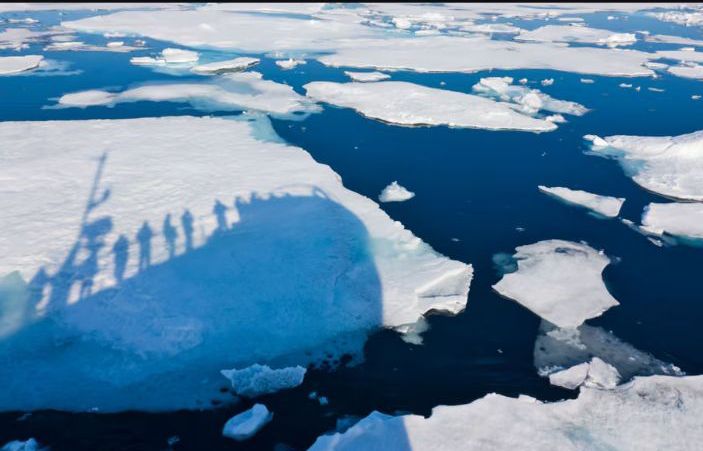
All of these forecasts have failed. Instead of vanishing, sea ice has slowed its rate of decline. September ice extent — the annual minimum — remains roughly half of what it was in 1979, but it has stubbornly refused to collapse altogether.
Nevertheless, these predictions served their purpose. They created a sense of imminent catastrophe, used to justify the 2008 UK Climate Change Act, the European Union’s emissions directives, and the United Nations’ series of increasingly aggressive agreements from Kyoto to Paris. The Arctic was transformed into a political prop — an icon of doom to drive policy.
Section 2: What the Data Really Shows
The new research reported by the Guardian is based on two datasets covering sea ice levels from 1979 to the present. It shows that since 2005, the downward trend has effectively paused. The long-term decline since the late 1970s is still evident — but for two decades the rate of loss has not matched the earlier acceleration.
The scientists point to multi-decadal ocean cycles as the explanation. These are natural fluctuations in the Atlantic and Pacific currents that regulate how much warm water enters the Arctic. When these currents align to bring warmer water northward, ice loss accelerates. When they shift, ice stabilises.
In short: nature has overridden the simple “more CO₂ = less ice” equation. Climate is not linear. It is a system of feedbacks, oscillations, and variability.
This mirrors what happened in global temperature records after 1998. Following a major El Niño, global surface temperatures appeared to “pause” for more than a decade, despite rising greenhouse gas emissions. Climate activists called this “the pause” and struggled to explain it — until 2015, when temperatures rose sharply again.
Science should welcome such complexity. It makes the picture more accurate. But for activists and politicians who have built careers on certainties, such pauses are a nuisance.
Section 3: Narrative Management & “Good News as Bad News”
The Guardian article itself illustrates the problem. Instead of treating the slowdown as evidence that the climate system is more resilient than feared, the report frames it as a temporary reprieve. Headlines reassure the reader that this does not mean the Arctic is safe, that climate change is still “unequivocally real,” and that melting will “resume at double speed.”
This rhetorical move — turning good news into bad news — is central to climate politics.
If ice melts quickly, it proves catastrophe.
If ice stabilises, it proves catastrophe will only be worse later.
If predictions fail, the models are adjusted but the conclusions remain.
There is no outcome that reduces alarm or encourages calm reassessment. Everything is fuel for urgency. That is not how science should work. That is how ideology works.
Section 4: When Predictions Fail
The history of failed Arctic predictions deserves more attention, because it reveals how “the science” is often presented as more certain than it truly is.
Take Al Gore’s 2007 speech. It was widely reported, repeated by campaigners, and even echoed by politicians. Yet when the ice did not vanish by 2013, there was no correction, no accountability, no apology.
The same is true of Maslowski’s forecast, which was circulated in peer-reviewed papers and mainstream media. When 2016 came and went with plenty of sea ice remaining, the story simply shifted: now it would be 2030, or 2040, or “later this century.”
Even the IPCC’s own projections have been repeatedly too pessimistic. Their 2007 “before 2030” prediction now looks implausible. But instead of acknowledging overreach, each new report simply recalibrates the models and repeats the same message of urgency.
Imagine if doctors forecast a pandemic would kill millions by 2015, and when it didn’t, simply pushed the date to 2030 without admitting error. That would be malpractice. In climate politics, it is routine.
Section 5: Policy Built on False Certainty
The problem is not just academic. The UK’s energy policy has been built on the assumption that these climate forecasts are infallible.
The 2008 Climate Change Act, drafted under Ed Miliband, enshrined legally binding carbon budgets.
Successive governments have pursued Net Zero policies regardless of cost, on the basis that catastrophic change is inevitable without them.
Billions have been spent subsidising intermittent renewables, tearing up farmland for solar farms, and planning vast grid expansions that will scar the countryside.
Households face soaring standing charges and inflated bills to fund these projects.
All of this has been justified by “the science.” But what happens when the science shifts? What if natural variability is more important than assumed? What if the models are wrong about the speed of change?
Policy, once written into law, does not adjust so easily. The UK cannot repeal the pylons it has already approved, or return farmland once covered in solar panels. Net Zero has locked the country into a rigid path — one that is immune to new evidence.
This is not how democracy should work. Science should inform policy, not dictate it through law. And when the evidence changes, policy should be able to adapt. Instead, we have built a system where politics props up outdated forecasts and doubles down on failed predictions.
Conclusion: Real Science vs. Climate Absolutism
The Arctic slowdown does not mean climate change is fake. But it does mean climate politics is dishonest.
True science is humble. It admits uncertainty. It welcomes contradiction. It updates its theories when new evidence emerges.
Climate absolutism does the opposite. It declares certainty. It brands dissenters as heretics. It reframes every piece of data — no matter how contradictory — into fuel for the same narrative.
“Believe the science” was never supposed to mean “shut up and obey.” Yet that is how it has been used. And now, when the Arctic itself refuses to cooperate with the script, the public is treated not to open debate but to spin and narrative management.
The Guardian’s report should be a moment of reflection. Instead, it has become another exercise in damage control. That tells us everything we need to know.
The lesson is clear: believe the science — but only if you also believe in doubt, debate, and accountability. Don’t believe the agenda.
 SAY NO TO THE DESTRUCTION OF OUR LAND
Leave a comment