The Cold Truth Britain Cannot Ignore
Picture a freezing night in January. The streets are silent under frost, the air is biting, and demand for electricity is at its peak. The wind isn’t blowing. Solar panels sit dark beneath a frozen sky. Millions of families, from Lands end to John O’ Groats, rely on one thing to keep warm and keep the lights on: gas.
Last winter, Britain had several of those nights. And on those nights, gas provided over 60% of our electricity, sometimes rising as high as 65%. Without gas, the UK would have been plunged into rolling blackouts. Without gas, hospitals, transport systems, and homes would have gone dark. Without gas, people would quite literally have frozen.
Yet, despite this undeniable reality, Ofgem — the UK’s energy regulator — has chosen ideology over survival. It has approved £24 billion in renewable infrastructure upgrades but has slashed £1.5 billion from National Gas’s requested maintenance budget. The result? A weakened backbone for our energy system, greater risk of catastrophic failure, and the very real prospect that the next cold snap could become a national emergency.
This is not just poor regulation. It is regulatory suicide — and it puts every household in Britain at risk.
Gas: The Backbone of Britain’s Grid
Politicians love to celebrate annual averages. They boast that “renewables provided over 50% of UK electricity in 2024”, as if that means we are living in a new green age. But averages don’t heat homes. They disguise the brutal truth: on the days when demand is highest, renewables often fail.
The Department for Energy Security and Net Zero’s own data shows that in 2024:
Gas supplied 30.4% of annual electricity generation — the single largest contributor.
Wind came close at 29.2%, but that figure hides weeks of near-total collapse during calm spells.
Solar, in midwinter, often contributed under 1%.
The real story is in the peaks.
Chart 1 – Gas Kept Britain Alive in January 2025
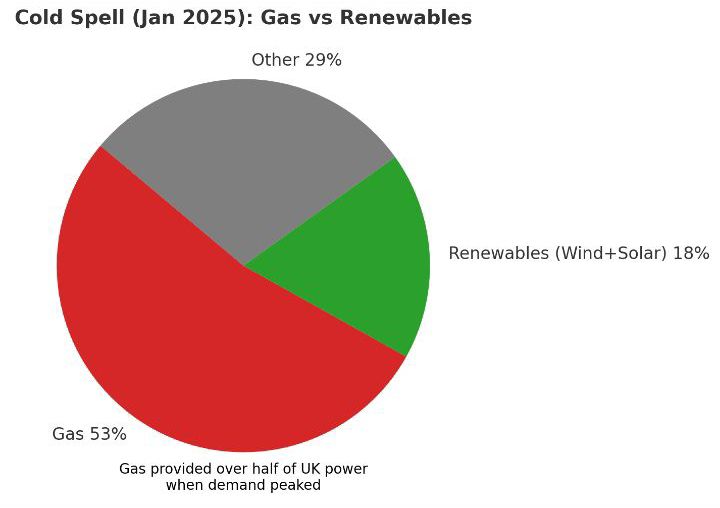
Gas provided 53% of UK electricity during a January 2025 cold spell. Renewables (wind + solar) collapsed to just 18%. The rest came from imports and other generation. Without gas, the grid would have failed.
Chart 2 – Peak Winter Reliance, December 2024

In December 2024, gas provided 65% of Britain’s electricity — almost two-thirds of the entire grid. Renewables could only manage 15%. This is the stark reality politicians refuse to admit.
Chart 3 – Annual Averages vs Winter Reality
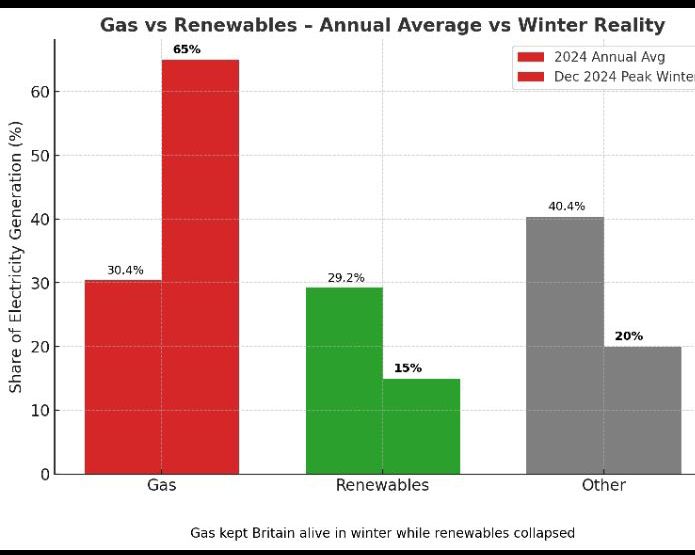
On paper, renewables (wind + solar) look strong, contributing 29% annually in 2024. But in the coldest weeks, their share collapsed to just 15%. Gas surged from 30% annually to 65% in winter reality. Averages hide the truth — it’s gas that saves the grid when it matters.
Ofgem’s Ideological Folly
Knowing all this, what did Ofgem do? It chose to punish National Gas.
National Gas requested £4 billion for maintenance, resilience upgrades, and cybersecurity between 2026 and 2031.
Ofgem cut that request by £1.5 billion — a 37% reduction.
At the same time, Ofgem approved £24 billion for renewable integration: new pylons, DC interconnectors, and grid reinforcements to support offshore wind.
This is not an investment strategy — it is ideology in action. Ofgem is not thinking like an engineer; it is acting like an activist. Its priority is to meet Net Zero targets, not to keep the lights on.
The regulator justifies the cuts by claiming that National Gas’s projects “lack proven consumer benefit” in the context of a “net zero future.” Translation: because the political class wants to phase out gas, we shouldn’t spend money making sure the current system doesn’t collapse.
This is reckless in the extreme. Even in the most optimistic scenarios, the UK will depend on gas well into the 2030s and 2040s. Pretending otherwise is fantasy.
The Risks to Ordinary People
If Ofgem’s gamble goes wrong, the consequences will be immediate and brutal:
1. Blackouts – Gas outages would trigger rolling blackouts nationwide.
2. Freezing Homes – The poorest will suffer most, with pensioners at greatest risk.
3. Economic Shock – Industry would be forced offline, costing jobs and output.
4. National Security – A weaker system is more vulnerable to cyberattacks or sabotage.
In short: Ofgem is placing Britain’s survival at the mercy of the weather.
The Bottom Line
Gas kept Britain alive last winter. It provided the majority of our power on the coldest days. It was the backbone of our energy security.
And yet, in the name of ideology, Ofgem has decided to undermine that backbone. By slashing National Gas’s budget and gambling billions on renewables, it has left Britain more vulnerable than ever.
This isn’t just misguided policy. It is a betrayal of duty. Regulators are supposed to protect the public, not put them in danger to satisfy political targets.
A Call to Action
The public must demand a change in course. Britain needs:
A national energy security review that prioritises resilience over ideology.
Investment in nuclear and domestic gas alongside renewables.
Proper funding for National Gas infrastructure and cybersecurity.
A regulator that answers to the people, not to Net Zero targets.
Because when the next cold snap comes — and it will — the difference between resilience and ideology will be counted in lives.
 SAY NO TO THE DESTRUCTION OF OUR LAND
Leave a comment