When residents walked into the Ivanhoe Centre in Conisbrough for the Whitestone 1 consultation, they expected answers. What they found instead was confusion, contradiction, and empty space. Both in the room and in the developers’ plans.
Tables were scattered around the hall with a few laminated maps and piles of glossy booklets, but no real detail. The developers’ representatives smiled politely, yet couldn’t answer the most basic questions: Where exactly will the substation go? How high will it be? How close to homes? What about the noise, the traffic, the flooding risk?No one knew.
A Room Full of Questions, and No Answers
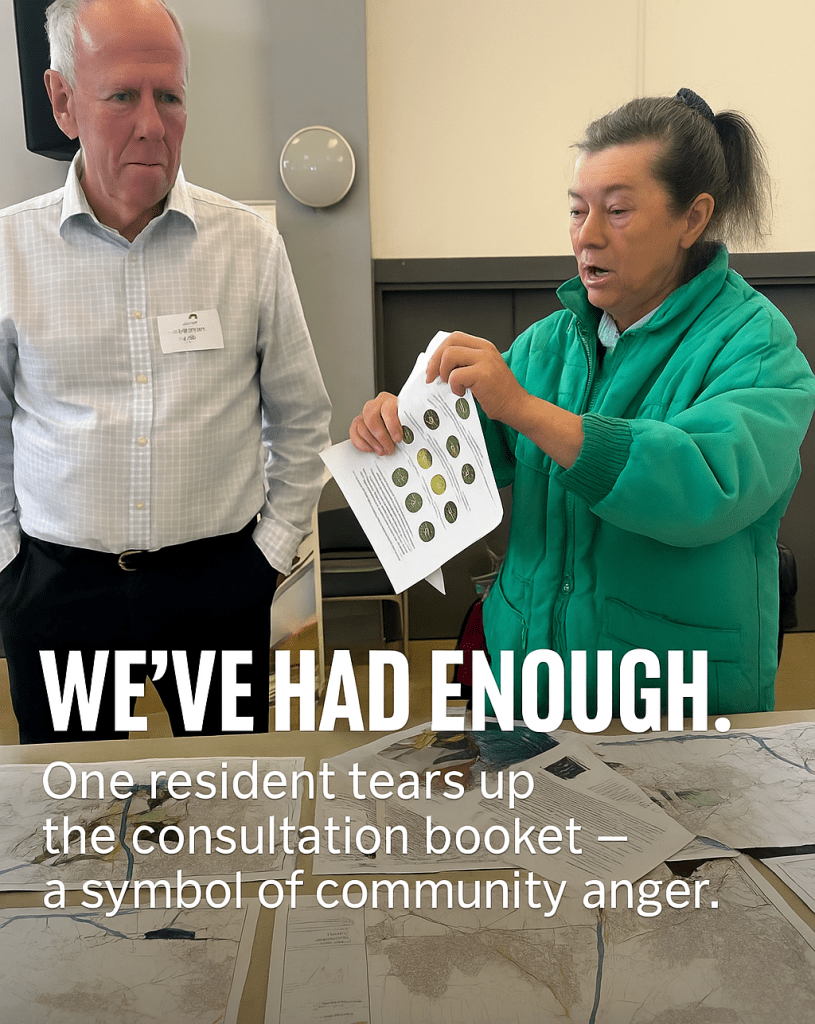
The consultation layout itself said it all. Sparse tables, no coherent flow, and almost no technical data. Even the Environmental Statement, supposedly the backbone of the process, was missing vital information. Visitors were told it was only a “draft,” that designs were “not finalised,” and that many details “would be determined later.”Residents left shaking their heads. One woman, in a moment that summed up the entire event, ripped up her consultation booklet in front of the developers — a simple but powerful act of protest. Because when a community feels ignored, words give way to action.
The Planning Inspectorate Saw It Coming
The Planning Inspectorate has already raised serious concerns about the Whitestone proposals, describing them as too vague, missing key information, and reliant on guesswork. In bureaucratic language, they call it the “Rochdale Envelope” approach — in plain English, it means we don’t know what we’re building yet, but we want permission anyway.
That’s exactly what people in Conisbrough saw on those tables. Endless “options,” “possibilities,” and “potential layouts” — but no firm commitments, no engineering data, and no respect for the scale of what’s being proposed.
It’s no wonder the Inspectorate said the plans were too incomplete for communities to make an informed assessment. When even the project team can’t explain what’s being built, how can residents be expected to give meaningful feedback?
The Human Impact
Behind every map and masterplan are real people:
Families in Clifton, Ravenfield, and Firsby facing years of disruption.
Walkers and cyclists who will lose open countryside to fences and security cameras.
Farmers being told their land is “green energy infrastructure,” not food production.
Developers talk of biodiversity gains and “permissive paths,” but what residents see is miles of steel fencing, humming transformers, and battery containers that look more at home on an industrial estate than in the South Yorkshire countryside.
Consultation or Performance?
The Whitestone 1 event at the Ivanhoe Centre wasn’t consultation — it was performance.
A carefully choreographed PR exercise, heavy on branding but light on facts. The information provided was so superficial that people couldn’t even judge the impact on their own homes.
Residents deserve honesty and transparency, not hollow claims about “listening.” Consultation means giving people something meaningful to respond to — not asking for opinions on blank spaces and possibilities.
Conisbrough Won’t Be Fooled
The message from Conisbrough is loud and clear:
We will not accept vague promises or token engagement.
We demand full disclosure and real accountability.
The developers might think they can tick a box and move on to the next stage, but the people of Doncaster are watching.
They’ve seen this playbook before — at Thorpe Marsh, Fenwick, and Marr Farm — and they’re not falling for it again.
This isn’t clean energy. This is corporate overreach disguised as consultation And the community has had enough.
 SAY NO TO THE DESTRUCTION OF OUR LAND
Leave a comment