When a government starts instructing business leaders on what to say, it’s rarely a sign of strength.
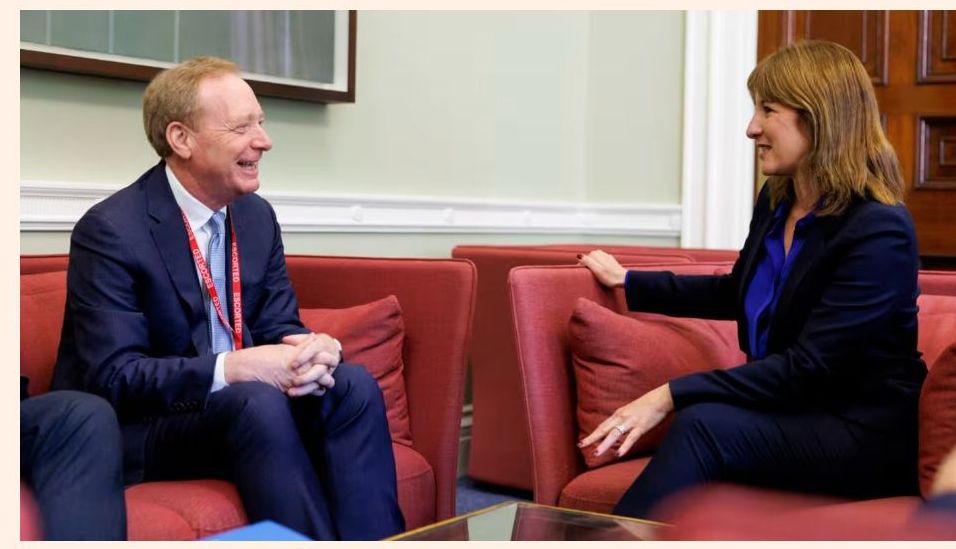
This week, Rachel Reeves, the Chancellor of the Exchequer, urged Britain’s leading CEOs to “talk up the UK economy” warning that if they didn’t, they risk helping Nigel Farage and Reform UK into Downing Street.
This was not some off-the-cuff comment. It was a coordinated Treasury message, delivered in private roundtables and amplified through corporate endorsements from Microsoft and JPMorgan Chase & Co..
It tells us everything we need to know about the current state of Britain’s political and economic establishment:
nervous, brittle, and desperate to control the narrative.
A Political Message Masquerading as Economic Optimism
Reeves’ team has been leaning hard on business leaders to project a “positive story” about Britain in the run-up to the November Budget ,the same budget where she is expected to raise taxes. Executives have been told explicitly: “Talk the economy down and you help Reform. Do you want that as the alternative?”
This isn’t economic policy. It’s political theatre. When a Chancellor needs CEOs to act as cheerleaders, it’s not because the numbers are good , it’s because the reality is harder to hide.
A Nervous Treasury, Not a Confident One
If Reeves genuinely believed the economy was turning a corner, she wouldn’t need to orchestrate this campaign. But she knows the truth:
growth has stalled at 0.2%, inflation is still running at 3.8%, and tax rises are coming. Households feel poorer. Businesses feel squeezed. And public patience is running out.Worse still, Reeves herself spent her early months in office warning of a £22 billion “black hole” and painting a bleak picture of the economy to justify emergency measures. Now she’s demanding others reverse that narrative. That’s not leadership ,that’s spin.
The Business Backlash
Many in business are not fooled. Behind the polite statements, there is real anger over Labour’s policies:
A £25 billion rise in employer National Insurance contributions.A new wave of workplace regulations.An increasingly hostile environment for industry and energy security.These are not the foundations of a “booming” economy. They are the hallmarks of a Treasury that’s taxing more, regulating more, and delivering less.
The Blob Closes RanksTo sell this message.
The government has rolled out high-profile endorsements. Brad Smith, President of Microsoft, called Britain “a force for stability in an uncertain world.” JPMorgan Chase & Co. described the UK as “increasingly attractive” for investment.But this carefully staged optimism doesn’t reflect the lived experience of most Britons , or most small businesses. Energy bills are high. Inflation remains stubborn. Real wages are stagnant. And the countryside is being carved up for vast, inefficient renewable schemes driven by Ed Miliband’s ideological Net Zero agenda , projects that offer no meaningful benefit to local communities.
The Fear of Reform
Strip away the gloss and this campaign is about one thing:
fear.
The Treasury knows Reform is resonating with voters , not because of clever slogans, but because Reform is speaking to the real issues people face:
Broken energy policy.
Economic stagnation.
Sky-high taxation.
A countryside under assault from industrialisation.Labour’s strategy is clear: if they can’t fix the problem, they’ll try to control the story.
But Narratives Don’t Pay the Bills
No amount of LinkedIn videos or choreographed roundtables can mask reality.
People know when their living standards are falling. They see their communities changing. They feel the economic squeeze every single day.The Blob can close ranks, but it can’t silence the country. Britain doesn’t need more PR ,it needs a functioning economy, affordable energy, lower taxes, and leadership rooted in truth, not spin.
🟡 In short: Reeves’ Treasury is not projecting confidence , it’s telegraphing fear.And the more they try to control the narrative, the clearer it becomes:
Reform isn’t the problem. Reform is the consequence of a system that’s failing.
 SAY NO TO THE DESTRUCTION OF OUR LAND
Leave a comment