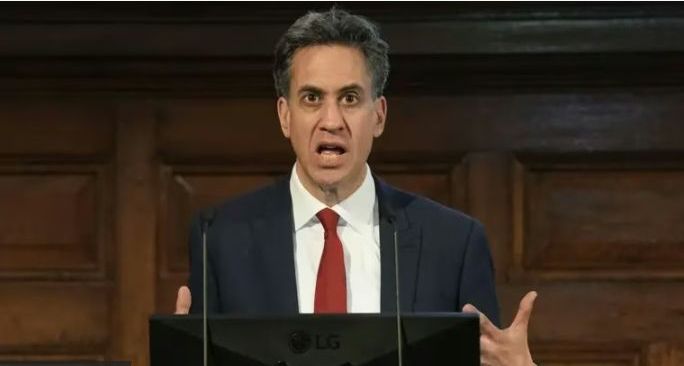
When the energy industry tells a government minister the truth to his face, you know the spin is cracking. On Wednesday, in full view of Parliament, Ed Miliband was forced to hear what millions of families already feel in their wallets: energy prices will keep rising for years, no matter how many Net Zero slogans are thrown around. This wasn’t the rallying moment he expected — it was a reality check.
The Moment the Mask Slipped
Wednesday’s parliamentary debate on energy didn’t go the way Miliband had hoped.Instead of applause for his Net Zero agenda, energy providers and industry voices delivered a blunt warning: energy prices will continue to rise for years to come — no matter how many grand green promises are made from the front bench.For years, Miliband has pushed the illusion that “clean power by 2030” would bring down bills. But in Parliament this week, the mask slipped. The experts themselves admitted what millions of households already know: the UK’s grid is overstretched, investment is lagging, and Net Zero targets are driving cost, not affordability.
Behind the soundbites are hard realities:
🚨 Delayed grid infrastructure projects are already adding billions in hidden costs.
📈 Renewable expansion without baseload power is making the system more unstable.
💰 Consumers will shoulder the price through rising standing charges and wholesale rates.
The energy industry didn’t echo Miliband’s optimism — they issued a warning. Britain’s energy system isn’t getting cheaper; it’s being loaded with ideological costs that ordinary people will pay for years.
Why Energy Prices Will Keep Rising
For years, the public has been told that wind and solar would bring “cheap, clean energy.” But the reality playing out across Britain tells a very different story. During Wednesday’s session, industry voices made it clear:
energy costs are not falling — they’re baked in to rise.
Here’s why:
1. The Grid Is Broken — and Getting Worse
Britain’s transmission network was built for steady, reliable power from coal, gas and nuclear stations. It wasn’t designed to cope with thousands of intermittent renewable projects scattered across the countryside.
Now, massive reinforcement projects are needed just to keep the lights on. These projects take years to build and cost billions of pounds — costs that will be passed straight to consumers through their bills.
2. Curtailment Is a Hidden Tax
When wind and solar farms generate power the grid can’t take, that energy is wasted — but developers are still paid not to produce it. This is known as curtailment, and last year alone it cost consumers over a billion pounds in wasted payments.That means households are being charged for electricity they never even received.
3. Baseload Power Is Shrinking
Reliable, round-the-clock power — from gas and nuclear — is being shut down faster than it’s being replaced. Intermittent renewables can’t fill that gap, and expensive backup capacity payments have to be made to keep old gas plants on standby. Again, the bill lands on you.
4. Standing Charges Are Skyrocketing
Even if you use less power, your standing charge keeps rising. Why? Because it’s being used to fund the cost of the transition — including grid reinforcements, constraint payments, renewable subsidies and failed policy experiments.
For millions of households, the standing charge has increased by over 500% in a decade.
5. Net Zero Targets Are Driving Policy, Not Common Sense
Instead of planning based on engineering, affordability or security, government policy is being dictated by legally binding carbon targets. These targets force through projects that aren’t ready, aren’t affordable, and often don’t work as promised.The result? A fragile grid, rising bills, and an energy system where ordinary people pay more while politicians claim “progress.”
What Britain Needs Instead
Britain doesn’t have to accept endless price hikes, fragile power supplies, or ideologically driven energy policy. We can build a secure, affordable, sovereign energy system — but it means doing things very differently from Ed Miliband’s Net Zero script.
1. Rebuild the Grid Around Reliability — Not Slogans
The backbone of our energy system must be reliable baseload power, not intermittent generation that depends on the weather. That means prioritising nuclear and gas to stabilise the grid before piling on more renewables.
Without a solid foundation, Net Zero is just a slogan — and an expensive one.
2. Invest in Domestic SMRs and Engineering
Small Modular Reactors (SMRs) built here in Britain can provide clean, constant power without covering thousands of acres of farmland. Instead of importing foreign solar panels and turbines, we should be investing in British-made energy solutions, creating skilled jobs and securing our energy future.
3. Stop Paying for Power We Don’t Use
Curtailment is a hidden tax on every household. No more blank cheques for wind farms paid to switch off. If the grid can’t take the power, the answer isn’t more renewables — it’s grid reform.
4. Use Rooftops, Not Farmland
Rooftop solar film and other microgeneration technologies can generate power closer to where it’s used — without tearing up green fields. This reduces transmission costs, grid strain, and local opposition, while giving communities more control.
5. Put the Public Back in Control
Energy isn’t just another market — it’s a matter of national security. Policy must serve the British people, not distant quangos, private developers, or Net Zero lobbyists. Decisions should be based on affordability, reliability, and sovereignty — not ideology.
The Bottom Line
Wednesday’s parliamentary session was a warning bell. The energy industry is spelling out what Miliband refuses to admit:
prices will rise, the grid is cracking, and Net Zero targets are driving us down a blind alley.Britain deserves better.We need power we can trust, bills we can afford, and a government that puts engineering before ideology.
 SAY NO TO THE DESTRUCTION OF OUR LAND
Leave a comment