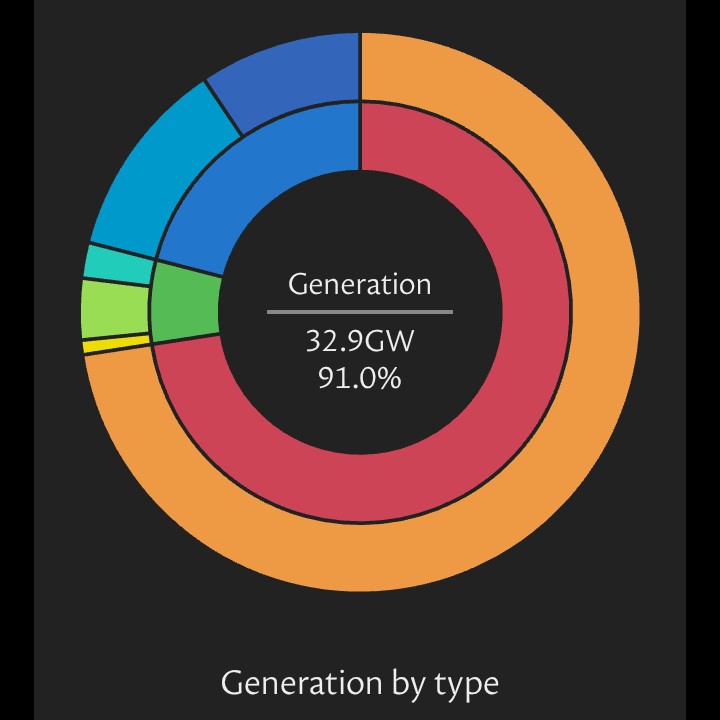
Last week, Britain’s energy system was quietly pushed to its limits. While most people went about their lives unaware, a prolonged collapse in wind generation forced our grid to rely on imported electricity and gas plants running flat-out just to keep the lights on.
This wasn’t a “bad luck” weather event. It was a glimpse of the fragile, import-dependent energy system that successive governments have deliberately built. And if the same conditions hit in January, we may not be so lucky.
The Wind Stopped Blowing — and So Did Our Energy Security
From Sunday through to Friday, wind generation averaged below 2 GW — around 7 % of national demand and only 7 % of installed capacity.
For context: the National Energy System Operator (ESO) Winter Outlook assumes there will always be at least 4 GW of wind available. Reality fell to half that.
Worse still, that 2 GW wasn’t steady. There were long stretches when generation collapsed well below 1 GW. That means wind power was effectively useless as reserve capacity.
While demand was still relatively low in October, the UK grid needed around 6 GW of imported power at peak times, with gas plants working flat out to plug the gap.

Europe Was in the Same Boat
There was no surplus wind power on the Continent to bail us out:
In Germany, wind fell to just 3 % of electricity generation on Monday. Two-thirds of their power came from coal and gas.
Denmark, usually hailed as a wind powerhouse, saw output collapse mid-week.
The Netherlands, Belgium, and even France faced similar low-wind conditions.
France had nuclear power to fall back on — the UK did not. And when Dunkelflaute hits multiple countries at once, interconnectors don’t guarantee supply, they just let everyone compete for what’s left.
National Grid Has Already Admitted the Plan
This isn’t speculation. In its 2025 Winter Outlook, ESO has already acknowledged that the UK will be “reliant on imports to meet demand” this winter.
That’s not a contingency plan — that’s the base case.
Peak demand in a cold snap: 45+ GW
Domestic dispatchable capacity: ~35 GW
The gap: 10 GW, to be filled by imports
If Europe faces the same shortage we saw last week, that gap won’t be filled. Imports are not guaranteed.
Import Dependency Is a Strategic Risk
This strategy isn’t just fragile — it’s reckless.
Norway is under political pressure to limit hydro exports, as they push up domestic prices.
Germany faces a 21 GW power deficit by 2030 as it shuts down coal plants.
France’s nuclear power will be in high demand from Germany and the Low Countries.
When push comes to shove, countries will prioritise their own people. And Britain, with too few firm power stations, will be left in the queue.
Tripling Wind Won’t Help When the Wind Doesn’t Blow
The government talks endlessly about “energy security” while pushing plans to triple offshore wind. But three times nothing is still nothing.
And covering the countryside with Chinese-made solar panels won’t save us either — in winter, solar generates only around 3 % of its capacity, and only in daylight hours.
Meanwhile, Britain’s gas fleet is ageing. Stations are due to close, and nothing equivalent is being built to replace them. We even exported over 1 GW to Ireland last week — while importing from Europe at the same time. That is not sustainable.
A Real Energy Security Strategy
If we want to avoid a winter of blackouts, soaring bills, and political panic, Britain needs a course correction — fast:
Build new modern gas power stations to restore domestic capacity.
Fast-track Rolls-Royce SMR deployment to provide clean baseload.
End the reckless over-reliance on weather-dependent generation.
Invest in rooftop solar and local microgrids, not sprawling solar farms on farmland.
Put energy sovereignty before ideology.
Last Week Wasn’t a Blip — It Was a Forecast
The wind drought we just lived through was a preview of the winter ahead. If similar conditions hit in December or January, when demand is higher and imports are stretched, the lights could go out.
And make no mistake: this is not an accident. It’s the direct result of political choices made over the past 15 years — choices that have left Britain dangerously exposed.
It’s time to stop pretending that Net Zero targets and wind farms equal energy security. They don’t.
Energy security means controlling your own supply, with reliable power that works whatever the weather.
 SAY NO TO THE DESTRUCTION OF OUR LAND
Leave a comment