The truth behind “green energy” that destroys our most precious carbon storesFor years, the British public has been told that wind farms are a simple, clean answer to climate change. Turbines on remote hillsides ,out of sight, out of mind ,harvesting free wind and powering the nation without harming a soul.It’s a neat story.But as is often the case, the real story is very different.Because in Britain, many of the landscapes being targeted for giant industrial wind turbines are not barren wastelands. They are peatlands, some of the most important natural habitats and carbon sinks on Earth. And once they’re damaged, they stay damaged.Wind energy can play a role in our energy mix.But onshore wind on peatland? That should never happen.Not once. Not anywhere. Not ever again.
Here’s why.
🌱 Peatland:
The UK’s Hidden Climate HeroPeatlands are Britain’s Amazon rainforest underfoot.They cover just 12% of the UK , yet store more carbon than all our forests combined.Thousands of years of decomposed vegetation, locking carbon away safely, meter by meter.When peat is left alone, it absorbs and stores carbon.When disturbed, it releases carbon for decades. Sometimes centuries.Once you cut into peat:
It driesIt oxidises
It breaks down And the stored carbon begins leaking back into the atmosphere
Industrial construction on peatland is not carbon neutral, it turns a carbon sink into a carbon emitter.And wind turbines require:
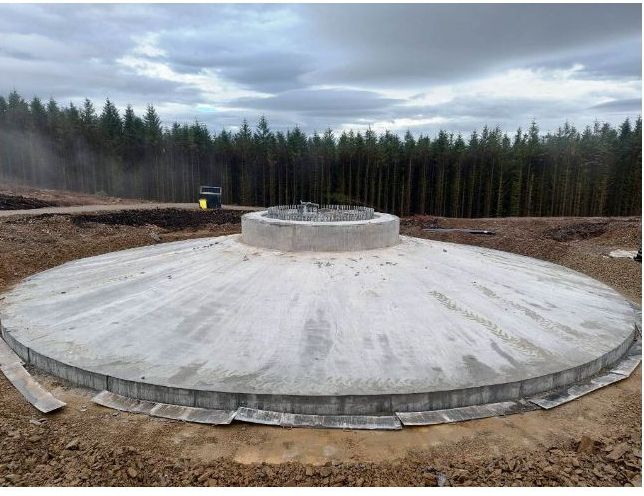
Deep concrete foundations
Heavy machinery
New haul roads
Underground cabling trenches
Maintenance access for decades
Each of those things destroys peat and disrupts water flow. And once damaged, peat cannot simply be “repaired” like a lawn. It took thousands of years to form; it may never fully recover.This isn’t green energy, it is ecological vandalism.
⚙️ The True Carbon Cost of “Green” Turbines
A modern 200-metre onshore turbine isn’t a delicate windmill. It is a 250-500-tonne steel tower sitting on a massive reinforced concrete base weighing 1,500–2,500 tonnes or more.To build just one turbine on upland terrain requires:
Hundreds of lorry trips
Road widening and hill cutting
Cranes transported in heavy convoys
Thousands of tonnes of stone laid on peat
Diesel generators and construction plant operating for months And then there’s the turbine itself:
Steel made in fossil-fuel furnaces
Copper mined, smelted, and shipped globally
Composite blades that cannot be recycled at scale
Oil and lubricants required for life
Wind turbines do not arrive by magic on an electric cloud, they have an enormous industrial footprint.On peatland, this footprint multiplies because everything is harder, heavier, and farther away.
🕓 Carbon Payback:
When the Maths Doesn’t Work
Developers love to claim that wind turbines pay back their carbon cost in a year.That claim belongs in the recycling bin.
On peatland:
Average wind speeds are lower than coastal sites
Output is intermittent and often misaligned with demand
Grid connection requires long trenching across moorland
Peat emissions begin immediately and continue for decades
Realistic carbon payback on peatland?8–15 years, if ever And here is the killer fact: If peat carbon loss exceeds turbine savings, the turbine is a net carbon emitter.
Meaning:We lose natural carbon storage
We industrialise protected landscapes
We get more emissions, not fewer
That is the opposite of climate action.
🦅 More Than Carbon: Peatland Ecosystems Matter
These upland moors are not empty land.They are living ecosystems, home to:
Curlew
Golden plover
Hen harrier
MerlinPtarmigan
Red grouse
Rare bog vegetation and insects
They are part of our cultural and natural heritage, shaped by centuries of low-impact traditional land use.Blanketing turbines across these landscapes destroys biodiversity, pushes out protected species, and scars the land permanently.All for intermittent power that may not even reduce emissions.
⚡ The Grid Reality:
Remote = Inefficient
Energy that must travel miles across new transmission lines is less efficient.
Remote peatland turbines require:New high-voltage lines or buried cable runs,Transformer stations
Long-distance connection to grid nodes
Ongoing access and maintenance traffic
Costs rise. Environmental disruption rises.Efficiency falls. System strain increases.If we must build new generation, logic says: Build it near demand centres or on brownfield land, not in the last wild places we have.
🛑 This Is Not About Opposing Renewables
Let’s be clear.
This isn’t about opposing wind power as a concept.It’s about deploying the right technology in the right place.There are alternatives that do not tear up peatlands:
Rooftop and industrial solar
Solar canopies on car parks
Onshore wind on low-grade agricultural or industrial land
Offshore wind where appropriate
SMRs powering heavy industry directly
Grid-first strategy to match generation with capacity
Household-scale storage and micro-generation
UK-designed thin-film solar like PowerRoll
We can decarbonise without destroying the countryside.
🗣️ A Line Our Politicians Must Hear
Peatland is not a renewable construction zone.It is a national carbon asset.We cannot talk about net zero while digging up carbon sinks to install machines that may never repay the carbon they cost.This is policy insanity dressed as progress.And it must end.
💬 In One Sentence
“Onshore wind on peatland is not green energy , it is the destruction of natural carbon stores for short-term political headlines”
 SAY NO TO THE DESTRUCTION OF OUR LAND
Leave a comment