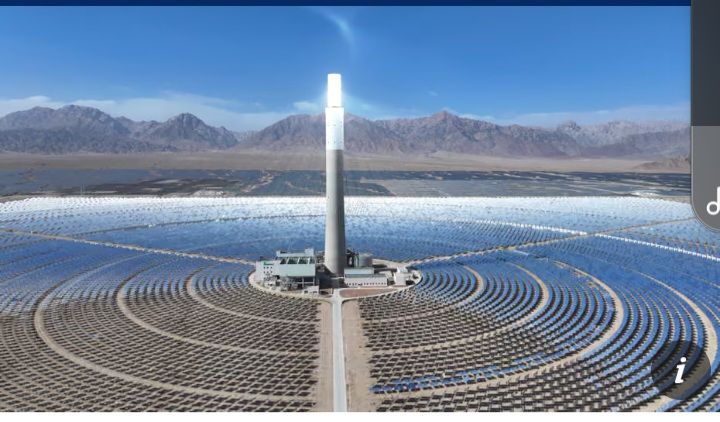
The Image That Misled a Nation.In October 2025, The Guardian published an article titled “Supply boom in cheaper renewables will seal end of fossil fuel era, says IEA.” It was illustrated with a striking photograph rows of mirrored panels stretching across a sun-drenched desert, converging on a gleaming central tower.To most readers, the image symbolised success: a futuristic vision of clean energy triumphing over fossil fuels. The setting appeared almost utopian , proof that solar power was finally delivering on its promises.But there’s one problem.The photograph was not of a thriving solar project at all. It was of the Ivanpah Solar Power Facility in the Mojave Desert, California a $2.2 billion solar-thermal experiment now facing early shutdown and economic failure.
The Reality Behind the Image
When Ivanpah opened in 2014, it was hailed as the world’s largest concentrated solar-thermal plant. Backed by a $1.6 billion loan guarantee from the U.S. Department of Energy, it was meant to generate up to 377 MW of clean electricity and demonstrate the viability of large-scale solar for the modern grid.A decade later, the project has become a cautionary tale.According to Associated Press (January 2025), Ivanpah’s “celebrated opening” has given way to a “bleak future” as its power purchase agreements are terminated early and its output remains below expectations. Pacific Gas & Electric Company (PG&E) the main buyer of Ivanpah’s electricity ,has confirmed that two of the plant’s three units are scheduled for closure by 2026.¹Even the New York Post reported in September 2025 that the “$2.2 billion solar plant in California [is] being turned off after years of wasted money,” calling it a “financial boondoggle.”²
Anatomy of a Failure
Ivanpah’s story is a textbook example of technological optimism overtaking practical engineering.Low Efficiency: The plant never achieved its projected 30 percent capacity factor, averaging closer to 20 percent.
Fossil Fuel Dependency: Despite its green credentials, Ivanpah burned natural gas daily to start up its boilers, undermining claims of zero-emission operation.Environmental Concerns: The high-temperature mirrors killed thousands of birds, leading wildlife agencies to label the site an “avian mortality hotspot.”Economic Unsustainability: With plummeting costs in conventional photovoltaic (PV) solar, Ivanpah’s complex thermal technology became obsolete within years.By 2025, what had once symbolised the “future of renewable energy” had instead become a relic, still standing, but already being phased out.
The Guardian’s Mirage
Against this backdrop, The Guardian’s use of Ivanpah’s image to celebrate a “boom in cheaper renewables” is more than just ironic, it’s misleading.The picture projects an illusion of success while concealing the hard reality: the very facility in the photograph is a failed project, running on borrowed time.No clarification was provided to readers that the image depicts a plant with cancelled contracts and a planned shutdown. The visual was presented as emblematic of renewable progress, when in truth it represents a decade of policy and financial disappointment.This matters because images shape perception. When a mainstream newspaper uses a bankrupt project to sell the narrative of renewable triumph, it erodes public trust, not in climate action itself, but in the integrity of the debate.
The Lesson for Britain
Ivanpah’s failure holds a clear warning for the UK. If a £1.8 billion solar complex in the California desert , blessed with near-perfect sunlight, abundant land, and government subsidies , cannot survive economically, what hope is there for industrial-scale solar projects on British farmland under cloudy skies and congested grid connections?
The truth is that large, land-intensive renewables are not inherently sustainable. Their apparent affordability depends on subsidies, imported materials, and externalised costs. Once those supports fade, many of these projects will struggle , just as Ivanpah did.
As Britain faces mounting pressure to sacrifice productive farmland for vast solar and battery schemes, the lesson from California is stark:
ideological energy planning leads to stranded assets, not sustainable power.The Importance of Truth in Imagery
Public understanding of energy policy depends on honest representation. If newspapers choose to illustrate their articles with failed projects, intentionally or not, they risk distorting the policy debate and misleading readers about what works and what doesn’t.
Solar power has a role to play, but it must be deployed intelligently: on rooftops, brownfield sites, and integrated within a resilient grid, not imposed on green fields through political symbolism.The Guardian’s photograph told a story of victory. The facts tell a story of failure.
References
1. Associated Press, “11 years after a celebrated opening, massive solar plant faces a bleak future in the Mojave Desert,” January 2025.
2. New York Post, “$2.2 billion solar plant in California turned off after years of wasted money,” September 2025.
3. U.S. Department of Energy Loan Programs Office, Ivanpah Loan Guarantee, 2014.
4. Wikipedia: Ivanpah Solar Power Facility (retrieved November 2025).
Author: Shane Oxer — Campaigner for Fairer and Affordable Energy
 SAY NO TO THE DESTRUCTION OF OUR LAND
Leave a comment