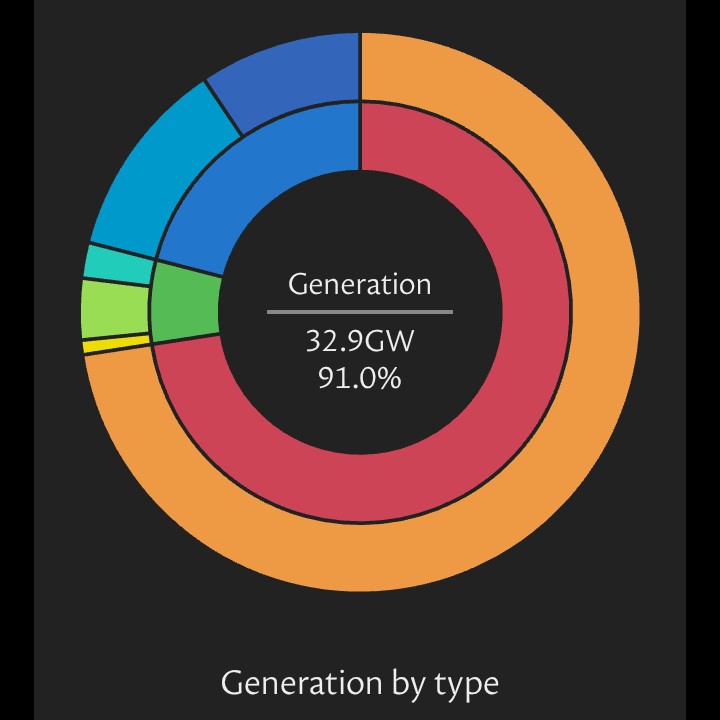
For over a decade, the British public has been told that the future of electricity will be “clean”, “cheap”, and “secure”. This vision has been repeated with such conviction by ministers, quangos, think-tanks and energy companies that it has become accepted as fact. Yet every real-world indicator now points in the opposite direction. We are not constructing a resilient grid; we are constructing the most expensive, most complex, and most fragile electricity system in British history. The tragedy is that the weakness of the model is visible in plain sight, reflected not in theoretical modelling or political speeches, but in the live data of the National Grid itself. The images taken from the grid tracker show solar falling to zero when demand rises, wind output swinging unpredictably, and gas stepping in to carry half the country’s electricity generation almost every day. Prices fluctuate wildly. Interconnectors reverse direction at the worst possible moments. And behind all of this lies a grid infrastructure being forced into permanent crisis by the political choice to prioritise intermittent generation over reliable power.

At the core of this failure is a simple but devastating assumption: That the UK can build enough wind and solar to compensate for the fact that neither technology can produce electricity on demand. Government planners operate on the premise that variability can be smoothed out by “diversifying” supply across large geographic areas, but British weather patterns are neither diverse nor predictable enough for this to work in practice. When solar collapses each night and during winter afternoons, the entire system must jump to attention to plug the gap. Wind, meanwhile, can swing from 14 GW to 4 GW in a matter of hours, or fall to almost nothing for days at a time during winter high-pressure systems. The result is an energy system that constantly oscillates between surplus and shortfall, demanding continuous intervention by gas plants, system operators, and interconnectors. This is not a stable grid architecture; it is a grid structured around permanent firefighting.
Because the renewable generation model is intrinsically unstable, the grid must now carry a second burden: billions of pounds of new transmission upgrades, substation reinforcements, voltage control systems, synchronous compensators, and balancing services. The more wind and solar we build, the more the grid must be rebuilt around them. This is why the UK now faces a £100 billion-plus grid upgrade programme, with many experts privately estimating much higher costs once delays and inflation are taken into account. None of this would be necessary if the generation mix were anchored in firm, predictable power. Instead, the intermittent nature of wind and solar creates a cascading need for new infrastructure: power arriving from distant offshore sites; surges of output that must be curtailed; shortages that must be covered by gas; and fluctuations that require expensive stabilising equipment. In practice, this means consumers are paying not for one grid, but for two – a renewable grid that cannot stand on its own, and a backup system that must be kept running permanently in the background.
Gas therefore becomes the quiet foundation of the entire system, even as politicians insist the UK is “moving away” from fossil fuels. The grid data consistently shows gas supplying 45–55% of the country’s electricity whenever demand rises or renewable output drops. Even with tens of billions already spent on wind farms and solar arrays, gas generation remains the pillar preventing blackouts. Ironically, the commitment to intermittent renewables has made gas more essential rather than less, because every new wind farm increases the size of the backup requirement. This reality is politically inconvenient, and so it is rarely stated openly. But the figures do not lie: Britain is not reducing its dependence on gas; it is entrenching it.
This instability feeds directly into higher consumer prices. The live data you captured shows wholesale prices ranging from £83/MWh to £145/MWh on an ordinary day. These prices are not the result of gas scarcity or Putin’s war, as ministers like to claim, but the consequence of managing a system that must constantly be balanced. The costs include paying wind farms to switch off during oversupply, paying gas plants to remain on standby for shortages, reinforcing long-distance transmission lines, managing grid constraints, stabilising voltage, and dealing with unpredictable cross-border energy flows. The myth of “cheap renewables” collapses the moment one considers the full system cost. Intermittent generation may be cheap at the point of production, but the system built around it is one of the most expensive in the developed world. This is why British energy bills remain among the highest in Europe despite our enormous investment in renewables.
The government’s own UK Government Resilience Action Plan (July 2025) quietly confirms the seriousness of the situation. For the first time, a National Power Outage is formally recognised as a risk to the country’s critical infrastructure. The document states explicitly that the UK grid has become increasingly complex and fragile, with the potential for significant strain during periods of high demand or low renewable output. This acknowledgement is extraordinary given the vast sums invested in the renewable transition. It reveals a truth that officials have largely avoided admitting publicly: the current direction of travel is not making the grid stronger. It is making it weaker, more volatile, and more likely to fail when the country needs it most.
All of this is occurring just as electricity demand is forecast to surge. The push for heat pumps, electric vehicles, rapidly expanding data centres, and the explosive growth of AI-driven computing means that by 2035 Britain’s electricity consumption may double. Winter peak demand could triple. Yet we are shutting down nuclear plants, delaying replacements, and refusing to expand domestic gas production. Solar cannot contribute meaningfully in winter. Wind droughts can last for days. Batteries provide only a few hours of supply. Hydrogen remains expensive, inefficient, and technologically unrealistic for grid-scale backup. In short, the grid we are building today cannot possibly meet the demands we are imposing on it tomorrow.
A functioning, modern energy system requires firm power ,electricity that is available exactly when needed, not only when weather permits. This means nuclear and gas must be the backbone of the system, supported by localised rooftop solar for households and businesses where appropriate. Small Modular Reactors, modern Combined Cycle Gas Turbines, domestic gas extraction, and practical grid reinforcement could provide the UK with the cheapest and most reliable energy in Europe. Instead, we are continuing to pour money into a system defined by its inability to deliver: a weather-dependent grid that requires constant intervention, vast hidden costs, and a parallel fossil-fuel backup that politicians pretend does not exist.
The evidence is overwhelming. The live grid data exposes it. The government’s own resilience plan acknowledges it. The prices on people’s bills reflect it. We are throwing money into a grid that cannot work because it has been designed around an ideology rather than engineering reality. Britain deserves better. We need energy sovereignty, affordability, and reliability ,not fantasies, not political soundbites, and not a grid that is guaranteed to fail at the moment we need it most.
Shane Oxer. Campaigner for fairer and affordable energy
 SAY NO TO THE DESTRUCTION OF OUR LAND
Leave a comment