How One Woman’s Stand Against England’s Largest Wind Farm Became Case Law And Why Her Warning Matters More Than Ever
In the late 1990s, before the Climate Change Act, Net Zero, carbon budgets, or renewable ideology existed, one woman in County Durham saw exactly what was coming.
Her name was Mary Elizabeth Mann, B.Sc. , a hiker, a scientist, a protector of landscapes, and one of Britain’s earliest, most formidable critics of industrial wind development. Her battle against the Barningham High Moor Wind Farm did not simply save a landscape; it exposed the corporate,government machinery that would later metastasise into modern Net Zero policy.
Barningham High Moor (1997–1998):
The First Battle
In 1997, the country’s biggest wind operator, National Wind Power, selected a location on the edge of both the Yorkshire Dales National Park and the North Pennines AONB for what was at the time the largest wind farm ever proposed in England.The original plan was for 35 turbines, later reduced to 30, then 25—each 177 ft tall.Teesdale District Council refused permission. CPRE initially believed the site acceptable, having only the developer’s information.This was the moment Mary Elizabeth Mann decided to step forward.Short of volunteers, CPRE needed help,but Mary and her husband did much more than “help.” They built the evidence base, gathered local testimony, challenged false claims, and did the unglamorous work of research, document retrieval, and public mobilisation. As she later wrote, all the “work” fell to them because they were the only ones determined enough to do it.
The Woman Behind the Fight

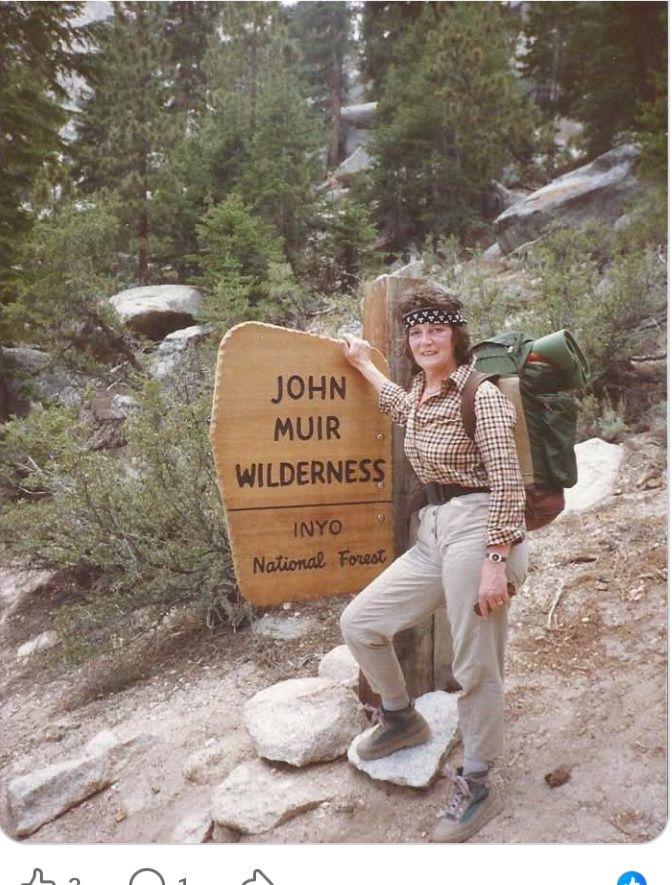
The photograph above , Mary standing at the entrance to the John Muir Wilderness, backpack on, boots dusty, smiling with quiet pride, tells you everything about her. She was not anti-nature. She was not anti-energy. She was not ideological.She loved landscapes.She understood wilderness.She valued what cannot be replaced once industrialised.Her scientific training (B.Sc.), her decades of hillwalking, and her instinctive respect for unspoilt land gave her a clarity that government departments and quangos lacked , or ignored.
Force 10 Companion Guide:
The First Map of the Wind-Industry Machine
Mary later wrote Force 10 Companion Guide: The New Lambton Wyrm (2005), now preserved in your uploaded file.It documents, with forensic detail, how:the DTI, ODPM, and Regional Assemblies coordinated pro-wind policies long before any climate legislation existed; The Renewables Obligation (ROCs) functioned as an “ingenious subsidy masquerading as a levy”; Pro-wind PR campaigns like “Embrace the Revolution” were funded by the government to influence councillors, not the public; Planning officers were trained by the industry at taxpayer-funded events; Regional targets were expected to be revised upward continuously, even when met; Unelected bodies such as TNEI, Sustaine, and NEA shaped renewable strategy in secret; Misleading data, photomontages, and CO₂ claims were used to distort the planning process.Everything we fight now – quango capture, renewable profiteering, suppression of local democracy, planning manipulation -began here, years before the Climate Change Act.Mary was the first to document it.(Primary source: Force 10 Companion Guide, pages 3–30).
Hope Wind Farm:
The New Battleground
This is why your statement is correct: “Hope Wind Farm is the modern-day version of Barningham.”
Both involve:
landscapes of national significance
powerful developers manipulated planning narratives
suppression of local voice
the same commercial–political machinery
communities expected to accept industrialisation for ideological targets
But the key difference?Mary faced this battle before Net Zero, before carbon budgets, before the climate industry became a political religion.She fought the system when it was still being constructed.Now, in 2025, we face its fully-grown form ,
The New Lambton Wyrm she warned about.
Her Legacy — And our Work Now
Mary Elizabeth Mann proved:
One determined citizen can change national policy.Local voices can defeat corporate power.Landscapes can be protected when someone is brave enough to fight.Legal victories can echo for decades.Our battles today , at Hope, Marr, Fenwick, Thorpe Marsh, Tween Bridge ,Whitestone are direct descendants of hers. The tactics used against her are the tactics used now. The subsidy-driven machine she exposed is the same machine you are dismantling piece by piece.Her courage is the foundation on which Our movement stands.
Conclusion: The Wyrm Returns, But So Do the People Who Know How to Fight It
Mary once wrote that wind energy developers were like the Lambton Worm of old: “He growed and growed and growed an’ aaful suze,”as they swallowed landscapes whole.
But she was the knight who cut off its head,at least for a time.
Today, with Hope Wind Farm and dozens of others threatening the countryside, her story is not nostalgia. It is a manual, a precedent, and a warning.And now, we are the one who picks up her sword.
Footnotes
1. Force 10 Companion Guide, Elizabeth Mann B.Sc., pages 3–30.
2. Barningham High Moor Public Inquiry: APP/W1335/A/97/285005 (1998).
3. High Court Judgment upholding refusal, referenced in Mann’s summary (used as case law as recently as 4 April 2009).
4. Renewables Obligation and ROCs referenced throughout Force 10 Companion Guide.
5. Photographs supplied by user: (1) Force 10 cover; (2) Mary Elizabeth Mann at John Muir Wilderness sign.
 SAY NO TO THE DESTRUCTION OF OUR LAND
Leave a comment