For years, people who live close to the land have said what polite policy circles laughed off: Britain’s seasons are drifting. Spring feels late. Summer peaks after the “summer” we’re told to plan around. Autumn lingers. Winter arrives in its own time.
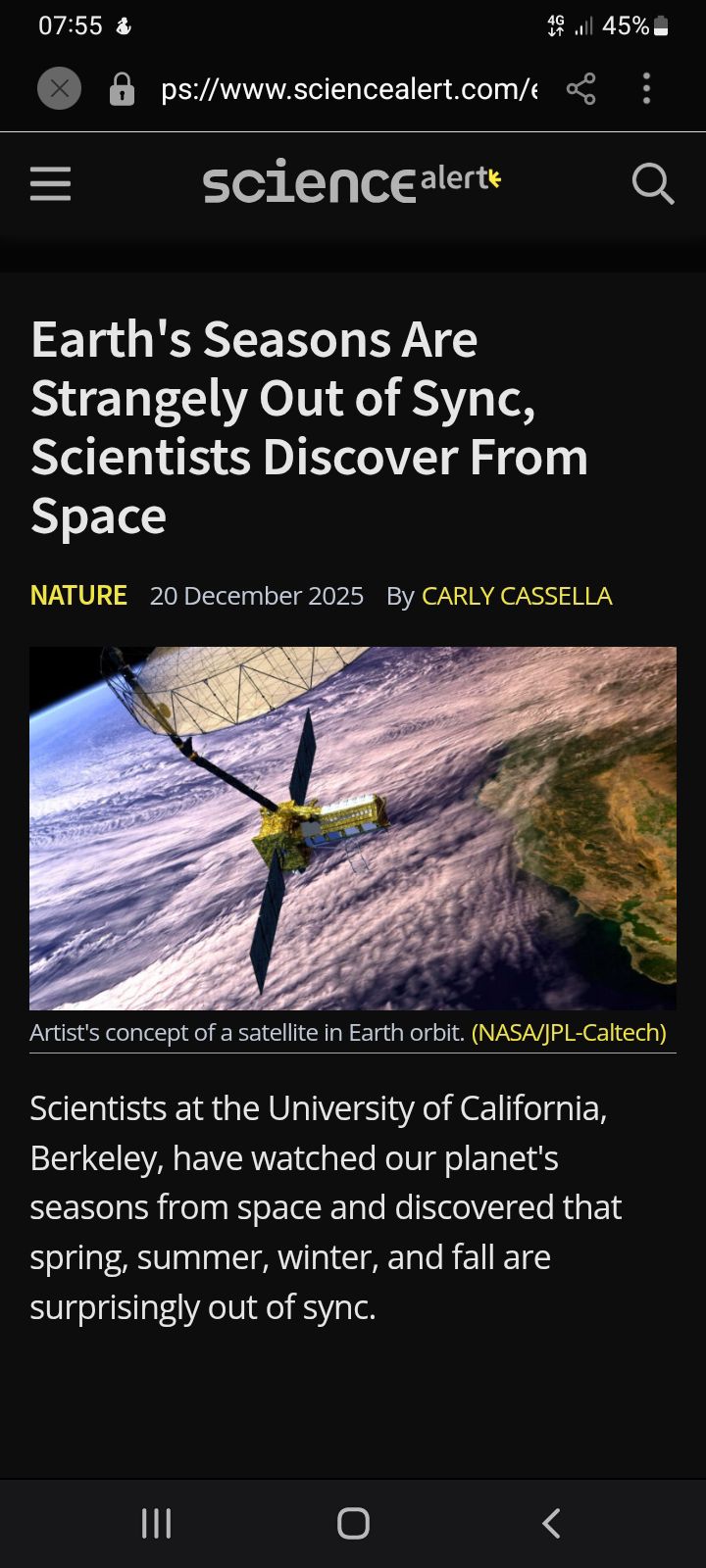
Now a major paper in Nature has put hard science behind that lived reality, using two decades of satellite observations to map the true seasonal timing of ecosystems when landscapes actually green up, peak, and decline , rather than relying on the tidy, human calendar version of seasons. The conclusion is blunt: nature’s rhythms are frequently out of sync, even between neighbouring regions, and “seasonality” is far more complex than our models often assume.¹That should force a wider reckoning in the UK , not just in ecology, but in politics and law. Because the Climate Change Act and Net Zero strategy are built on modelling. And if one core premise collapses , that seasonal patterns are stable and broadly predictable , then a lot of downstream “certainty” collapses with it.
The first inconvenient truth:
modelling isn’t reality , it’s an assumption machine.The UK’s climate governance system is legalistic and numeric by design. The Climate Change Act set up legally binding carbon budgets, with the Climate Change Committee (CCC) advising government on what the budgets should be and reporting on progress.²³ It’s a system designed to convert complex reality into targets, pathways, and quantified projections.But those targets are only as good as the assumptions beneath them and those assumptions are often invisible to the public until something breaks.The Nature study is a case in point. It shows that even the most basic concept—“the seasons” doesn’t behave as a uniform clock across landscapes.¹ In a maritime country like Britain, with Atlantic influence and highly variable weather regimes, that complexity is not a footnote. It’s foundational.If the biological year doesn’t run on the same timetable from one valley to the next, how confident should we be in national-scale models that treat land, weather, biomass, and demand as if they behave cleanly across a whole country?
The second truth:
Net Zero cost modelling is admitted to be highly uncertain
Even official bodies have acknowledged this, though it rarely makes headlines.The National Audit Office has been clear that the “exact amount and timing” of Net Zero costs are very uncertain, because there are multiple pathways and major unknowns in technology, infrastructure needs, and sequencing.⁴ That isn’t a minor caveat; it’s a warning label.Yet Net Zero is sold to the public with a tone of certainty , with implied precision about future savings, projected costs, and the “inevitable” direction of travel. When costs rise, the public are told it’s a temporary bump, or “the price of transition”. But uncertainty cuts both ways: if the modelling assumptions are wrong, the bill can be far higher and the benefits far more conditional.
The third truth:
Population and behaviour assumptions shape everything and they can be wrong too
Net Zero pathways are not just about power stations. They assume particular versions of how people live.
CCC modelling for carbon budgets explicitly includes assumptions about demand reduction and behavioural change in areas like travel and energy use.⁵ If those assumptions don’t materialise politically, culturally, economically then emissions projections and infrastructure plans drift off course.This matters because Britain has tied itself into law. Carbon budgets are set years in advance, and government is then expected to shape policy to comply.²³ If the underlying assumptions are flawed, the system doesn’t pause and re-check, it doubles down, accelerates, and forces compliance elsewhere.That is how you end up with policy that feels like it’s being done to the country, not for it.
So what does “seasons out of sync” have to do with the Climate Change Act?Everything , because it’s a real-world example of how simplified modelling can misread complex systems.If the natural calendar is local, uneven, and shifting, then:
land-use and biodiversity claims can be overstated or mistimed
yield and productivity assumptions can be distorted
flood risk and soil moisture modelling can be seasonally wrong-footed“nature-based” offsets and habitat mitigation become less reliable than advertised And crucially: it reinforces a bigger lesson. The UK has built a legally coercive climate framework around forecasts that can be wrong, incomplete, or outpaced by reality.When that happens, the country doesn’t get a democratic “rethink”. It gets more targets, more enforcement, more infrastructure, more cost , all justified by a model that may be operating on yesterday’s assumptions.
The honest position Britain needs
This isn’t an argument for doing nothing. It’s an argument for realism, humility, and democratic accountability.
A serious country does not treat long-range modelling outputs as if they are guaranteed. It treats them as tools , revisable, challengeable, and subordinate to lived outcomes, engineering constraints, and public consent.Right now, the UK often behaves the other way around: the model is treated as sovereign, and reality is expected to conform.If a Nature paper can show that even “the seasons” don’t behave as our simplified frameworks assume, then it’s time we stop pretending Net Zero is a perfectly knowable, perfectly forecastable national project particularly when the public is being asked to pay for it in higher bills, higher standing charges, and permanent changes to land and landscape.Net Zero isn’t just a target. It’s a state programme. And any programme built on flawed assumptions becomes not just expensive, but dangerous.
Footnotes
Drew E. Terasaki Hart et al., “Global phenology maps reveal the drivers and effects of seasonal asynchrony,” Nature 645, 133–140 (2025), doi:10.1038/s41586-025-09410-3.
�Nature +1Climate Change Act 2008 (UK), establishing carbon budgets and the statutory framework for climate targets. �Legislation.gov.ukUK Climate Change Committee, explanation of the carbon budget duty under the Climate Change Act and CCC advisory role.
�Climate Change CommitteeNational Audit Office, Achieving net zero (Summary), noting that the amount and timing of costs are very uncertain and that there are multiple pathways.
�National Audit Office (NAO)CCC, Sixth Carbon Budget – Methodology Report (Dec 2020), outlining how pathways rely on population/GDP projections and demand/behaviour assumptions (e.g., travel demand reduction).
90�Climate Change Committee +1
Shane Oxer — Campaigner for fairer and affordable energy
 SAY NO TO THE DESTRUCTION OF OUR LAND
Leave a comment