How a movement founded on protecting life came to justify harm, sacrifice truth, and abandon the people it claimed to serve.There was a time when environmentalism spoke plainly about life , about clean air, safe water, healthy soil, and the responsibility to protect both people and the natural world from reckless destruction. It was a moral movement rooted in care, restraint, and stewardship. Its aim was not ideological conquest, but human wellbeing.
That moral clarity has been lost.
What now passes for environmentalism has undergone a profound inversion. In the name of saving the planet, policies are pursued that knowingly increase poverty, destabilise communities, degrade landscapes, and place human wellbeing second to abstract targets.
The language remains moral, but the substance has changed. What began as a defence of life has hardened into a system that treats human harm as acceptable collateral.This is not an accident. It is the result of a deliberate shift , from environmental protection as a human good, to climate governance as a technocratic doctrine insulated from moral scrutiny.
From Stewardship to Abstraction
The original environmental ethic was grounded in tangible realities: polluted rivers, poisoned air, unsafe housing, industrial disease. Its victories were practical and humane , cleaner cities, safer workplaces, restored ecosystems.
Environmentalism once spoke for people who lacked power.
Today, it speaks a different language.
Modern climate policy is dominated not by lived experience but by models, targets, and trajectories. Carbon has become an abstract unit of moral accounting, detached from human context. Decisions are justified not by whether they improve lives, but by whether they align with projections decades into the future.In this framework, the question “does this harm people now?” is subordinated to “does this meet the target?”
This is the pivot point of moral failure.
When emissions metrics become more important than human outcomes, the ethical compass is reversed. When energy affordability, housing security, and public health are treated as secondary considerations, policy ceases to be humane. It becomes ideological.
The Normalisation of Harm
Perhaps the most disturbing feature of contemporary climate policy is how openly it accepts harm as necessary.
Rising energy bills are framed as “price signals.” Fuel poverty becomes a regrettable but unavoidable transition cost. Cold homes and excess winter deaths are discussed in statistical language that strips them of their human reality.
The suffering of the vulnerable is rebranded as an unfortunate but acceptable side effect of progress.This is not environmentalism. It is moral displacement.The logic is always the same: the pain is unfortunate, but the goal is noble. Yet a moral system that justifies suffering in the present for speculative benefits in the future has crossed a dangerous line.
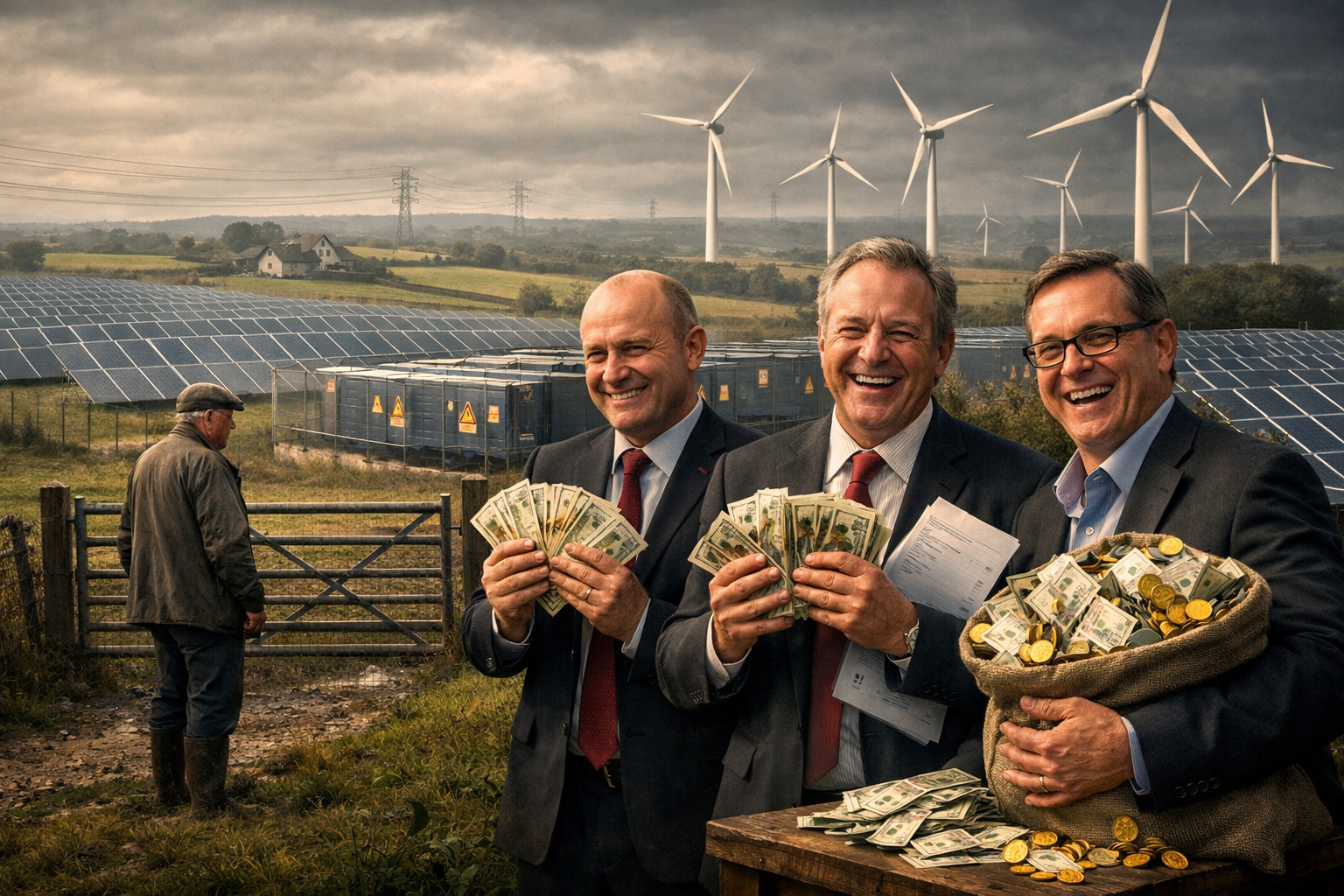
It asks the poorest to pay today for promises that may never materialise, while those shaping policy remain insulated from the consequences.The people most affected by rising energy costs, degraded landscapes, and industrial intrusion are rarely those designing the frameworks. Rural communities, pensioners, low-income households , these groups are asked to carry the burden of policies from which they derive little benefit and over which they have no meaningful control.
When Process Replaces Ethics
A defining feature of this moral inversion is the replacement of ethical judgement with procedural compliance.
If a project meets a set of regulatory criteria, it is deemed acceptable , regardless of its real-world impact.
Environmental assessments become box-ticking exercises. Consultation becomes performative. Objections are logged, acknowledged, and ignored.
Once a project aligns with policy, moral scrutiny evaporates.In this system, harm is not denied; it is administratively managed.
This bureaucratisation of morality allows decision-makers to claim virtue while avoiding responsibility. They can point to process, policy, or modelling and insist that outcomes , however damaging , are beyond their control. Accountability dissolves into procedure.The result is a culture in which ethical discomfort is treated as an inconvenience rather than a warning.
The Quiet Redefinition of Progress
Perhaps the most profound betrayal lies in how the meaning of “progress” has been quietly rewritten.Once, progress meant healthier lives, cleaner environments, and greater security. Today, it is increasingly defined by the scale of infrastructure deployment, the speed of rollout, and adherence to abstract targets , regardless of consequence.
Landscapes are industrialised in the name of sustainability. Communities are overruled for the greater good. Democratic consent is replaced with managed consultation. Dissent is framed as ignorance or denial.In this inverted moral order, questioning outcomes becomes taboo. To ask whether a policy causes harm is to risk being labelled obstructive or regressive. The space for ethical debate collapses, replaced by a binary of compliance or condemnation.This is how a movement loses its soul.
A Crisis of Conscience
The deepest failure of modern climate policy is not technical or economic.
It is moral.
A system that justifies hardship, dismisses lived experience, and prioritises abstract targets over human dignity has lost its ethical foundation. It no longer asks, “Is this right?” It asks only, “Does this align?”That is not environmentalism. It is managerial dogma.True environmental responsibility cannot be built on indifference to suffering. It cannot require the silencing of communities or the erosion of democratic consent. And it cannot demand sacrifice from those least able to bear it while insulating those who design and profit from the system.
A genuine environmental ethic would begin with people , their health, security, and dignity and build outward. It would measure success not in gigawatts or compliance metrics, but in whether lives are improved and ecosystems genuinely protected.
Until that moral compass is restored, climate policy will continue to betray the very principles it claims to defend And that betrayal will not be measured in emissions , but in trust, justice, and human cost.
Shane Oxer. Campaigner for fairer and affordable energy
 SAY NO TO THE DESTRUCTION OF OUR LAND
Leave a comment