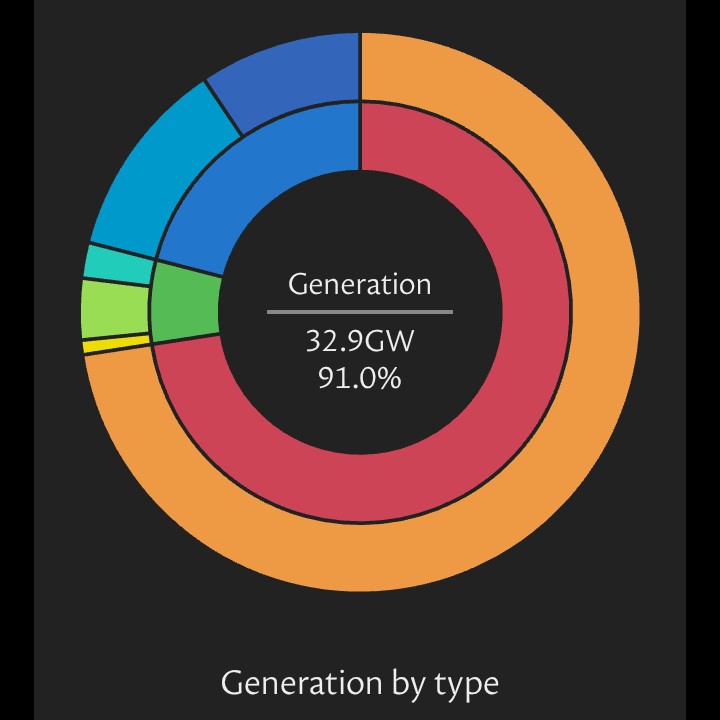
Britain’s energy crisis is not the result of global shocks, bad luck, or temporary volatility. It is the direct and predictable outcome of a policy framework that elevated carbon accounting above engineering reality. Over the past two decades, the UK pursued wind and solar at scale not because they were the best forms of power for a cold, winter-peaking, industrial economy, but because the Climate Change Act made them the least politically and legally risky way to hit carbon targets. The consequence has been a power system that produces electricity when it is least needed, fails when demand is highest, and costs more the more it is expanded.¹
Wind now averages roughly 35–40% output against installed capacity, while large-scale solar performs worse still, at ~10–12% annually, collapsing to near-zero during winter evenings.²³ These are not marginal shortcomings; they go to the heart of system design. Electricity grids are built around peak demand and reliability, not annual averages. Yet Britain expanded intermittent generation as if energy volume alone could replace firm power. It cannot. What cannot be relied upon at peak must be backed up in full, and that single fact explains why costs exploded.

As wind and solar capacity grew, so did curtailment — electricity that is generated but deliberately wasted because the grid cannot absorb or transport it. Nationally, around 5–10% of wind output is now curtailed, with local rates far higher in constrained regions.⁴ Solar curtailment is rising rapidly for the same reason: too much power arriving in the wrong places, at the wrong times. Consumers pay twice — once through subsidies and again through constraint payments — for electricity that never reaches a socket. Energy that cannot be used is not cheap; it is system waste.
The decisive metric policymakers avoided is capacity credit: how much of a technology can be relied upon during system stress. For wind, this is typically 5–15%. For solar in winter evenings, it is effectively zero.⁵ This means that despite tens of gigawatts of installed renewables, Britain must still retain almost the entire gas fleet to keep the lights on. Intermittent renewables displace energy volumes on paper, but they do not displace capacity in reality. The system therefore runs two parallel infrastructures at once — one intermittent and subsidised, one firm and essential — and households pay for both.
This outcome was not accidental. The Climate Change Act, enforced through carbon budgets and carbon taxation, deliberately penalised dispatchable fossil generation while classifying wind and solar as “zero-carbon at point of generation”, regardless of usability or system impact. Carbon pricing was easy to apply to gas; it was politically convenient and legally measurable. Reliability, inertia, seasonal alignment, and grid stability were not priced at all. The result was a distorted investment signal: firm power was punished, intermittent capacity was rewarded. Investors followed the law. Engineers were sidelined.
Crucially, the Act contains no binding duty to minimise system cost, protect affordability, or preserve industrial competitiveness. Breach a carbon budget and ministers face legal risk; double household bills and nothing in law is triggered. That asymmetry drove behaviour. Departments pursued technologies that delivered rapid, visible carbon reductions within short budget cycles, even if they failed over a 30- to 60-year system lifetime. Nuclear — including modern Small Modular Reactors — could have cut emissions while preserving system stability, but long lead times and poor optics within five-year carbon windows pushed it aside.⁶
The result is the energy paradox Britain now lives with: record renewable build-out alongside higher prices, rising standing charges, grid congestion, industrial decline, and permanent dependence on gas for security. Carbon taxation did not replace fossil costs; it stacked new costs on top of them — subsidies, grid reinforcement, balancing services, capacity payments, and curtailment compensation — all socialised onto bills.⁷ This is why electricity prices rose structurally, not temporarily, and why they have not fallen despite ever more wind and solar.
The uncomfortable conclusion is unavoidable. Wind and solar are not inherently useless technologies, but they were misapplied at system scale under a carbon law blind to engineering and cost. Britain did not decarbonise cheaply; it de-engineered its power system to satisfy a legal framework that values tonnes of CO₂ on spreadsheets over reliable power in the real world.
We did not just choose the wrong energy.We legislated for the most expensive way to run an electricity system.
Footnotes
UK National Audit Office, Decarbonising Power and Network Costs, HC reports.
National Energy System Operator, Electricity Generation Capacity Factors, 2024–2025.
Department for Energy Security and Net Zero, UK Solar Generation Statistics, annual averages.
Ofgem, Constraint Payments and Network Congestion Reports, 2023–2025.
Ofgem / Capacity Market derating factors for intermittent generation, latest T-4 auction guidance.
OECD-NEA, The Value of Firm Low-Carbon Power; IEA nuclear performance benchmarks.
International Energy Agency, System Integration of Renewables; UK network charging statements.
Shane Oxer. Campaigner for fairer and affordable energy
 SAY NO TO THE DESTRUCTION OF OUR LAND
Leave a comment