The offshore wind auction that exposes the great Net Zero infrastructure fraud.
By Shane Oxer — Campaigner for fairer and affordable energy
This week’s government announcement on offshore wind contracts was presented as a historic victory for British “energy sovereignty”.
In reality, it was something very different: another large batch of paper power stations approved in a system that cannot physically connect them to the grid for many years to come.¹
Britain is now world-class at signing contracts for electricity it cannot transport, cannot balance, and in many cases cannot use.
The gap between what ministers announce and what the grid can actually deliver has become the central scandal of UK energy policy.
The latest Contracts for Difference (CfD) auction awarded new offshore wind projects an average strike price of roughly £91/MWh (2024 prices) up from the previous round , while ministers insisted this still represented “good value” compared to gas.² What they did not mention is that this price excludes the single most expensive part of the entire transition: the grid needed to make any of it work.
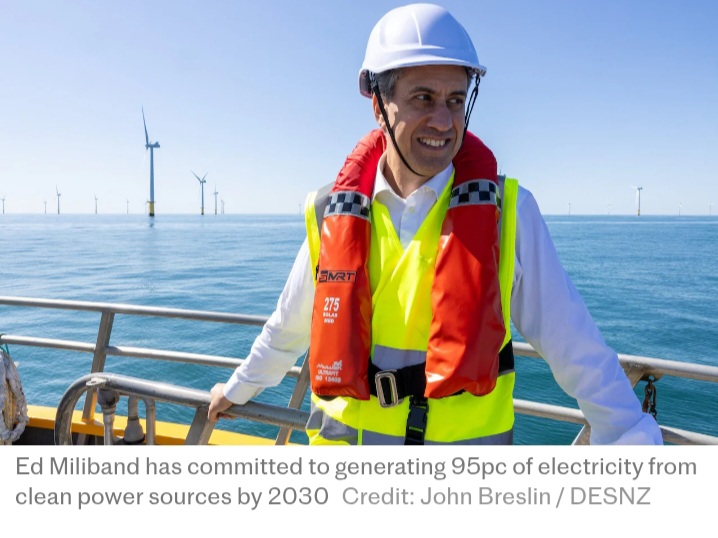
Offshore wind does not plug into a socket. Each project requires offshore substations, HVDC converter platforms, seabed export cables, onshore landing points, new 400kV substations, super-grid transformers, and often entirely new overhead line corridors.³
Much of this infrastructure does not yet exist, is not yet consented, and in many cases is not scheduled for completion until the 2030s.
The National Energy System Operator’s own “Beyond 2030” programme shows that huge sections of the onshore and offshore reinforcement plan will not be delivered in time to support the government’s build-out targets.⁴
At the same time, Ofgem and the transmission operators have confirmed severe supply-chain bottlenecks in super-grid transformers and HVDC equipment , the very components this strategy depends upon.⁵
This is not a theoretical problem. It is already happening.
The Ofgem / NESO Transmission Entry Capacity (TEC) Register and Appendix G datasets show dozens of large, consented renewable projects that cannot export reliably until 2029–2035 or later.⁶
These schemes exist in planning law and subsidy contracts, but not in operational reality.
This is why Ørsted walked away from Hornsea 4 , a flagship offshore wind project that had already been awarded a government contract. The company did not suddenly lose faith in wind. It lost faith in the economics of building megaprojects into a system paralysed by grid delays, inflation, interest rates and construction risk.⁷
Yet instead of confronting this, ministers are doubling down.
They now claim offshore wind at £91/MWh is “cheap” compared to new gas generation at £147/MWh a figure that includes a politically-set carbon tax.⁸ This is not a market comparison. It is a policy-weighted accounting construct.
The offshore wind number excludes:
Grid reinforcement costs
HVDC networks
Constraint payments
Curtailment
Balancing services
Backup gas capacity
Inertia and stability equipment
System re-engineering costs.
All of which are now running into tens of billions of pounds and will be paid by consumers regardless of whether a single extra unit of useful energy is delivered.⁹
Even the government quietly admits the contradiction.
In the same breath as promising bill reductions, it confirms that Ofgem’s grid upgrade programme will start adding to household bills.¹⁰ Moving some costs from bills to taxation does not make them disappear. It simply hides them.
Meanwhile, Britain continues to build generation faster than it can build wires.
The result is a system that increasingly pays power stations not to run because the electricity has nowhere to go. Constraint payments have already exploded and will rise sharply as more disconnected capacity is added.¹¹
This is not decarbonisation. It is infrastructure vandalism.
The UK has inverted the logic of energy planning:
It approves projects before the grid exists
It subsidises output it cannot use
It builds DC generation into an AC system without synchronisation
It promises “energy security” while making the system more fragile
In short:
Approvals first. Physics later. Press releases always.
The most honest description of the latest auction is this:
Britain has just signed contracts for electricity that, in large part, will not be deliverable for many years — and some of it may never be deliverable at all.
This is not an energy strategy. It is a spreadsheet strategy.
And the public is being asked to pay for both the fantasy and the failure.
Footnotes
DESNZ CfD Auction Round announcement, 2026.
UK Government CfD AR6 results, strike price data (2024 prices).
National Grid ESO, Holistic Network Design & Offshore Coordination documents.
NESO, Beyond 2030: Regional Network Development Plan, 2024–2025.
Ofgem & National Grid supply chain statements on SGT and HVDC constraints, 2024–2025.
Ofgem / NESO Transmission Entry Capacity Register (TEC), Appendix G datasets, Jan 2026.
Ørsted press release on discontinuation of Hornsea 4, 2025.
DESNZ comparative generation cost statements, 2026.
National Grid ESO, Pathway to 2030, system cost and network reinforcement estimates.
Ofgem price control and network investment announcements, 2025–2026.
National Grid ESO annual constraint payments and balancing cost reports, 2023–2025.
 SAY NO TO THE DESTRUCTION OF OUR LAND
Leave a comment