For more than a decade, the British public has been assured that Net Zero would be affordable, even beneficial: that renewables are “the cheapest form of energy ever”, that the transition would “pay for itself”, and that any costs would be modest, temporary and manageable.
That story is now collapsing under the weight of arithmetic.
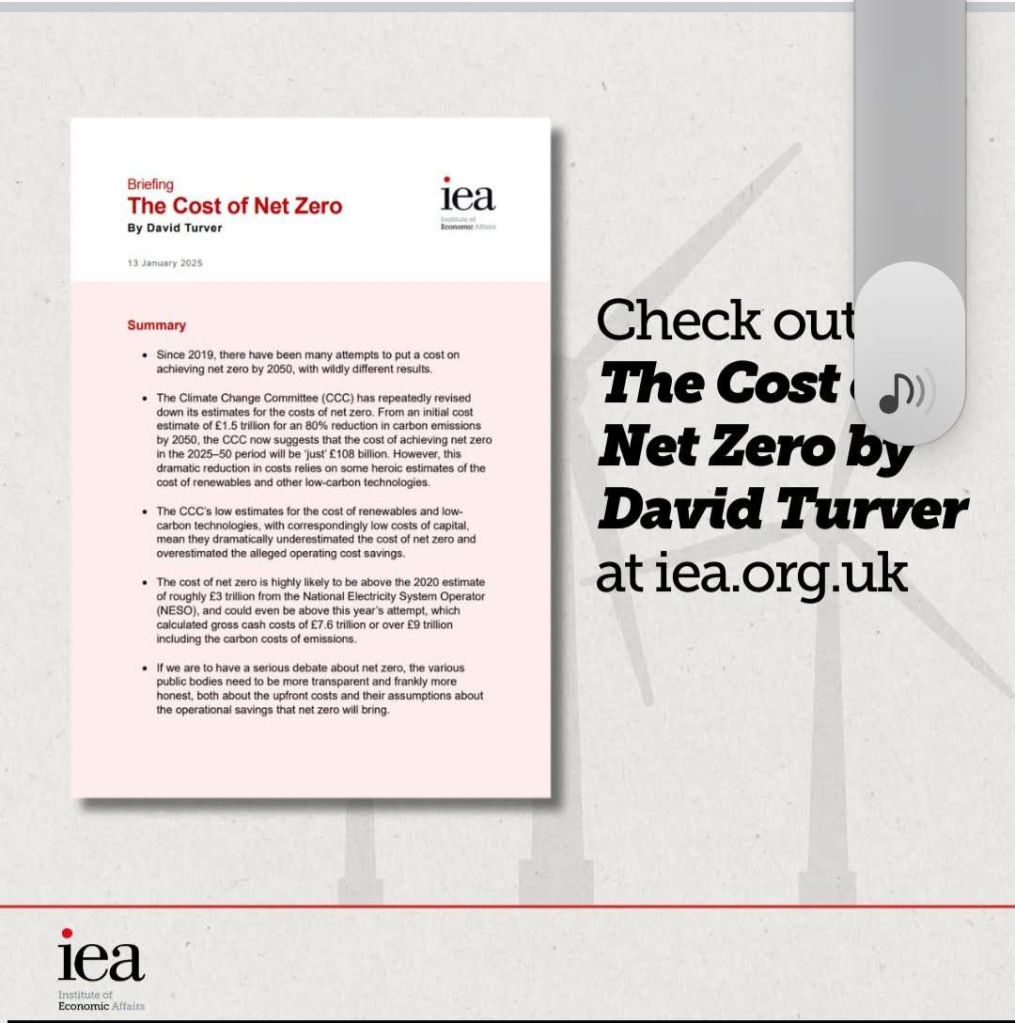
New analysis by the Institute of Economic Affairs, based on the Government’s own system modelling, suggests that the true cost of delivering Net Zero is not in the hundreds of billions, nor even in the low trillions, but £7.6 trillion in direct cash spending — and more than £9 trillion once carbon costs are included.[1] Even these figures, the authors warn, are likely to be underestimates.
This is not a marginal policy error. It is, by any reasonable definition, the largest financial commitment ever undertaken by a British government in peacetime , and it has been made without a vote, without informed consent, and without honest public accounting.
The Accounting Trick
The most revealing question is not why the numbers are so large, but why the official figures have for so long appeared so small.
Only a few years ago, the Climate Change Committee (CCC) acknowledged that the cost of Net Zero could approach £1 trillion. More recently, it has claimed the figure is closer to £108 billion.[2] This dramatic “reduction” did not occur because the transition suddenly became cheaper. It occurred because the methodology was changed.
Large parts of the system cost were quietly removed from the calculation:
grid reinforcement, backup generation, storage, overbuild, curtailment, system balancing, financing costs, and risk premiums.
In effect, the CCC stopped costing the system and began costing only selected components of it.
This is the central deception of the entire Net Zero project: if you cost individual technologies in isolation and ignore the system required to make them work, you can make anything look cheap.
But the system is the cost.
Offshore Wind:
The Reality Check
Consider offshore wind, the backbone of Britain’s decarbonisation strategy. The CCC assumes that by 2030, offshore wind should cost around £1,500 per kilowatt of installed capacity.[3]
The real, contracted cost of Hornsea 3 , one of the flagship projects , is £3,682 per kilowatt.[4]
That is not a rounding error. It is well over double the official assumption. And it is not an outlier;
it is increasingly typical once financing, construction risk, grid connection and supply chain constraints are properly accounted for.
Solar:
The Same Pattern Repeats
Solar tells the same story.
The CCC assumes costs of roughly £403 per kilowatt by 2030.[5] Recent UK solar farm projects are coming in at £952–£995 per kilowatt.[6]
Again, more than double.
And again, these figures still exclude much of the wider system cost:
grid reinforcement, curtailment, balancing services, inverter replacement cycles, and the cost of maintaining parallel conventional generation to cover periods of low output.
The Interest Rate Fantasy.
Perhaps the most revealing assumption of all sits in the National Energy System Operator’s (NESO) financial modelling. It assumes borrowing costs of 5.0–5.2 per cent.[7] At the time of writing, 30-year gilt yields are around 5.3 per cent , before any project risk, technology risk, construction risk or political risk is added.[8]
In infrastructure finance, this difference is not trivial. It is the difference between a viable-looking spreadsheet and an unaffordable reality. The model only works by assuming below-market money.
That is not prudent planning. It is financial wishful thinking.
The Costs Still Being Ignored
Even the IEA’s multi-trillion-pound figures almost certainly understate the true bill, because vast categories of cost remain poorly captured or excluded altogether:
Grid-scale overbuild
Super Grid Transformer shortages
HVDC overlays
Synchronous compensation and stability services
Curtailment payments
Capacity market distortions
Duplicate networks
Standby gas plant kept alive “just in case”
Stranded and failed assets
Britain is not replacing its energy system. It is building a second one on top of the first, and paying to maintain both.
Why Bills Keep Rising
This is why household bills continue to rise even when wholesale gas prices fall. Not because of temporary shocks, nor because of geopolitics, but because consumers are being asked to finance the most expensive infrastructure transformation in British history through their energy bills.
Standing charges have exploded. Constraint payments now run into the billions. Grid costs are surging. Subsidies are everywhere. And yet the system is becoming less stable, not more.
The Democratic Failure
The most troubling aspect of all this is not technical but constitutional.
No government has ever put the following proposition to the electorate:
“We intend to spend £9–10 trillion rebuilding the energy system, your bills will rise for decades, your countryside will be industrialised, and your electricity supply will become more complex and fragile. Do we have your consent?”
Had it done so, the answer would almost certainly have been no.
Instead, the commitment has been made by a combination of statutory targets, quangos, and technocratic momentum — insulated from democratic scrutiny and protected from honest cost disclosure.
The Real Question
The question is no longer whether Net Zero can be delivered on time.
It is this:
How did Britain commit itself to the most expensive policy in its history without ever being told the price?
Conclusion:
A Financial Trap
Net Zero as currently designed is not economically rational, not technically coherent, and not democratically legitimate.
It is an ideology-driven, debt-fuelled, system-wide gamble with the country’s prosperity and stability.
Reality is now beginning to intrude. The numbers are emerging. They are vast. And they are only going in one direction.
Footnotes (working references)
[1] Institute of Economic Affairs, The Cost of Net Zero, David Turver, January 2026.
[2] Climate Change Committee, successive Net Zero cost assessments, 2019–2024.
[3] CCC, Offshore Wind Cost Assumptions, 6th Carbon Budget documentation.
[4] Hornsea 3 project cost disclosures and strike price data.
[5] CCC, Solar PV cost assumptions, 6th Carbon Budget.
[6] Recent UK solar NSIP and large-scale planning applications, 2024–2025.
[7] NESO system cost modelling assumptions, Clean Power 2030 / Beyond 2030.
[8] UK Debt Management Office, 30-year gilt yields, January 2026.
 SAY NO TO THE DESTRUCTION OF OUR LAND
Leave a comment