By Shane Oxer — Campaigner for fairer and affordable energy
For years, the British public has been told that the obstacles to Net Zero are merely political: planning delays, local objections, or a lack of “ambition”. If only the system moved faster, we are told, the transition would be painless and inevitable. But that story is now breaking down, not because of public resistance, but because Net Zero is beginning to collide with the hard infrastructure of the state itself.¹
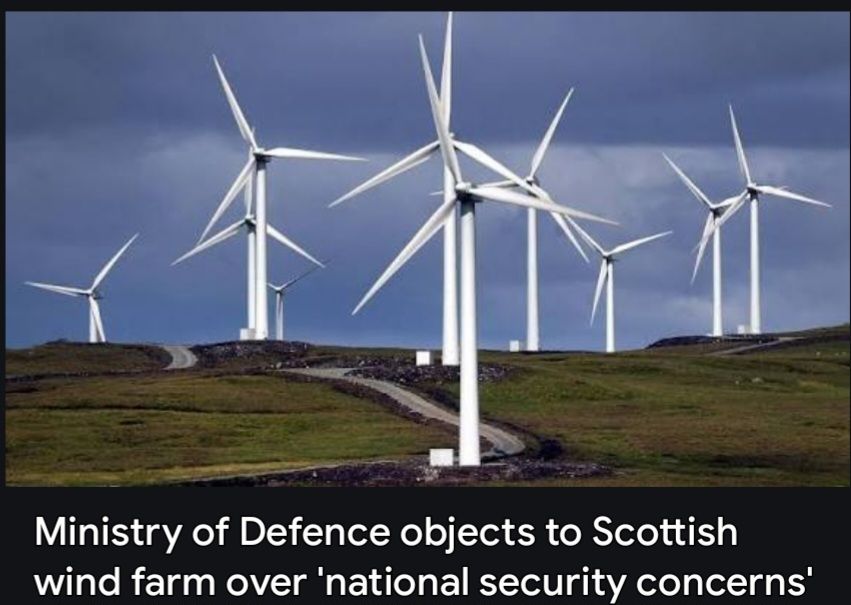
Last week, the Ministry of Defence lodged a formal objection to a proposed wind farm in the Scottish Borders near Hawick. This was not about scenery, wildlife, or local inconvenience. It was about something far more serious: interference with the Eskdalemuir seismic monitoring station, the UK’s only facility for detecting underground nuclear tests anywhere in the world.² This station underpins Britain’s obligations under the Comprehensive Nuclear Test Ban Treaty.³
The MoD’s verdict was blunt. The cumulative impact of wind turbines in the area has already exhausted the allowable interference limit. There is, in its words, “no seismic noise capacity available”.⁴ No amount of mitigation, planning conditions, or technical tinkering can change that. The answer is simply: no.
This matters far beyond one Scottish planning application. It exposes a truth the Net Zero narrative has carefully avoided: large-scale renewables are not assessed turbine by turbine, but cumulatively against the physical and operational limits of national systems.⁵ Once those limits are reached, the system does not bend. It fails.
Modern wind turbines do not merely alter landscapes. They generate measurable low-frequency vibration and ground-borne seismic noise. Around Eskdalemuir, this is managed through a 10-kilometre exclusion zone, a 50-kilometre safeguarding zone, and a strictly controlled cumulative “noise budget”.⁶ When that budget is used up, it is used up. This is not a planning judgement. It is physics.
The same principle applies to radar, air traffic control, and military low-flying training corridors. Turbines interfere with radar returns, distort airspace safety envelopes, and create physical obstacles in areas used for high-speed, low-level flight.⁷ These effects do not remain local. They accumulate across whole regions.
This is why the Eskdalemuir case should be seen as a warning, not an anomaly. The UK is now approaching saturation in multiple strategic domains simultaneously: grid capacity, transformer availability, substation space, planning tolerance, landscape absorption — and now defence and national security infrastructure.⁸
The comforting fiction of the energy transition has been that all of this can be solved with “mitigation”. Developers always claim that impacts can be managed with conditions, monitoring, and adaptive measures. The MoD has just demonstrated the limits of that thinking. Some systems do not have elastic tolerances. They have hard thresholds. Once crossed, the function of the system itself is degraded.
This is not an abstract problem. It goes to the heart of whether Britain can continue to operate as a serious, technologically advanced state. You cannot run a modern air defence system, an integrated civil aviation network, and a military training environment inside a forest of moving 200-metre obstacles without consequences.⁹ You cannot maintain ultra-sensitive seismic monitoring while steadily raising the background noise floor of the ground itself.
The Eskdalemuir objection also proves something politically uncomfortable: Net Zero does not automatically override national security. When the two collide, Net Zero has to give way. And as turbine density continues to rise across the country, these collisions will become more frequent, not less.
This is not a failure of planning. It is a failure of strategy.
Britain is attempting to rebuild its entire energy system around sources that are spatially voracious, infrastructure-heavy, and systemically intrusive, without first asking whether the country itself — geographically, militarily, and infrastructurally — can actually accommodate them.¹⁰
The country is not infinite. The grid is not infinite. The sky is not infinite. And now we know that even the ground itself is not infinite.
At some point, a serious question has to be asked: can a dense, advanced, militarily committed, aviation-dependent industrial nation really base its core energy system on technologies that consume ever-increasing amounts of land, airspace, and system tolerance?
The Eskdalemuir case suggests the answer is already beginning to arrive — not in speeches, but in hard refusals.
Reality, as ever, is undefeated.
Footnotes
UK Net Zero infrastructure rollout and cumulative system constraints.
MoD objection to Mid Hill Wind Farm, Scottish Borders, January 2026.
Comprehensive Nuclear Test Ban Treaty (CTBT) monitoring obligations and UK role.
MoD statement: “no seismic noise capacity available” within Eskdalemuir safeguarding zone.
MoD and CAA cumulative impact assessment frameworks for wind turbines.
Eskdalemuir 10km exclusion zone and 50km safeguarding zone policy.
CAA / MoD guidance on wind turbines, radar interference, and low flying training areas.
National Grid ESO / NESO transformer, substation and connection constraint reports.
RAF low flying training structure and UK airspace safeguarding maps.
National Infrastructure Commission / DESNZ land-use and grid expansion assumptions.
 SAY NO TO THE DESTRUCTION OF OUR LAND
Leave a comment