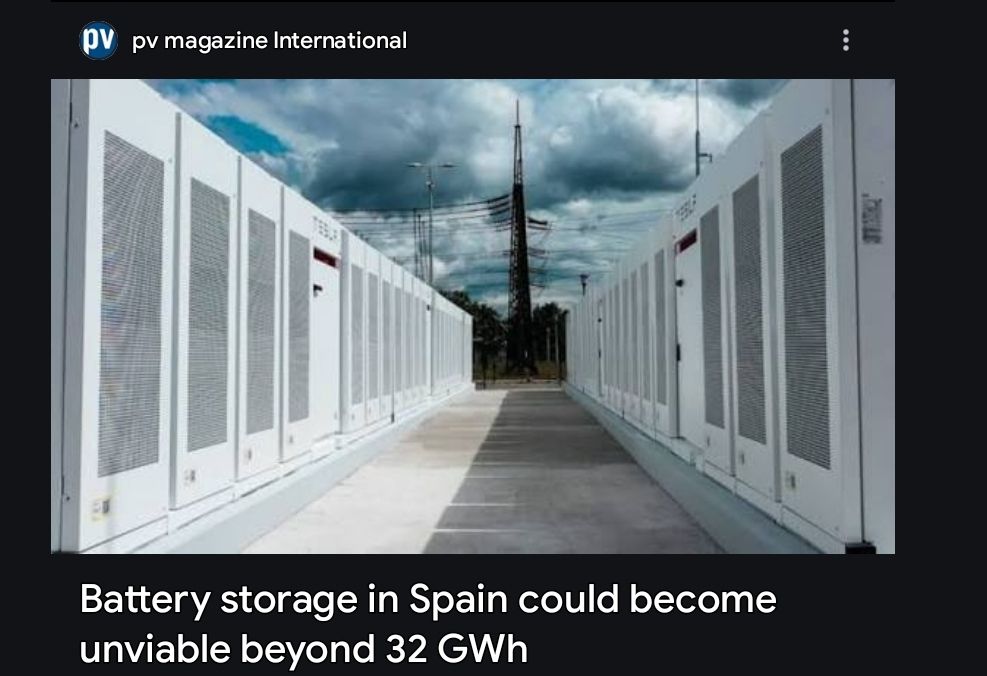
Spain has just published the academic proof that battery storage collapses under its own weight. Across the UK , from Scotland to the South West , planners are approving exactly the same mistake at industrial scale.
For years, Britain’s energy debate has been dominated by a comforting idea: that if we simply build enough batteries, the problem of intermittent renewables will solve itself. When the wind does not blow and the sun does not shine, storage will step in, the grid will be balanced, and Net Zero will proceed smoothly. It is an appealing story. It is also now demonstrably false.
In January 2026, researchers from the University of Seville published a detailed economic analysis showing that battery storage in Spain becomes self-defeating beyond a cumulative capacity of around 32 GWh. Beyond that point, storage does not stabilise the system but instead destroys its own revenue model by collapsing price volatility, rendering further investment uneconomic.¹ This is not an ideological critique. It is a mathematical one.
Why batteries only work if the system is broken
Batteries do not generate electricity. They do not create energy. They do not secure supply. Their entire commercial purpose is to exploit price differences: buying electricity when it is cheap and selling it when it is expensive. The business model depends entirely on volatility.
The paradox, now proven in the Spanish study, is that the more batteries you add to a system, the more they erase the very price differences they rely upon. They flatten peaks, fill troughs, and compress spreads. Eventually, if enough are built, they eliminate volatility altogether. At that point, storage stops being a solution and becomes a victim of its own success.²
The Spanish warning that Britain is ignoring
The Seville team used real day-ahead market clearing curves rather than idealised planning models, allowing them to simulate how storage interacts with a real electricity market. Their conclusion is blunt: beyond roughly 32 GWh of installed capacity, additional batteries in Spain produce diminishing and then negative economic returns because arbitrage opportunities collapse.¹ Too much storage makes storage worthless.
This is not a peculiarity of Spain’s market. It is a structural feature of all arbitrage-based systems. The same mathematics applies in Britain, whether the batteries are being built in Lincolnshire, the Midlands, or the Scottish Highlands.
A UK system already under strain
If Spain hits this wall at 32 GWh, Britain is likely to hit it sooner and harder. The UK grid is more congested, more geographically unbalanced, and more dependent on inverter-based generation than Spain’s. Nowhere is this more visible than in Scotland, where vast quantities of wind generation are being connected to a grid that cannot move the power south, leading to enormous curtailment costs and perverse market outcomes.³
Yet instead of fixing the grid and building firm generation, policy has defaulted to approving ever more storage. Across Scotland in particular, but increasingly in England and Wales too, planning authorities are being flooded with battery applications, often clustered around already constrained substations. The assumption seems to be that storage is a harmless add-on. It is not.
The engineering reality nobody wants to face
Batteries are not power stations. They do not provide inertia, fault current, or system strength. They cannot stabilise the grid in a blackout, they cannot carry a country through a windless winter, and they cannot solve seasonal imbalance. They are DC devices being asked to prop up an AC synchronous system.⁴
They have a role, but it is a narrow one: short-term smoothing and specific grid services. Treating them as a foundation technology is an engineering category error.
The coming storage bubble
As battery density increases across the UK, price spreads will compress, revenues will undershoot forecasts, and refinancing assumptions will start to fail. The crisis will not arrive first as a technical failure but as a financial one: merchant battery operators unable to service debt, emergency “market reforms”, and the quiet appearance of subsidy supports and capacity payments to keep projects afloat. This will look uncomfortably similar to what has already happened with constraint payments and other hidden system costs.³⁵
Scotland as the warning, not the exception
Scotland already shows the future. It has world-class wind resources, a grid that cannot export the power, soaring curtailment payments, and now a surge of storage proposals attempting to arbitrage a system that is structurally broken. None of this fixes the underlying problem: a lack of transmission capacity and a lack of firm, synchronous generation where it is needed.
What is happening north of the border is now spreading south.
The deeper delusion
We are trying to run a national civilisation on what is, at heart, a trading strategy. You cannot run a country on arbitrage. A serious power system is built around controllable generation, physical stability, and engineering margins. Britain is attempting to build one around weather, financial models, and political wishful thinking.
The unavoidable conclusion
Spain has now produced the academic proof of something engineers have long understood: storage is a support technology, not a foundation. The UK is treating it as a foundation, from Scotland to the Home Counties. That mistake will cost tens of billions of pounds. When it fails, it will be described as unforeseen. It was not.
Footnotes
- University of Seville, via pv magazine, Battery storage in Spain could become unviable beyond 32 GWh, 21 January 2026.
- Ibid, analysis of price cannibalisation and arbitrage collapse effects.
- National Grid ESO / NESO data on Scottish curtailment costs and constraint payments, 2022–2025.
- National Grid ESO, System Operability Framework, inertia and system strength requirements.
- NAO and Public Accounts Committee reports on network costs and constraint payments.
Shane Oxer. Campaigner for fairer and affordable energy
 SAY NO TO THE DESTRUCTION OF OUR LAND
Leave a comment