The next time you wince at the price of a loaf of bread or a basket of groceries, remember this: Britain is deliberately destroying the people who grow its food. Not by accident. Not by neglect. But by policy.
We are told this is about the environment, about “transition”, about “sustainability”. In reality, it is about bureaucracy, debt and ideology. And it is turning one of the most efficient and resilient food-producing systems in the world into something brittle, expensive and import-dependent.
This is not a niche farming story. It is a cost-of-living scandal that affects every household in the country. If food is becoming more expensive and less secure, it is because the entire system that produces it is being quietly broken.
The public is encouraged to believe that higher food prices are caused by distant global forces. But the truth is much closer to home. British policy is making British food more expensive by driving farmers out of business, loading those who remain with costs and paperwork, and replacing production with imports and ideology.
Once you understand that, the rest of the story becomes depressingly logical.
The crisis in British farming did not begin yesterday, but it has accelerated sharply in recent years. One of the most important changes has been the destruction of the Basic Payment Scheme (BPS), which for decades acted as a basic income stabiliser for farms operating on thin and volatile margins. Under the current agricultural transition, BPS has been cut to a fraction of its former value or eliminated altogether for many farms, and is scheduled to disappear entirely by 2027.¹ In practice, this means thousands of businesses have lost the last financial buffer that made their operations viable.
At the same time, farmers are being asked to compete with imports produced to lower standards, while absorbing sharp increases in the cost of fuel, fertiliser, machinery, labour and finance.² These pressures would be severe enough on their own. But they are compounded by an ever-growing burden of audits, schemes, inspections and compliance regimes that consume time, money and management capacity without producing a single extra tonne of food.³
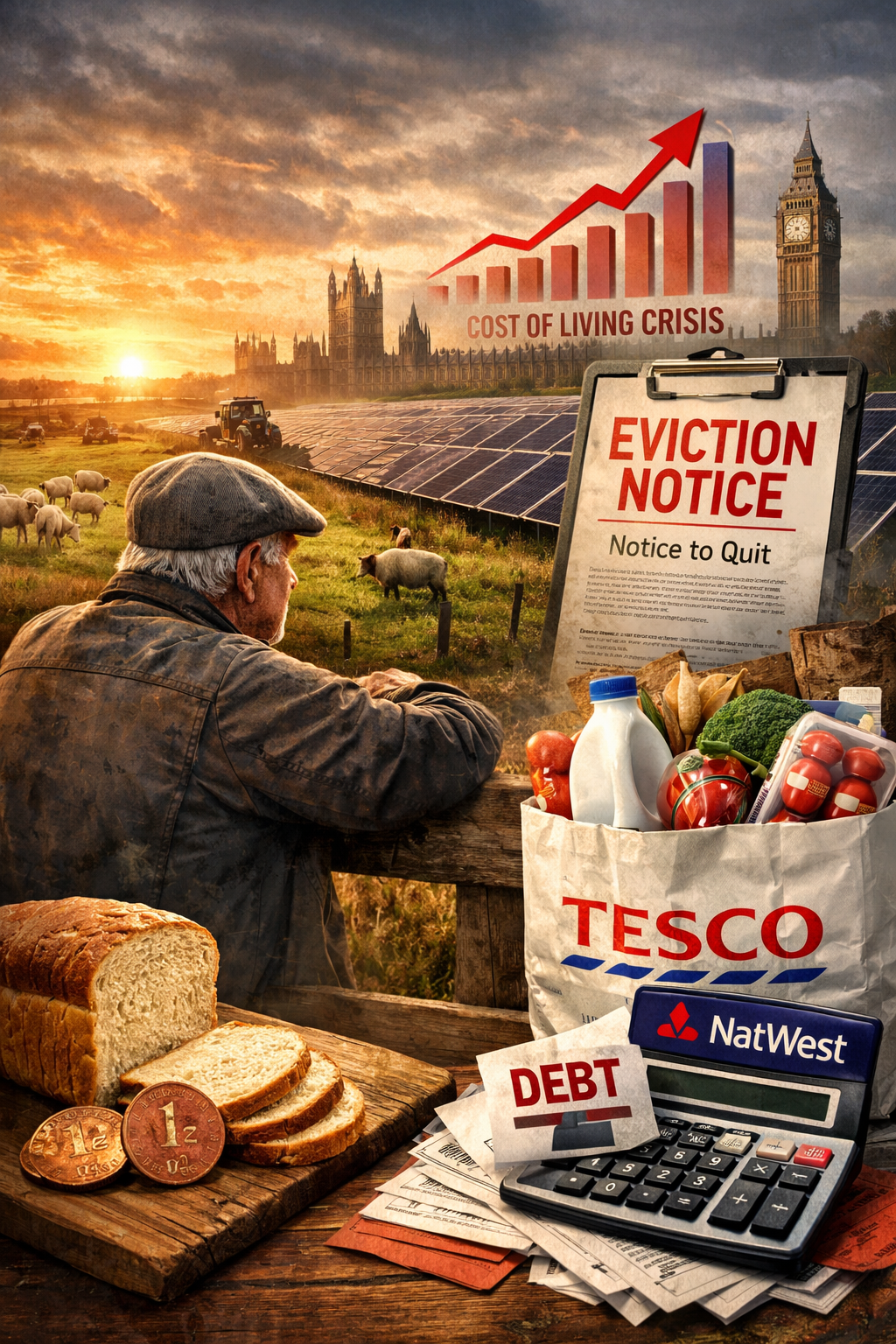
A less discussed but increasingly serious part of this story is what is happening to tenant farmers. In many tenancy agreements, a change of land use from agriculture to “development” , including large-scale solar — triggers break clauses that allow the landlord to terminate the tenancy, often with as little as 12 months’ notice.⁴ As the countryside fills with speculative energy projects, agents and landowners are increasingly chasing these deals, sometimes taking 20 per cent or more of the value. The result is a perverse incentive to remove the tenant and stop producing food altogether. This is not an orderly transition. It is a quiet land grab.⁵
If all this feels abstract, consider one simple and shocking fact. Out of a loaf of bread, the farmer typically receives between 1p and 9p.⁶ The person who grows the wheat, carries the weather risk, pays the fuel and fertiliser bills, runs the machinery and manages the land receives only pennies. When families pay more at the checkout, it is not because farmers are getting rich. They are being squeezed to the point of collapse.
Supermarkets sit at the centre of this system. Their buyer power is immense, and for many farms, losing a single major contract is existential. That means “negotiations” are often not negotiations at all. They are take-it-or-leave-it terms imposed on businesses that have no realistic alternative route to market. This imbalance has existed for years. What has changed is that a new layer of cost and control is now being added on top.
Tesco, Britain’s largest supermarket, openly states that around 98 per cent of its emissions are “Scope 3” — in other words, they come not from its own shops or lorries, but from its supply chain: farmers, processors and producers.⁷ This means Tesco cannot meet its Net Zero targets by changing itself. It can only meet them by changing its suppliers. In effect, it has become a private regulator of British agriculture, not through law, but through market power.
To make this system work, Tesco has partnered with NatWest to offer so-called “green loans” to farmers to pay for new equipment, renewables, heating systems and carbon monitoring infrastructure.⁸ This is presented as support. In reality, it is debt-financed compliance with corporate climate policy. Tesco has said that around 1,500 farmers have signed up to these schemes.⁹ Even on conservative assumptions, this represents tens of millions of pounds of new debt being loaded onto a sector whose income support has just been ripped away. At current interest rates, this means many thousands of pounds in interest per farm over the life of the loans.¹⁰
It is crucial to understand what this spending does not do. It does not increase yields. It does not make food cheaper. It does not improve food security. Its primary purpose is to improve corporate carbon accounting metrics.
People often ask why farmers are not speaking out more loudly about this. The answer is straightforward. When your buyer controls your route to market, speaking out means risking your business. Complaints therefore happen privately. Compliance happens publicly. This is not free choice. It is coercion by market access.
The political class refuses to connect this to the cost-of-living crisis, but the link is direct. When you destroy domestic farming, drive small producers out, load the sector with debt and bureaucracy, turn land into solar sites and replace production with imports, you do not get cheap and resilient food. You get higher prices, greater vulnerability and less control. In other words, you get a permanent food-price problem.
There is a truth that nobody in power seems willing to say out loud: you cannot destroy the people who grow your food and expect food to stay cheap. And you cannot load a collapsing industry with debt, compliance and ideology and call it sustainability.
This is no longer just a farming issue. It is about your weekly shop, your household budget, and whether Britain remains capable of feeding itself at all.
Footnotes
- DEFRA, Agricultural Transition Plan: phased reduction and removal of BPS payments by 2027.
- ONS and NFU data on rising agricultural input costs and farm income pressure.
- Farmers Weekly and NAO reporting on compliance, audit and scheme burdens.
- Standard clauses in Agricultural Holdings Act and Farm Business Tenancy agreements; land-use change practice.
- Rural land agent and planning industry reporting on solar rents and development incentives.
- UK food supply chain studies showing farmers receive only a few pence per loaf.
- Tesco Climate Transition Plan and ESG disclosures.
- Tesco–NatWest partnership announcements on green finance for farmers.
- Tesco public statements on farmer participation numbers.
- Typical SME/agricultural loan interest calculations at current rates.
 SAY NO TO THE DESTRUCTION OF OUR LAND
Leave a comment