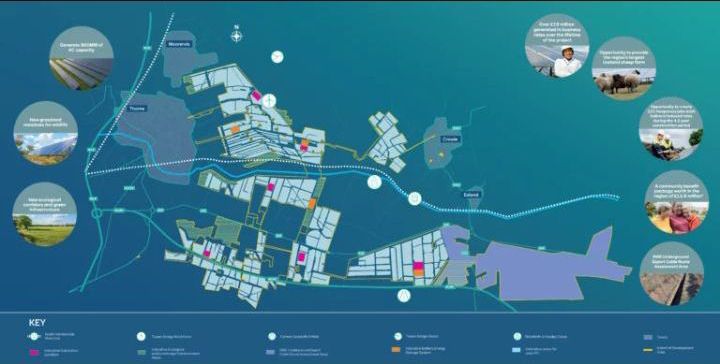
The project, promoted by RWE, was first withdrawn in August 2025 after it became clear that the developer could not say with certainty where the scheme would connect to the electricity grid, or when that connection would be delivered. For a project seeking nationally significant status, that is not a minor omission. It goes to the heart of whether the scheme is real or merely aspirational.
Any cautious developer would have stepped back, resolved the grid position, and returned only when the fundamentals were secure. Instead, Tween Bridge was pushed straight back into the system , still without a confirmed grid connection.Culminating earlier this year in an extraordinary request to the Planning Inspectorate to pause the examination process until September2026.
The reason for that request is laid bare in the developer’s own words. In its formal correspondence, RWE admits that “planning for the project has so far proceeded on the basis that it would connect to the national grid transmission network from 2029”. That assumed connection date, the company concedes, underpinned the financial viability of the project and “all preparation for its delivery”.
In other words, the entire scheme , from its business case to its environmental assessments , was built on an assumption rather than a confirmed reality.
That assumption has now collapsed. The same letter acknowledges that, following reforms to grid connections, the project has been pushed into a new window, with connection now expected somewhere between 2031 and 2035. And the consequences of that delay are not downplayed. RWE openly states that if a connection date as late as 2035 were offered, it “could have very significant implications for the viability of the project”.
This is not a marginal technical adjustment. It is an admission that the project may no longer make commercial sense at all.
Faced with this uncertainty, the developer did not do the responsible thing and withdraw. Instead, it asked the Planning Inspectorate to effectively freeze the planning system while it waited to see whether the numbers would still add up. The request was politely framed, but its substance was stark: hold everything, impose prolonged uncertainty on communities and regulators, and allow a speculative project to sit in limbo until the grid picture becomes clearer.
To its credit, the Planning Inspectorate refused. Its response should be read carefully by ministers who continue to insist that the system is working as intended. Granting such a pause, the Inspectorate warned, would create negative resource implications, abortive work across the system, and prolonged uncertainty for affected people. That is bureaucratic language, but the meaning is plain: the public would bear the cost of a private gamble.
More damaging still was the Inspectorate’s assessment of the application itself. In a sentence that should echo through every future energy inquiry, it states plainly that “the current application lacks a grid connection” and that this is “one of the principal issues” for examination.
Not a side issue. Not a detail to be resolved later. A principal flaw.
The Inspectorate goes further, asking why the applicant could not simply re-submit the scheme once the grid connection issues were resolved. That question exposes the uncomfortable truth at the heart of this case. If a project does not yet know how it will connect to the grid, why is it consuming public time and resources at all?
There is an additional problem lurking beneath the surface, and it is arguably just as serious. The Inspectorate notes that delaying the grid connection has significant implications for the Environmental Statement, because surveys and assessments were “presumably predicated on an earlier grid connection date and associated construction period”. In other words, the environmental case itself may already be outdated, tied to a timetable that no longer exists.
This raises a troubling question for the wider system. How many major energy projects are currently being examined on the basis of environmental evidence linked to grid assumptions that are now known to be unrealistic? A planning regime that allows this cannot credibly claim to be rigorous.
Supporters of schemes like Tween Bridge often cloak them in the language of urgency: climate targets, net zero deadlines, national need. Yet the correspondence reveals a more prosaic driver. This project proceeds if the grid arrives early enough. It falters if it does not. The risk is not borne by the developer alone, but by communities, regulators and the credibility of the planning system itself.
This is where the green gloss begins to wear thin. What we are seeing is not climate urgency overriding caution, but commercial calculation pushing recklessly ahead of infrastructure reality. Land is blighted, people are drawn into years of uncertainty, and public bodies are stretched. All while developers wait to see whether future grid upgrades they do not control will come to the rescue.
Tween Bridge matters because it is not unique. Across the country, the planning system is filling up with what can only be described as zombie energy projects: schemes promoted with confidence and political urgency, but dependent on grid reinforcements that may not arrive for a decade, if at all. The result is delay, distrust, and growing public scepticism about the entire energy transition.
The remedy is not complicated. No nationally significant energy project should be allowed into examination without a defined grid connection point and a credible, evidenced timetable. Aspirations are not enough. Assumptions are not enough. If a developer does not know where the power is going, it should not be applying.
Until that line is drawn, fools will continue to tread where angels fear to go. and Britain’s energy planning will remain trapped in a cycle of over-promise, under-delivery, and entirely avoidable chaos.
Shane Oxer. Campaigner for fairer and affordable energy
 SAY NO TO THE DESTRUCTION OF OUR LAND
Leave a comment