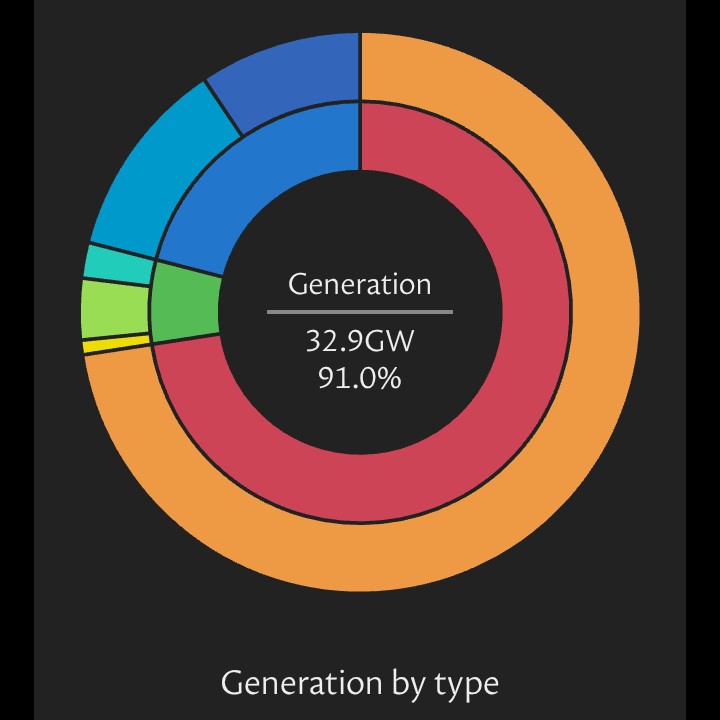
Seventeen years after the passage of the Climate Change Act 2008, the practical outcomes of the UK’s Net Zero strategy are now visible across household bills, industrial competitiveness, grid stability, and land use. While the policy was sold as a route to affordability, resilience, and green prosperity, the evidence increasingly shows the opposite. Rather than lowering costs and strengthening energy security, Net Zero has imposed structural inefficiencies on the UK energy system that are now being borne by households, businesses, and the countryside alike.
Energy costs among the highest in the developed world
UK electricity prices have risen dramatically relative to comparable economies. By 2023–2024, domestic electricity prices in the UK were routinely three to four times higher than those in countries such as France and the United States, and significantly higher than the EU average.[1] Crucially, this divergence is not driven by fuel input costs , gas prices broadly converged across Europe following the 2022 energy shock , but by policy costs embedded in the UK system. These include renewable subsidies, Contracts for Difference (CfDs), grid reinforcement charges, balancing costs for intermittent generation, and curtailment payments paid when surplus power cannot be used.[2] As Ofgem has acknowledged, non-energy policy costs now form a substantial and growing share of the typical electricity bill.[3]
A sharp rise in fuel poverty
As a direct consequence of rising prices and standing charges, fuel poverty has expanded significantly. Government data shows that the number of households in fuel poverty in England rose to over 3.2 million, with even higher proportions in Scotland and Wales.[4] Charities including National Energy Action and Citizens Advice report that millions of households now self-disconnect, under-heat their homes, or accrue energy debt, despite repeated state interventions.[5] Notably, this crisis has persisted even as wholesale gas prices fell sharply from their 2022 peak, indicating that structural policy costs , not global markets , are now the dominant driver of high bills.[6]

Industrial decline and rising national debt
High electricity costs have made the UK increasingly uncompetitive for energy-intensive industries such as steel, chemicals, ceramics, glass, and fertiliser production. Multiple firms have either closed UK operations or shifted production overseas, citing energy prices as a decisive factor.[7] This has reduced domestic output, weakened supply chains, and hollowed out skilled employment. At the same time, government has been forced to subsidise both consumers and generators to prevent system failure, adding tens of billions of pounds to public borrowing.[8] The net effect is a shrinking tax base combined with rising state expenditure , a structural contributor to long-term debt rather than a temporary crisis response.
Increased risk of blackouts and energy restrictions
The UK grid is now operating with reduced margins of safety. Official assessments from the system operator have repeatedly warned that capacity margins are tight, particularly during winter peak demand periods.[9] The rapid expansion of intermittent wind and solar generation, combined with the closure of reliable thermal plant, has increased reliance on imports, emergency reserve contracts, and demand-side response measures.[10] Far from being a resilient system, the grid now depends on favourable weather conditions and consumer demand reduction to remain stable , a marked departure from historical energy security norms.[11]
Farmers, land use, and food security under threat
One of the least examined consequences of Net Zero policy is its impact on land use. Large areas of productive agricultural land are now being removed from food production to host solar farms, battery storage facilities, and grid infrastructure.[12] This shift has accelerated despite government food security strategies warning of rising import dependence and global supply instability.[13] The National Farmers’ Union has repeatedly raised concerns that current planning and energy policy places food production at a disadvantage, undermining domestic resilience for marginal carbon gains.[14]
A policy driven by targets, not outcomes
Taken together, these outcomes point to a central flaw in the UK’s Net Zero approach: legally binding carbon targets have been prioritised over system cost, engineering reality, and social impact. The Climate Change Act and subsequent carbon budgets compel compliance regardless of affordability or deliverability, leaving government to manage the consequences rather than reassess the strategy.[15] What began as a climate ambition has hardened into a rigid framework that now drives higher costs, weaker security, and growing public discontent.
At this stage, the question is no longer whether Net Zero has consequences , but whether policymakers are willing to acknowledge them honestly, and reform a system that is demonstrably failing the people it was meant to serve.
Footnotes & References
- Eurostat, Electricity prices for household consumers, 2023–2024; U.S.
- Energy Information Administration (EIA), International Electricity Prices.
- National Grid ESO, Balancing Services Use of System Charges; NAO, Decarbonising Power, HC 503, 2020.
- Ofgem, Infographic: Typical Domestic Energy Bill Breakdown, updated 2024.
- Department for Energy Security & Net Zero (DESNZ), Annual Fuel Poverty Statistics Report, 2024.
- National Energy Action, UK Fuel Poverty Monitor, 2023; Citizens Advice, The Cost-of-Living Crisis and Energy Debt, 2024.
- Ofgem, Wholesale Market Indicators, 2023–2024.
- Make UK, Industrial Energy Prices and Competitiveness, 2023; British Ceramic Confederation submissions to BEIS.
- National Audit Office, Energy Bills Support Schemes, 2023; OBR, Economic and Fiscal Outlook, March 2024.
- National Grid ESO, Winter Outlook Reports, 2022–2024.
- DESNZ, Capacity Market Auctions and Security of Supply, 2023.
- House of Lords Economic Affairs Committee, UK Energy Supply and Net Zero, HL Paper 59, 2023.DEFRA, Agricultural Land Classification Guidance; Planning Inspectorate decisions on solar NSIPs, 2021–2024.
- UK Government, Food Security Report, 2021 & 2024 update.
- National Farmers’ Union, Response to Solar and Land Use Consultations, 2023.
- Climate Change Act 2008; Climate Change Committee, Carbon Budget Delivery Reports, 2019–2024.
 SAY NO TO THE DESTRUCTION OF OUR LAND
Leave a comment