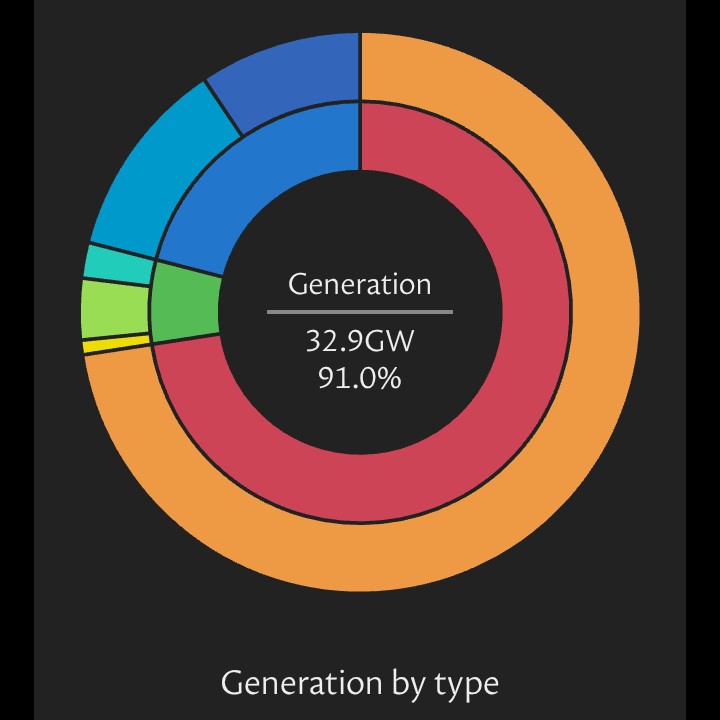
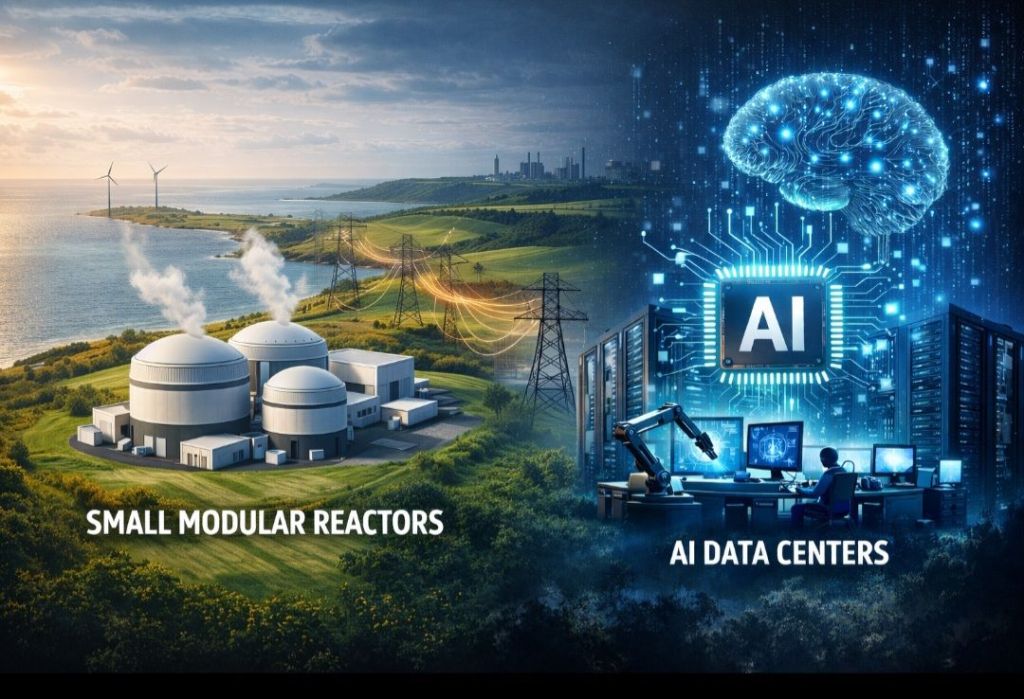
This week, Great British Energy – Nuclear welcomed plans for up to 12 advanced modular reactors at Hartlepool. A partnership between X-Energy and Centrica promising 2,500 jobs and near-continuous industrial power. At the same time, environmental and permitting work is accelerating at Wylfa as Britain positions itself to build a fleet of Small Modular Reactors.
Ministers speak of a “golden age of nuclear”. Industry talks of powering AI data centres and heavy manufacturing. The language is serious. The ambition is serious. The energy demand is very serious.
So here is the obvious question:
If nuclear is the future, why are we covering Britain in solar?
The Physics We Keep Ignoring
Let us strip this back to fundamentals.
An advanced modular reactor or SMR typically runs at a capacity factor of around 90 per cent. It produces power day and night, in January and July, in calm weather and gales alike. It is synchronous generation , meaning it supports grid stability rather than undermining it.
Solar, by contrast, averages roughly 10–11 per cent annual output in the UK. In winter , when demand peaks , it can fall below 5 per cent for extended periods. On short, dark days it produces next to nothing during evening peak.
These are not ideological statements. They are physics.
If 12 AMRs were built at Hartlepool at roughly 80–100MW each, they would deliver close to 1GW of near-continuous power. At a 90 per cent load factor, that equates to roughly 7–8 terawatt hours per year.
To match that with solar would require several gigawatts of nameplate capacity , and thousands upon thousands of acres of land , along with vast battery installations to cover evening peaks and winter shortfalls.
Which raises the second question:
Why are we industrialising the countryside to build an inferior substitute for what we now admit we actually need?
The AI Excuse Changes Everything.
The real shift in the debate is AI.
Ministers now openly say nuclear is required to power data centres and advanced industry. They are correct.
Artificial intelligence infrastructure demands high-load, constant supply. It cannot pause for cloud cover. It cannot shut down when wind speeds fall below cut-in thresholds.
You cannot run a digital economy on hope.
Yet even as government acknowledges this, planning inspectors continue to approve solar farms across farmland, green belt and upland moors. Battery Energy Storage Systems are pushed into floodplains and beside substations already struggling with connection queues.
We are told this is “clean growth”. But if nuclear is the clean industrial backbone, solar becomes what it always was: supplementary, not foundational.
Land, Landscape and Logic
The contradiction becomes starker when viewed from the ground.
Across Yorkshire, Lincolnshire, Nottinghamshire and beyond, applications stack up for solar installations covering hundreds , sometimes thousands , of acres. Prime agricultural land is reclassified as energy infrastructure.
Rural communities are told this is the price of decarbonisation.
But nuclear delivers vastly more energy per square metre than solar. It does so without fragmenting farmland or carpeting valleys in glass and steel.
If we are serious about land stewardship , about protecting food security and landscape character. Then logic dictates prioritising high-density generation.
Instead, policy behaves as though land were infinite and intermittency irrelevant.
It is neither.
Grid Reality
There is another uncomfortable truth.
Solar expansion drives transmission expansion. Offshore wind requires massive reinforcement corridors. Super grid transformers, new pylons, new converter stations , all justified on the basis of moving intermittent energy from where it happens to blow or shine to where it happens to be needed.
Nuclear, particularly when sited on former industrial or coastal sites like Hartlepool or Wylfa, integrates more cleanly into the existing transmission backbone. It reduces balancing costs. It reduces curtailment. It reduces the need for expensive short-duration batteries.
If government is now serious about a nuclear fleet, it must also confront the sunk-cost psychology of the renewables build-out.
Are we reinforcing the grid for a solar-heavy future , or for a nuclear-anchored one?
We cannot rationally optimise for both at once.
The Politics of Hesitation
There is, of course, a political dimension.
For 15 years, solar and wind were framed as moral imperatives.
Nuclear was treated as slow, expensive and politically awkward. Entire subsidy regimes, planning reforms and industrial narratives were built around intermittent renewables.
Now AI growth and industrial strategy are forcing a recalibration. Even parties historically cautious on nuclear are shifting tone. The language of “fleet build” and “energy sovereignty” is no longer fringe , it is ministerial.
But political embarrassment should not dictate infrastructure strategy.
If the strategic answer is nuclear-led firm power , complemented by gas, hydro and sensible rooftop solar , then the land-hungry rush for utility-scale solar must be reassessed.
Otherwise we risk building two contradictory systems at once:
one stable and high-density, the other sprawling and volatile.
A Question of Coherence
Britain does not lack engineers. It does not lack capital. It does not lack ambition.
What it lacks is coherence.
You cannot argue that AI and advanced manufacturing require 24/7 firm supply , and simultaneously argue that covering farmland in low-capacity-factor generation is the backbone of national strategy.
You cannot promise a golden age of nuclear and approve solar developments that would be redundant if that nuclear fleet actually materialises.
And you certainly cannot claim land protection and food security matter , while licensing their erosion in the name of temporary energy optics.
The Fork in the Road
Hartlepool and Wylfa signal something important. For the first time in years, the UK appears willing to treat nuclear not as an apology but as a cornerstone.
If that shift is genuine, it demands courage.
Courage to admit that not every solar project should proceed.
Courage to prioritise grid stability over headline gigawatts.
Courage to protect countryside where higher-density alternatives exist.
Energy strategy cannot be built on parallel fantasies.
It must choose its spine.
If nuclear is the future, then let us build it properly and stop pretending that carpeting Britain in solar panels is anything other than a costly distraction.
Shane Oxer. Campaigner for fairer and affordable energy
 SAY NO TO THE DESTRUCTION OF OUR LAND
Leave a comment