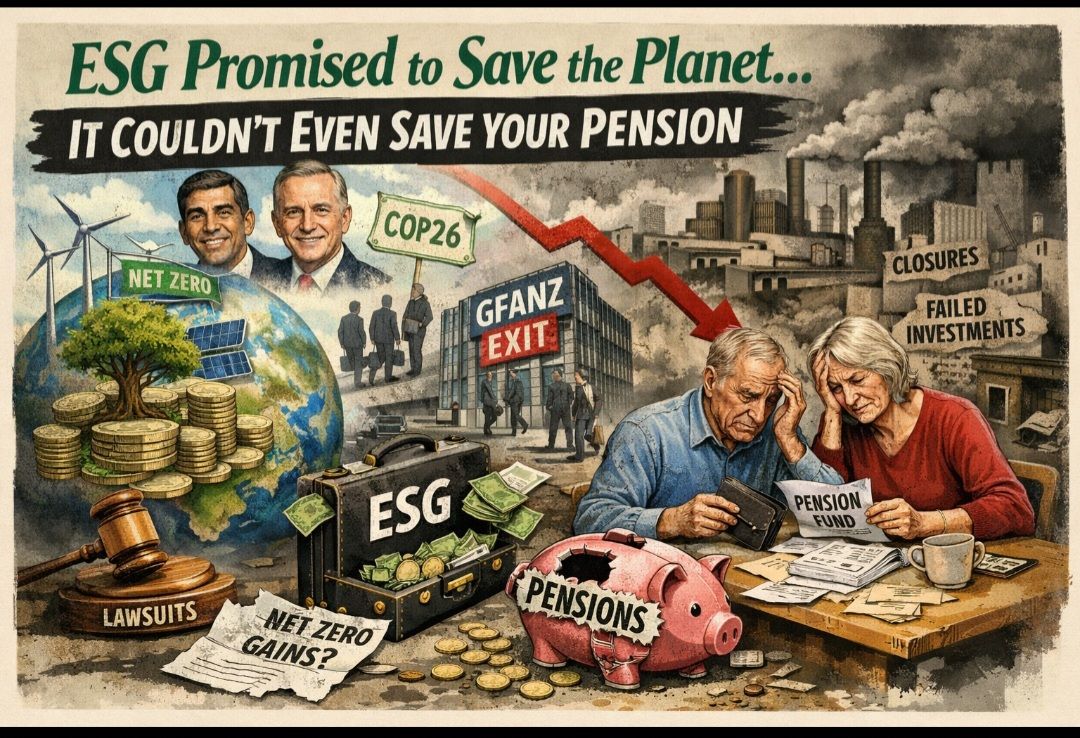
In November 2021, at COP26 in Glasgow, a remarkable claim was made. The financial system, we were told, had pivoted. Governments might legislate and regulate, but markets would deliver transformation. Through the Glasgow Financial Alliance for Net Zero, institutions managing some $130 trillion in assets had “aligned” behind Net Zero. Climate was now, in the words of Mark Carney, at the centre of every financial decision.
It sounded like a revolution. The plumbing of capitalism had been rewired. Capital would flow away from “brown” industries and toward “green” ones. Pension funds would become instruments of planetary repair. The private sector would do what politics alone could not.
Four years on, the revolution looks less like destiny and more like overreach.
The first cracks appeared not in political speeches but in academic analysis. Research reported in the Financial Times found that the European Union’s flagship sustainability regime , the Sustainable Finance Disclosure Regulation (SFDR) , did not meaningfully reduce the carbon intensity of investment funds, nor significantly increase capital flows to greener assets.[9] The regulatory machine expanded. Disclosures multiplied. Yet measurable emissions impact inside labelled funds barely shifted.
In plain terms: the label changed. The portfolio often did not.
This matters because Europe’s framework was the most ambitious attempt yet to embed ESG into the mechanics of finance.
If even that struggled to produce demonstrable transformation, then the claim that financial alignment alone could decarbonise the economy begins to wobble.
And wobble it did.
In January 2025, the world’s largest asset manager, BlackRock, exited the Net Zero Asset Managers initiative.[1][2] This was no fringe player. It was the central pillar of the ESG era. The departure was not accompanied by denunciation of climate concern. It was couched in the language of fiduciary duty and regulatory complexity. But the message was unmistakable:
coordinated climate finance had become politically and legally risky.
Within months, the tone shifted further. Commentary noted the cooling of Larry Fink’s previously evangelical rhetoric.[3] Meanwhile, shareholder litigation began to test the boundaries of climate coordination, including a Reuters-reported lawsuit alleging climate-related collusion and fiduciary breach.[4] Whether such claims ultimately prevail is secondary to the signal they send. ESG was no longer a consensus virtue. It was a contested legal terrain.
Then, on 3 October 2025, the Net-Zero Banking Alliance , the flagship banking coalition born at COP26 , ceased operations.[5][6][7] Banks voted. The structure dissolved.
The grand climate finance orchestra quietly packed away its instruments. An alliance once presented as the disciplined vanguard of global transformation ended not with defiance, but with administrative closure.
The symbolism was profound. If private finance was to save the planet through voluntary alignment, the most visible mechanism for that alignment had just folded.
And almost immediately afterwards, Bill Gates publicly called for a strategic “pivot” in climate policy , urging greater focus on adaptation and practical welfare over singular obsession with temperature targets.[8] Again, not a renunciation. But a recalibration. A recognition that the rhetoric of seamless, market-driven salvation had outrun deliverability.
The timeline is stark. BlackRock recalibrates. Carney’s banking alliance collapses. Gates pivots. The mood changes.
Yet in politics , particularly in Westminster , the insistence persists. Ed Miliband continues to advocate accelerated decarbonisation and compressed timelines.
Clean power targets remain politically sacrosanct. The argument is that the transition must intensify, not pause.
This is where tension accumulates , between financial realism and political urgency.
ESG was built on an assumption that capital allocation could reshape the physical economy at speed. That if enough asset managers refused to fund carbon-intensive activity and instead redirected flows toward renewables and clean technologies, industry would pivot accordingly.
But finance does not override physics.
Energy systems depend on steel, silicon, copper and transformers with multi-year lead times. Grids require reinforcement before capacity can connect. Storage technologies face duration constraints. Supply chains for key components remain geopolitically concentrated.
A taxonomy cannot accelerate transformer manufacture. A disclosure regime does not shorten planning consent timelines. A summit declaration does not build a substation.
If policy compresses timelines beyond industrial capacity, valuations are built on hope rather than engineering.
And this is where pensions enter the frame.
Most savers did not opt into ESG as activists. They encountered it through default pension allocations, trustee guidance and regulatory expectation. Climate risk was framed as financial risk , and therefore prudent stewardship required Net Zero alignment.
There is truth in that argument. Climate change creates transition risk. But there is also risk in assuming that policy ambition equates to industrial feasibility.
If assets are priced for rapid transition but infrastructure lags, repricing follows.
When repricing follows, pension performance absorbs the shock.
Pensions are not campaign tools. They are deferred wages. They represent decades of labour converted into long-term capital. When they are entangled in policy narratives that outrun delivery capacity, exposure increases.
The deeper flaw of ESG was philosophical. It assumed that coordinated moral signalling within competitive markets could be sustained indefinitely. For ESG to meaningfully shift capital, major institutions needed to act together. But coordination in competitive systems is inherently unstable. If one firm defects and prioritises return, it gains advantage. Once legal or political risk attaches to coordination, discipline erodes.
That erosion is precisely what occurred.
The moment climate finance alliances became litigation risk, enthusiasm cooled. The moment political consensus fractured, voluntary alignment became optional.
The revolution turned out to be conditional.
None of this negates environmental responsibility. Long-term investors must account for transition risk. Serious governments must plan for decarbonisation. But there is a difference between prudent risk management and elevating financial branding into an industrial strategy.
Europe’s broader economic context sharpens the critique. Growth has lagged the United States. Energy-intensive sectors have struggled with high costs. Industrial competitiveness has eroded. ESG was presented as part of a new growth model , capital-led, innovation-driven, morally anchored.
Yet labelling funds does not restore competitiveness. Industrial revival requires affordable energy, secure supply chains and delivery capability.
Financial alignment cannot substitute for structural advantage.
The danger now is not simply that ESG underdelivered. It is that confidence erodes.
Pension systems depend on trust. Savers accept long-term illiquidity because they believe fiduciary duty comes first. If investment allocation appears influenced more by political fashion than by disciplined return analysis, trust weakens.
And weakened trust is expensive.
When leaders proclaimed that $130 trillion had been mobilised, they were not lying. But they were conflating alignment statements with capital deployment.
Alignment is not allocation. Declarations are not delivery.
Markets cannot be browbeaten into prosperity.
Physics cannot be subordinated to disclosure frameworks.
Capital can finance infrastructure , but it cannot conjure it.
If ESG had demonstrably reduced emissions inside labelled funds and delivered consistent risk-adjusted outperformance, it would not require summit choreography or regulatory scaffolding. It would speak through returns.
Instead, it required narrative reinforcement.
And narratives fade.
BlackRock recalibrated. The Net-Zero Banking Alliance closed. Gates pivoted toward realism. Meanwhile, political momentum pushes ahead, compressing timelines and raising expectations.
That divergence , between market caution and policy acceleration , is where risk accumulates.
ESG promised to save the planet.
It has yet to prove it could meaningfully decarbonise the funds that carried its name.
If, in the process, it introduced valuation risk tied to compressed political timelines and fragile coordination, history may not record it as visionary capitalism. It may record it as a cautionary experiment in moralised finance , one in which rhetoric outran industrial reality.
And when rhetoric outruns reality in capital markets, the applause fades quickly.
But pension deficits linger for decades.
Footnotes
[1] Reuters, “BlackRock quits climate group as Wall Street lowers environmental commitments,” 9 January 2025.
[2] IPE, “BlackRock exits climate alliance,” 10 January 2025.
[3] Forbes, “In Annual Letter, BlackRock’s Larry Fink Omits Climate Change and ESG,” 31 March 2025.
[4] Reuters, “BlackRock execs hit with investor lawsuit over alleged climate collusion,” 10 February 2026.
[5] Financial Times, “Global banking climate alliance folds four years after launch,” October 2025.
[6] The Banker, “Climate alliance NZBA disbands,” 3 October 2025.
[7] The Guardian, “Banking industry’s net zero alliance shuts down,” 3 October 2025.
[8] Reuters, “Bill Gates calls for climate strategy pivot ahead of COP30,” 28 October 2025.
[9] Financial Times reporting on academic research assessing EU SFDR impact, 2026.
 SAY NO TO THE DESTRUCTION OF OUR LAND
Leave a comment