As ministers accelerate the largest expansion of solar farms in British history, a deeper question is emerging: can a country that already imports nearly half its food afford to industrialise its farmland for power that is weakest when demand is highest?
Britain’s energy transition is quietly becoming a land-use revolution and the trade-offs are no longer theoretical.
Britain is quietly making one of the most consequential land-use decisions in its modern history and almost no one is debating it honestly.
In the name of clean energy, we are beginning to cover some of the country’s most productive farmland with solar panels at a scale that would have been unimaginable just a decade ago. The latest renewables auction alone approved 157 new solar projects delivering around 4.9GW of capacity, with schemes stretching across England, Scotland and Wales and due to come online by the end of the decade.
Ministers call this progress. Many farmers call it something else entirely.
Because once you strip away the press releases and the rhetoric about “home-grown power”, a stark question emerges: what happens when a country that already imports roughly 40–45% of its food starts permanently removing its best agricultural land from production?
This is not a marginal issue. It is a structural shift.
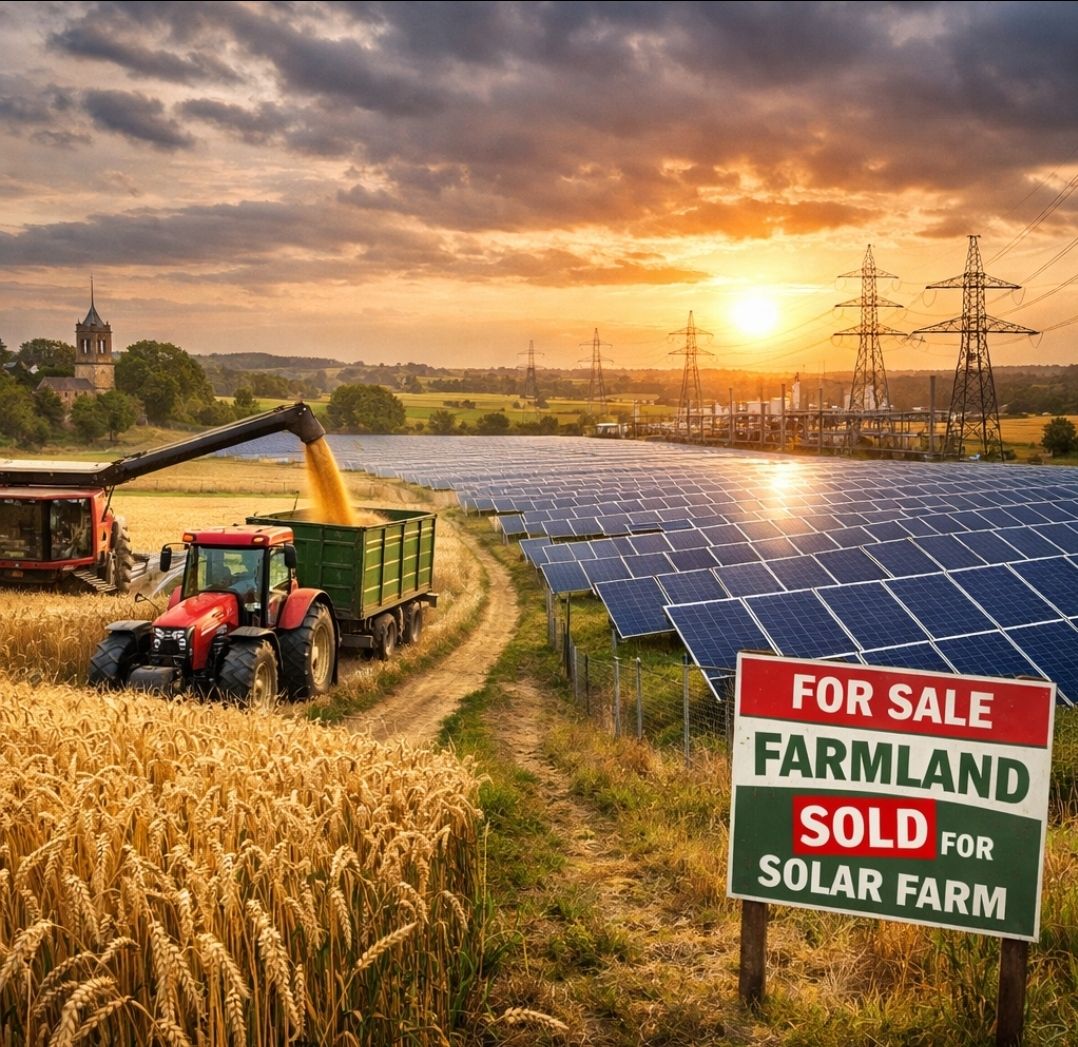
Solar farms are typically consented for 30 to 40 years , a timeframe that in farming terms is effectively permanent. Fields are fenced, drainage patterns altered, soil structure disrupted and farm systems fragmented. While developers speak of reversibility, anyone who understands land knows that agricultural continuity, once broken, is not easily restored.
And the scale is accelerating rapidly. Campaigners and rural groups estimate that the latest wave of solar could consume thousands of hectares of agricultural land , with some projects alone covering hundreds of hectares. The controversial West Burton scheme on prime Lincolnshire-Nottinghamshire farmland is only one example of a trend that is becoming national in scope.
Yet the deeper problem is not simply land use. It is strategic coherence , or rather the lack of it.
Britain’s energy debate has shifted dramatically in the past two years. Government and industry now openly acknowledge that the future economy. From AI and data centres to electrified transport and heavy industry , will require enormous amounts of reliable, round-the-clock power. The language has changed. We hear talk of a “golden age of nuclear” and renewed emphasis on firm generation.
But if firm, high-density power is essential, why are we simultaneously industrialising the countryside with one of the lowest-density energy sources available?
Solar in the UK produces on average roughly 10–11% of its nameplate capacity annually, and far less during winter, when electricity demand peaks. In other words, it delivers the least power precisely when the country needs energy the most.
This means that even as farmland is covered with panels, Britain must still build and pay for , parallel systems of firm generation and grid reinforcement to keep the lights on through cold, still winter weeks. The result is not replacement but duplication, with costs ultimately borne by consumers.
It is difficult to think of another area of national infrastructure where such a contradiction would be tolerated.
The official argument is that solar is cheap and quick to deploy. But cheap compared to what? Once grid upgrades, balancing costs, constraint payments and backup capacity are included, the picture becomes far more complex. What appears inexpensive at the project level can become costly at the system level.
Meanwhile, the land trade-off is immediate and visible.
Britain is not a vast country with abundant spare land. It is a densely populated island with competing demands for housing, nature recovery, infrastructure and agriculture. Treating farmland as if it were simply vacant industrial space reflects a profound misunderstanding of both rural economies and national resilience.
Food security is no longer an abstract concern. The past five years have shown how quickly global supply chains can be disrupted by war, climate shocks and geopolitical tensions. Reducing domestic productive capacity in this context is not a trivial policy choice , it is a strategic gamble.
Even organisations supportive of renewable energy acknowledge the issue. The Campaign to Protect Rural England has repeatedly argued that rooftops, warehouses, car parks and brownfield land could host vast amounts of solar without sacrificing productive farmland. The fact that these options remain underused suggests that the current pattern of development is driven more by planning convenience than national strategy.
For rural communities, the transformation is already tangible. Solar farms do not arrive alone. They bring substations, access roads, security fencing and often new transmission infrastructure. What is presented as green energy can feel, on the ground, like industrialisation by stealth.
This helps explain the growing political backlash. Farmers think in generations, not electoral cycles. Land is not simply an asset but a legacy. When policies appear to treat it as expendable, resistance is inevitable.
None of this is an argument against renewable energy. It is an argument for priorities.
A rational land-use hierarchy would place solar first on rooftops and the built environment, then on brownfield and low-grade land, and only as a last resort on productive farmland. Such a framework would align energy policy with food security rather than forcing a trade-off between the two.
At present, that hierarchy is largely absent.
Instead, Britain risks drifting into a situation where it pursues two incompatible visions at once: a high-tech, electrified economy that requires vast amounts of reliable power, and a land-intensive generation strategy that delivers power intermittently while consuming space needed for other national priorities.
Eventually, reality will force a choice.
Because land, like energy, is finite. A country cannot indefinitely spread low-density infrastructure across its countryside without consequence, nor can it pretend that surrendering productive land is cost-free in a world growing more volatile by the year.
A serious nation does not sleepwalk into strategic vulnerability. It does not confuse activity with strategy, or targets with outcomes. And it does not sacrifice its capacity to feed itself in pursuit of policies that still require entirely separate systems to keep the lights on.
Because once productive land is lost, it is rarely recovered. Once landscapes are industrialised, they are seldom restored. And once a nation becomes more dependent on imported food, reversing that dependence is neither quick nor easy.
History rarely judges harshly those who confront difficult realities. It is far less forgiving of those who ignored them while there was still time.
Britain must decide what kind of country it intends to be. One that builds its future on resilient foundations, or one that gradually trades them away, acre by acre, until the consequences can no longer be ignored.
That choice is coming, whether we acknowledge it or not.
 SAY NO TO THE DESTRUCTION OF OUR LAND
Leave a comment