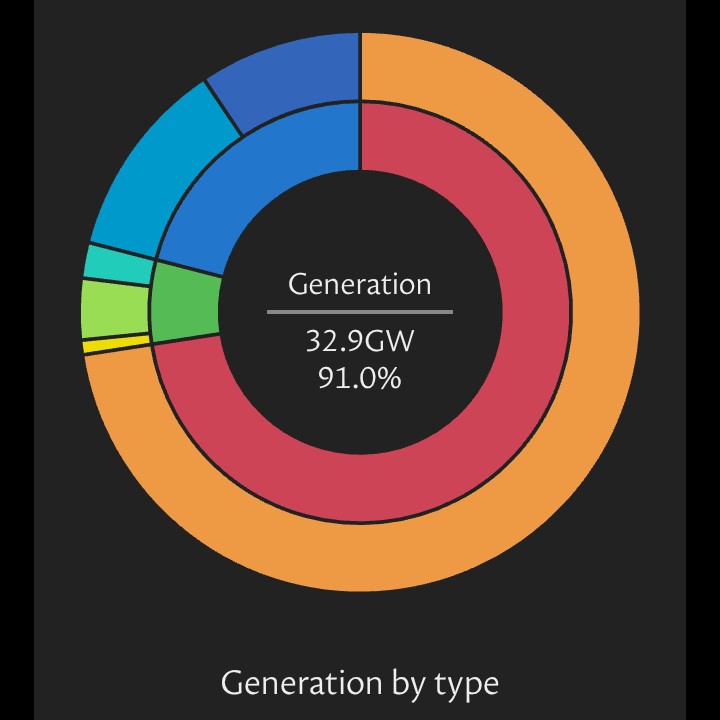
A solar farm approved into a grid known to be constrained , because targets now matter more than truth.
🧨 Opening anecdote
Talk to any grid engineer not a politician, not a policy adviser and they’ll tell you the same thing: electricity systems don’t run on slogans.
They run on physics.
They watch flows, frequency, constraints, and margins in real time, knowing that if the balance is wrong, the consequences are immediate.
Now imagine their reaction when a major new power station is approved into a part of the network already known to be constrained for years to come , without proving it can actually deliver usable electricity.
That is exactly what the Fenwick decision represents.
And it is the inevitable result of a system now driven by ideology rather than engineering.
⚠️ A Decision That Ignores Reality
The approval of Fenwick Solar Farm is not just another planning decision. It is a case study in how Britain’s energy policy has drifted away from common sense.
The project has been granted consent even though the detailed grid connection process will only begin after approval.
In plain English:
Permission first. Reality later.
This is the opposite of responsible infrastructure planning.
🔌 The Thorpe Marsh Constraint. The Elephant in the Room
Fenwick depends on connecting into the Thorpe Marsh corridor , a part of the network widely understood to be constrained until roughly 2031–2033, according to Northern Powergrid Appendix G and National Grid transmission data.
That means any new generation connecting here faces years of constraint risk.
But instead of confronting this reality, the decision simply assumes the power will be useful.
It is a triumph of wishful thinking over system truth.
🧠 Miliband’s Ideology Over Engineering
This decision sits squarely within the political framework created by Ed Miliband’s Clean Power 2030 agenda , a strategy built on the belief that more renewable capacity automatically equals progress.
But electricity systems do not reward belief. They reward balance.
The Fenwick decision shows how policy has shifted from asking:
👉 Does this project work within the system?
to
👉 Does this project help meet the target?
That is not planning. That is target chasing.
📊 The Carbon Accounting Mirage
The decision leans heavily on projected carbon savings, calculated against fossil fuel baselines.
But this assumes every unit of solar generation displaces fossil fuel power — an assumption that becomes increasingly detached from reality in constrained areas where electricity may be curtailed or generated when demand is low.
The numbers look impressive on paper.
But paper doesn’t run the grid.
⚖️ When “Need” Becomes a Political Shield
Throughout the decision, the project’s contribution to low-carbon generation is given overwhelming weight.
This reveals how the planning balance is now framed: once a project aligns with Net Zero targets, the conclusion is almost inevitable.
Local impacts, farmland loss, landscape damage, and system constraints are acknowledged , but they are treated as obstacles to be managed rather than reasons to pause.
Policy trumps evidence.
🏛️ A System That Socialises Risk
One of the most troubling aspects of the decision is the implicit assumption that the grid will adapt to accommodate new generation.
But grid reinforcements are not free.
They are paid for by consumers through higher bills, constraint payments, and system balancing costs.
Developers receive consent.
The public carries the risk.
🌾 The Question No One Wanted to Ask
Lost amid the technical language is the most basic question of all:
Will this project reliably deliver electricity when Britain actually needs it?
The decision never properly answers this , because under the current policy framework, the answer is almost beside the point.
Generation capacity is treated as success in itself, regardless of whether it improves system performance.
🔍 What Fenwick Really Reveals
Fenwick is not an anomaly. It is a symptom of a deeper problem.
Britain’s energy planning system now operates on a series of assumptions:
Policy alignment equals merit.
Carbon modelling equals benefit.
Connection agreements equal feasibility.
But none of these assumptions guarantee real-world value.
🧾 The Cost of Ideological Planning
When projects are approved without proving system benefit, the consequences are predictable:
More infrastructure in the wrong places
More constraints
Higher system costs
Greater complexity
All ultimately funded by households and businesses.
This is not a rational energy strategy. It is expansion driven by political ambition rather than operational need.
🧨 Conclusion. Physics Will Have the Final Say
The Fenwick decision should be a wake-up call.
Approving major generation into a constrained corridor years before reinforcements arrive shows how far decision-making has drifted from engineering reality.
Ed Miliband’s Clean Power vision may promise transformation, but without grounding in system physics it risks creating an electricity system that is more expensive, more fragile, and less efficient.
Targets do not generate electricity.
Ideology does not balance the grid.
Physics always wins in the end.
Shane Oxer. Campaigner for fairer and affordable energy
 SAY NO TO THE DESTRUCTION OF OUR LAND
Leave a comment