Evidence that the wires can’t match the rhetoric
Executive summary
On a floodplain near Doncaster, the reality of the UK’s energy transition becomes a physical question: can the electricity actually move through the network?
In the Thorpe Marsh corridor, official network data indicates the answer is not yet.
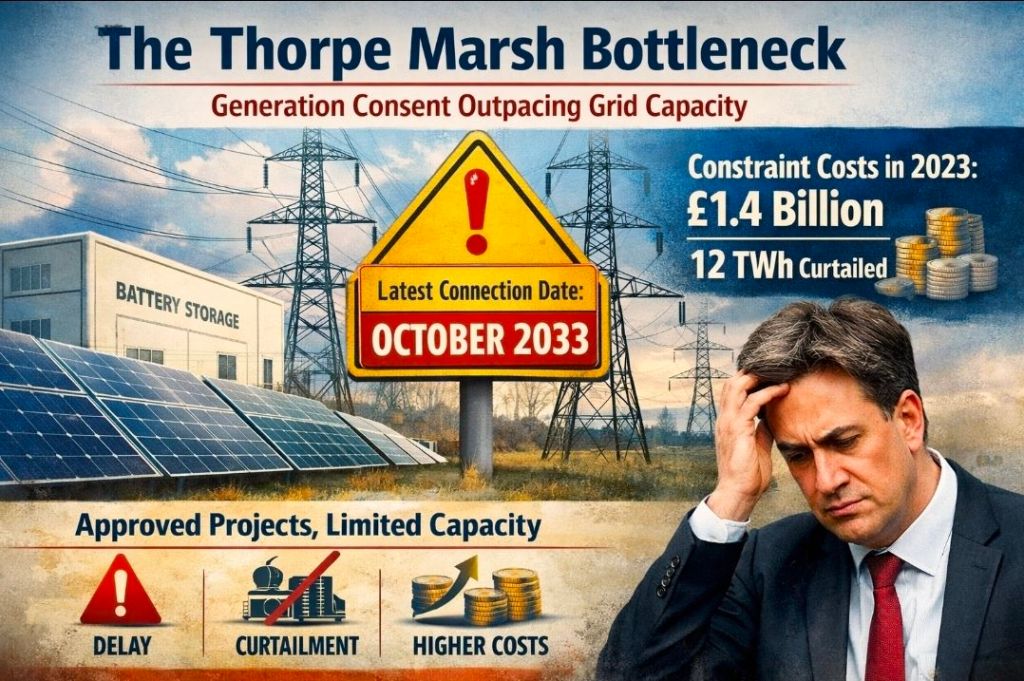
Northern Powergrid’s Appendix G shows the West Melton / Thorpe Marsh node with a latest connection date of October 2033, providing a clear “grid reality check” based on contracted positions and required reinforcements. �
The Thorpe Marsh Bottleneck.docx None
At the same time, national evidence shows the financial consequences of network congestion are already material. Parliamentary data records around £1.4 billion in constraint costs in 2023, with approximately 12TWh of balancing actions used to manage system constraints. �
The Thorpe Marsh Bottleneck.docx None
The February 2026 consent for Fenwick Solar illustrates the policy tension: the decision acknowledges that National Grid optioneering will begin after consent is granted, demonstrating a sequencing approach where planning approval precedes confirmed network deliverability. �
The Thorpe Marsh Bottleneck.docx None
Taken together, these sources support a central thesis:
Planning decisions are consenting megawatts without securing the pathway for those megawatts to flow.
https://petition.parliament.uk/petitions/756685
Network anatomy
The Thorpe Marsh corridor operates as a layered system with different operators and responsibilities:
National Grid Electricity Transmission owns and maintains the high-voltage transmission assets.
National Energy System Operator manages system planning, queues, and balancing.
Northern Powergrid operates the distribution network and publishes Appendix G contracted position data.
Fenwick’s grid connection statement confirms export via 400kV cables to Thorpe Marsh, with works inside the connection bay undertaken by National Grid. �
The Thorpe Marsh Bottleneck.docx None
This structure allows a situation where:
Planning consent can be granted before reinforcements are delivered
Connection offers can exist despite operational constraints
Congestion costs are socialised to consumers
Projects clustering around the corridor
The area is attractive to developers due to historic grid strength and existing infrastructure, resulting in significant clustering of projects.
Key examples include:
Fenwick Solar Farm – up to 237.5MW with connection to Thorpe Marsh
Thorpe Marsh BESS – approximately 1,400MW / 3,100MWh storage
Developer-promoted “green energy hub” concept leveraging existing grid capacity
Concentrating large export and import capability behind known constraints increases the probability of curtailment and redispatch before reinforcements are completed. �
The constraint evidence
Northern Powergrid’s Appendix G provides the most concrete deliverability indicator.
Key entries show:
West Melton / Thorpe Marsh – latest connection date October 2033
West Melton 3 – October 2033
Keadby – October 2034
Thurcroft – October 2034
Drax – October 2029
This demonstrates that a significant portion of contracted capacity sits behind known constraints, with relief dates extending into the early 2030s. �
The Thorpe Marsh Bottleneck.docx None
The implication is clear:
The constraint is embedded in official network planning, not speculative commentary.
Transmission reinforcements
Transmission planning documents identify multiple interventions required to increase transfer capability, including:
Power flow control devices between Thorpe Marsh and West Melton (target around 2030)
Thorpe Marsh substation reconfiguration (around 2032)
Corridor reconductoring including Brinsworth–Thorpe Marsh (around 2032)
These milestones cluster between 2030 and 2033, aligning with the Appendix G connection dates. �
Curtailment and consumer cost risk
Ofgem states that where the network cannot carry generated electricity, consumers effectively pay generators to reduce output.
National balancing costs and constraint payments demonstrate that congestion is already a material system cost. �
The Thorpe Marsh Bottleneck.docx None
Until reinforcements are complete, additional generation behind constraints increases the likelihood of:
Curtailment
Redispatch
Higher balancing costs
What the Fenwick decision demonstrates
The Fenwick consent highlights the policy sequencing issue.
The decision notes:
Grid optioneering will begin after consent
Multiple connection options were considered
Substantial weight was given to national need
This illustrates how policy urgency can outweigh network deliverability considerations at the planning stage. �
Key conclusion
The Thorpe Marsh corridor demonstrates a structural issue in the UK energy transition:
Generation is being consented faster than the network can accommodate it.
Official network data indicates the corridor remains constrained until at least October 2033, while national evidence shows congestion already carries significant consumer cost.
This is not an argument against decarbonisation. It is an argument for aligning planning decisions with demonstrable grid deliverability.
Recommended policy test
Introduce a mandatory grid deliverability statement for major energy consents requiring publication of:
Relevant Appendix G latest connection dates
Transmission reinforcement milestones
Expected constraint exposure
Such transparency would allow decision-makers and the public to assess whether approved capacity can realistically deliver system benefit within policy timelines.
https://petition.parliament.uk/petitions/756685
Shane Oxer. Campaigner for fairer and affordable energy
 SAY NO TO THE DESTRUCTION OF OUR LAND
Leave a comment