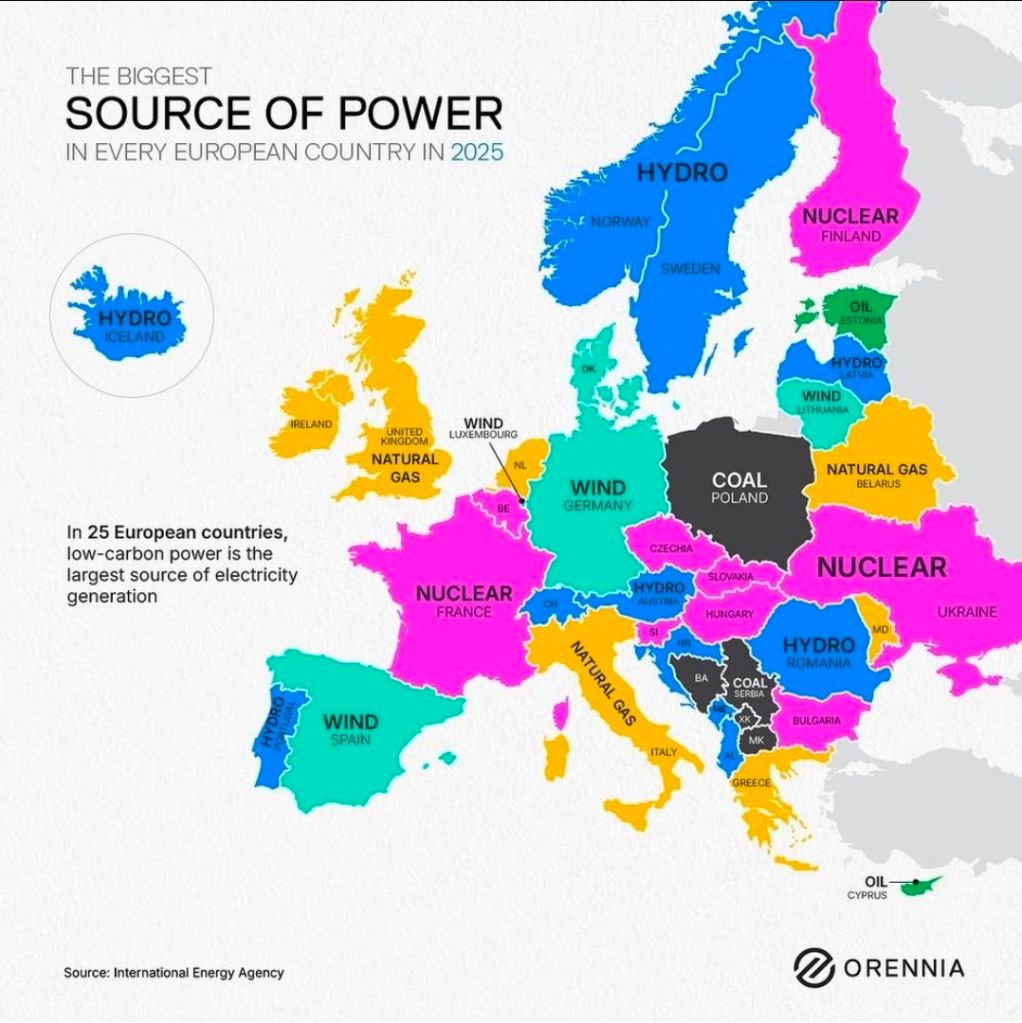
A simple map has been circulating this week showing the largest source of electricity generation in each European country in 2025. For Britain, the answer is not wind. It is not solar. It is natural gas.
After 17 years of climate legislation, subsidy schemes and renewable expansion, gas remains the single biggest source of UK electricity generation.[1][2]
That is not a political talking point. It is an engineering reality.
Since the Climate Change Act of 2008, Britain has transformed its generation mix. Coal has all but vanished. Offshore wind capacity has surged from negligible levels to more than 30 gigawatts.[3] Solar has expanded from near-zero to over 15 gigawatts installed.[4] Contracts for Difference auctions have channelled billions into renewable infrastructure.
And yet, when the annual generation totals are counted, gas still leads.[2]
Why?
Because electricity systems are not built around averages. They are built around worst-case scenarios.
The central weakness of wind and solar is not that they never generate power. On some days, wind provides more than half of Britain’s electricity. The weakness is that they generate when weather allows, not when demand requires.
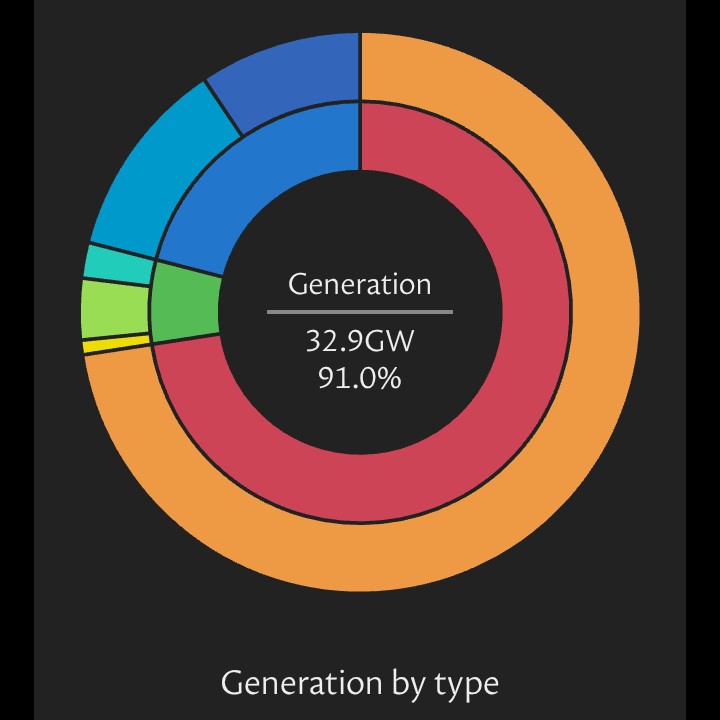
Take solar first. In summer, solar output can look impressive. In winter, it collapses. UK solar capacity factors in December and January typically fall into the low single digits , often between 3 and 6 per cent.[5] Output is zero during the evening peak, precisely when national demand surges as households switch on heating, lighting and appliances.[6]
Britain’s highest electricity demand occurs on cold, dark winter evenings between roughly 4pm and 7pm.[6] At that moment, solar contributes nothing. The system must rely on something else.
Wind performs better in winter overall, but it too is governed by meteorology, not mechanics. Offshore wind capacity factors average around 35–45 per cent annually; onshore wind averages lower.[7] Those figures, however, disguise volatility. During winter high-pressure systems. The very conditions that often bring freezing temperatures , wind output can drop sharply for days at a time.[8]
The grid cannot be designed around the average windy day in April. It must survive the still, frozen week in January.
When wind and solar falter, gas fills the gap.
Gas turbines do more than produce electricity. Combined Cycle Gas Turbines can ramp up rapidly, respond to sudden demand changes and provide essential frequency stability and inertia to the grid.[9] Britain’s electricity system was designed around large synchronous generators that inherently stabilise voltage and frequency. As coal and nuclear stations retire, those stabilising services must come from somewhere. Increasingly, they come from gas , or from expensive compensating equipment designed to mimic what gas plants do naturally.
This is the part of the energy debate rarely discussed. Wind and solar are variable. Stability is not.
Advocates argue that storage will resolve the mismatch. But scale matters. Most grid-scale batteries currently deployed in Britain provide between one and four hours of storage duration.[10] They are highly effective at smoothing short-term fluctuations. They are not capable of sustaining tens of gigawatts of demand through a multi-day winter wind drought.
To replace gas entirely, Britain would require long-duration storage measured in days or even weeks of national demand. That infrastructure does not yet exist at anything approaching the necessary scale.
Until it does, gas remains the guarantor of supply.
This is not to deny that renewables have grown, nor that they reduce fuel consumption when conditions are favourable. Gas usage has fallen compared with the early 2010s. Emissions from the power sector have declined substantially.[2] Those are real achievements.
But the idea that Britain has “moved beyond gas” is fiction.
The uncomfortable truth is that after nearly two decades of investment and policy intervention, the UK electricity system still depends on gas for reliability. When demand peaks and weather disappoints, it is gas that prevents blackouts.
This is not a failure of ambition. It is a consequence of physics.
Electricity demand is highly seasonal in Britain. Solar output is highly seasonal in the opposite direction. Wind is inherently variable. The more intermittent generation we add, the greater the requirement for flexible backup. Remove too much dispatchable capacity too quickly, and the system becomes fragile.
There is a broader lesson here. Energy transitions are not slogans. They are infrastructure projects governed by engineering constraints. Policymakers may legislate targets. They cannot legislate the wind to blow during an anticyclone, nor the sun to shine at 6pm in January.
Gas, for now, remains the backbone because it is the only large-scale, flexible, dispatchable technology available at sufficient scale to balance Britain’s grid hour by hour.
The choice facing the country is not between renewables and gas in some abstract moral contest. It is between realism and illusion.
Realism recognises that reliability must come first. It accepts that backup capacity is not optional but fundamental. It understands that decarbonisation without firm generation simply transfers risk into the system.
Illusion assumes that nameplate capacity equals deliverable power, that averages equal guarantees, and that storage promises equal operational readiness.
Britain has already learned what happens when energy policy drifts too far from engineering fundamentals: volatility, vulnerability and spiralling system complexity.
If we are serious about keeping the lights on through the coldest nights of winter, we must start from first principles. Until long-duration storage exists at scale , or firm alternatives such as new nuclear are delivered in meaningful volume , gas will remain central to grid security.
We can pretend otherwise. But the data, and the physics, say the same thing.
When Britain’s system is under strain , when it is dark, cold and still , it is not solar panels or offshore turbines that stand between supply and blackout.
IT IS GAS
References
[1] International Energy Agency (IEA), Electricity generation data, 2024–2025.
[2] UK Department for Energy Security and Net Zero (DESNZ), Energy Trends: UK electricity generation statistics.
[3] DESNZ Renewable Energy Planning Database, installed offshore wind capacity growth since 2008.
[4] DESNZ Renewable Energy Planning Database, UK solar PV capacity statistics.
[5] National Grid ESO historical solar load factor data (winter averages).
[6] National Grid ESO, Winter Outlook and peak demand statistics.
[7] RenewableUK and DESNZ wind capacity factor data.
[8] National Grid ESO system reports during low-wind winter events (e.g. 2022–2023).
[9] National Grid ESO, Operability Strategy Report (frequency and inertia requirements).
[10] Ofgem and National Grid ESO data on UK battery storage duration profiles.
Shane Oxer. Campaigner for fairer and affordable energy
 SAY NO TO THE DESTRUCTION OF OUR LAND
Leave a comment