For generations the British countryside has been part of our national identity. It feeds us, sustains wildlife, shapes our landscapes and communities, and provides millions of people with a sense of peace and belonging that modern life often struggles to offer.
But across the country something profound is happening.
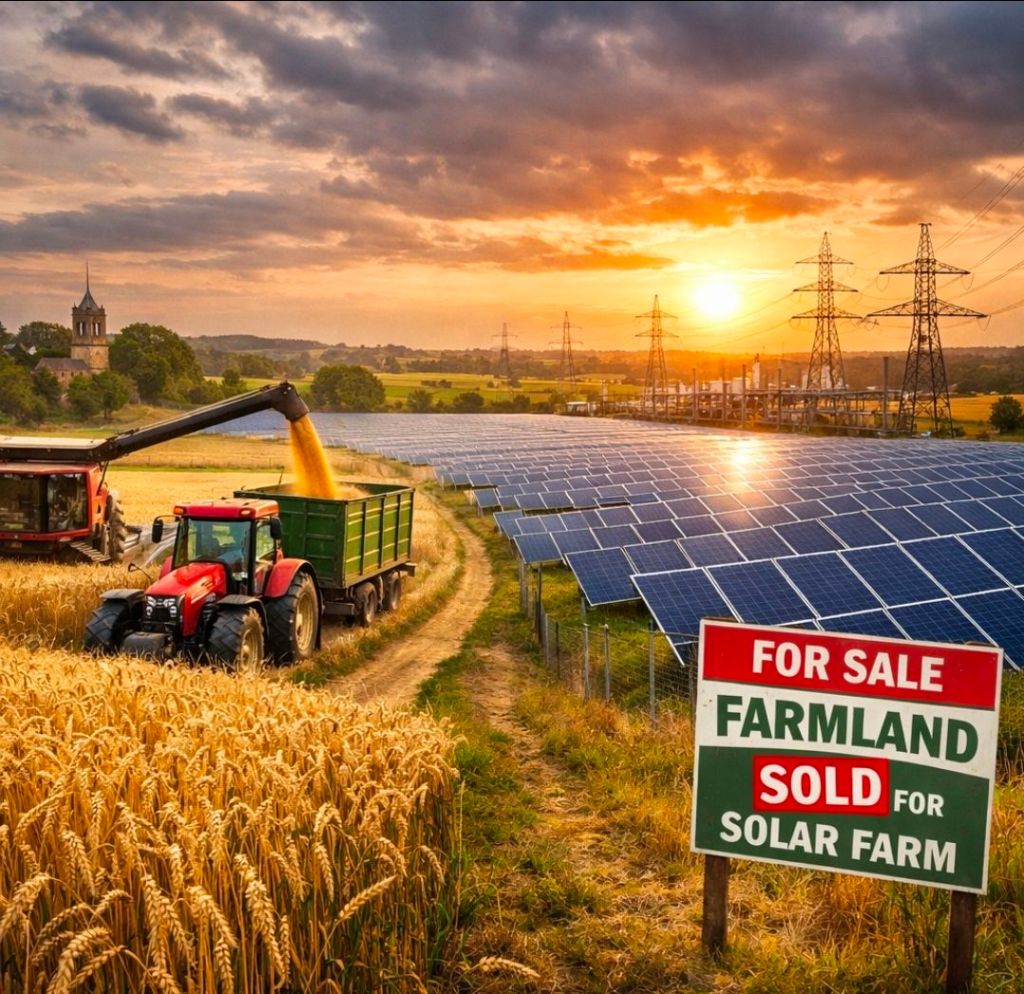
Large areas of farmland and open countryside are increasingly being targeted for vast energy developments , industrial-scale solar farms, battery storage facilities and the new infrastructure needed to support them. Villages that have been surrounded by fields for centuries are suddenly facing proposals to cover thousands of acres with solar panels, substations and grid infrastructure.
Many people instinctively feel something is wrong, yet the wider public has rarely been told the real reason this is happening.
To understand why the countryside is now under pressure, we must first understand how Britain’s energy system used to work and why it is changing so rapidly.
A System That Once Worked
For most of the twentieth century Britain’s electricity system was carefully designed around a simple principle: reliability.
The national grid was built to connect a relatively small number of large power stations , coal, gas and nuclear plants to towns and cities across the country. These stations used large spinning turbines known as synchronous generators. They produced stable electricity continuously and provided the physical inertia that keeps the electricity system stable.
This system was coordinated nationally through organisations such as the Central Electricity Generating Board, which planned the location of power stations and grid infrastructure decades in advance.
The result was a highly reliable electricity system that required relatively little land. A single large power station could generate the same electricity as hundreds of smaller installations scattered across the countryside.
In short, Britain produced vast amounts of energy while leaving most of its countryside untouched.
The Shift to Dispersed Energy
Over the past two decades that system has begun to change.
New energy technologies such as wind and solar generate electricity differently. Instead of large synchronous turbines connected directly to the grid, they produce electricity through electronic inverters and depend on weather conditions.
This means they generate electricity intermittently and often require far larger areas of land to produce the same level of power.
A single large solar development can cover hundreds or even thousands of acres. When multiplied across the country, the land requirements become enormous.
What was once a system based on a few concentrated generation sites is becoming a system based on thousands of dispersed installations.
This is one of the main reasons farmland and open countryside are increasingly being targeted for energy projects.
The Seasonal Problem
There is another complication that is rarely discussed.
In Britain, electricity demand peaks in winter when heating, lighting and industrial activity are highest. Solar generation, however, reaches its maximum output in summer when the days are longer and the sun is stronger.
In winter , when the country needs electricity the most , solar generation can fall dramatically.
This mismatch means solar farms alone cannot provide the consistent power needed to run an advanced economy. Instead, the grid must rely on other forms of generation or complex balancing mechanisms to maintain stability.
The engineers responsible for running the electricity system understand this challenge well, yet the wider public rarely hears about it.
A Grid That Has Been Neglected
Perhaps the most important factor behind the expansion of energy infrastructure into rural areas is the condition of the grid itself.
Britain’s national electricity network is one of the most sophisticated engineering systems ever built, much of it constructed between the 1950s and 1980s. But in many areas it has not been upgraded at the pace required to support new forms of generation.
Modern energy technologies are often built far from the traditional power station locations that the grid was designed to serve. As a result, new substations, transmission lines and infrastructure are required to move electricity from dispersed generation sites to where it is actually needed.
Because upgrading the grid can take many years, developers frequently search for large areas of land near existing substations where they can connect quickly. That land is often farmland or open countryside.
In many cases the countryside is not being targeted because it is the best place to generate electricity , but because it is the easiest place to connect to an overstretched grid.
Why National Resilience Matters
All of this raises a deeper issue: national resilience.
In an increasingly uncertain world, the ability of a country to feed itself and power its economy is becoming strategically important once again.
Global supply chains that once seemed stable are now exposed to geopolitical tension, conflict and economic disruption. Food security and energy security are no longer abstract policy concepts they are fundamental components of national resilience.
Farmland is therefore more than simply land that can be developed. It is a national asset that supports food production and rural economies.
The countryside also provides environmental stability, helping to manage flooding, preserve biodiversity and maintain landscapes that have evolved over centuries.
Losing large areas of agricultural land to industrial energy development raises important questions about long-term national priorities.
The Importance of Grid Stability
Another issue rarely discussed outside engineering circles is the role of synchronous generation in maintaining grid stability.
Traditional power stations contain massive rotating turbines that provide inertia , a physical stabilising force within the electricity system. This inertia helps prevent sudden frequency changes that can destabilise the grid.
As more generation comes from inverter-based technologies such as solar and wind, maintaining that stability becomes more complex. Grid operators increasingly rely on additional technologies such as synchronous condensers and stabilisation systems to replicate the stabilising effects that large power stations once provided naturally.
This does not mean renewable technologies have no role to play in the energy system. But it does mean that reliable, stable generation remains essential to maintaining a secure electricity network.
A Question of Planning
The fundamental issue is not simply whether the country uses renewable energy or traditional generation. It is whether the system is being planned strategically.
Energy systems work best when infrastructure is developed in the correct order:
First, the grid must be strengthened.Second, reliable generation must ensure stability.Third, additional technologies can be integrated where they make sense.
When that order is reversed, the system can become fragmented and inefficient, with infrastructure spreading across large areas of land without delivering the resilience the country actually needs.
A More Balanced Path
Britain does not need to industrialise vast areas of its countryside in order to maintain a secure energy future.
A more balanced approach could include:
strengthening and modernising the national grid
prioritising reliable synchronous generation such as nuclear and gas
placing solar on rooftops, car parks and industrial land rather than prime farmland
investing in long-term infrastructure planning that treats energy security as a national priority
By focusing on resilience, infrastructure and intelligent land use, the country can meet its energy needs without sacrificing the landscapes that define it.
The Choice Ahead
The debate about energy is often presented as a simple choice between progress and resistance. In reality the question is far more complex.
It is about how Britain balances energy security, food security and environmental stewardship in an uncertain world.
The countryside is not an empty space waiting to be developed. It is a vital part of the nation’s resilience and identity.
If we lose it carelessly, we may one day realise that we sacrificed far more than fields and hedgerows.
We sacrificed part of the foundation that makes this country worth protecting.
Shane Oxer. Campaigner for fairer and affordable energy
 SAY NO TO THE DESTRUCTION OF OUR LAND
Leave a comment