The Marr Solar Farm saga in Doncaster has taken a troubling turn.
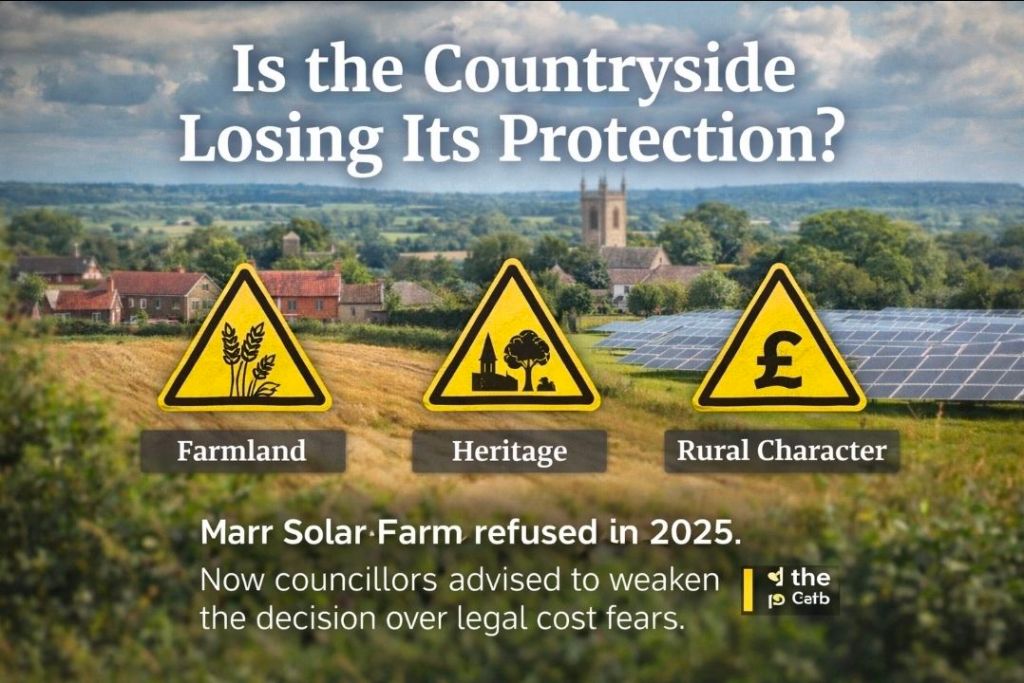
In December 2025, Doncaster Council’s Planning Committee refused a large ground-mounted solar farm proposed on agricultural land near Marr village. The refusal was not a close call or a technicality. Councillors rejected the scheme for clear planning reasons that many residents recognised immediately.
The council concluded that the development would:
• Harm the openness of the Green Belt
• Damage the rural landscape and the setting of Marr Conservation Area
• Remove productive agricultural land from use for around forty years.
These are not minor planning issues. They go to the heart of how planning law is supposed to protect the countryside, heritage assets and productive farmland.
Yet only months later the council is now being advised to weaken its own refusal.
Why the Council Is Being Advised to Step Back
The reason lies in a recent High Court judgment:
Wrotham Parish Council v Secretary of State for Housing, Communities and Local Government (2026).
Planning officers are warning councillors that defending the Green Belt refusal at appeal could expose the council to a significant costs award. Estimates mentioned in the council report suggest that the financial risk could reach hundreds of thousands of pounds.
No council wants to face that prospect.
As a result, councillors are now being advised to withdraw the Green Belt reason for refusal before the appeal even begins.
This is being presented as a necessary response to the High Court ruling.
But the situation is not nearly as straightforward as it is being portrayed.
What the Court Actually Said
The case centred on how the National Planning Policy Framework should interpret the concept of so-called “Grey Belt” land.
The court clarified that when determining whether land should be treated as Grey Belt, decision-makers must consider the impact of the specific development proposed, not hypothetical development.
This means planners must examine whether policies protecting important assets provide a strong reason to refuse the development.
Those policies include protections for:
• Conservation areas
• Listed buildings
• Important landscapes
• Flood risk areas
• Ecological sites
These protections are set out in Footnote 7 of the National Planning Policy Framework.
And this is where the Marr case becomes particularly interesting.
The Marr Proposal Directly Affects Protected Heritage Setting
The council’s own refusal decision states that the solar farm would harm:
• the setting of Marr Conservation Area
• nearby listed buildings
• the open rural character of the landscape
• the visual setting of Marr Grange Farm Shop and Tea Rooms.
These impacts fall squarely within the heritage and landscape protections referenced in national planning policy.
In other words, the very policy tests discussed by the High Court are already triggered by the Marr proposal.
This raises an obvious question.
If the development harms the setting of a conservation area and nearby heritage assets, does that not itself provide a strong reason to refuse it?
If so, the land cannot automatically be treated as Grey Belt.
The Farmland Question Cannot Be Ignored
Another issue remains even if the Green Belt debate changes.
The development would remove high-quality agricultural land from production for roughly forty years.
This land is classified as Best and Most Versatile agricultural land , the most productive farmland in the country.
National planning policy states clearly that such land should be protected wherever possible.
Forty years is not a short-term land use change. It represents the loss of two generations of farming.
At a time when food security and domestic agricultural resilience are increasingly discussed at national level, that loss should not be treated lightly.
Planning Should Not Be Driven by Fear of Costs
The debate around Marr is now shifting away from the planning merits of the scheme and towards the financial risk of defending the council’s own decision.
This raises an uncomfortable question.
Are planning decisions now being shaped less by the merits of development proposals and more by the fear of legal costs?
Local residents expect their elected councillors to defend the countryside when clear harm has been identified.
The Marr decision was originally taken on precisely that basis.
If that position is now being reconsidered, it should be because the planning merits have genuinely changed , not because defending the countryside might prove expensive.
A Wider Issue Emerging Across the Country
The Marr case may be a local planning dispute, but it reflects a much wider national issue.
Across England, the expansion of large-scale solar developments on agricultural land is increasingly colliding with policies designed to protect landscapes, heritage and rural economies.
The introduction of “Grey Belt” policy has created new uncertainty about how Green Belt land should be treated.
For many rural communities, Marr is becoming a test of whether planning protections for the countryside still have real meaning.
The outcome will send a message far beyond one village in South Yorkshire.
Conclusion
The countryside deserves decisions based on planning evidence and policy , not on the fear of litigation risk.
The Marr Solar Farm case will show whether local planning decisions can still stand firm when farmland, heritage and rural character are at stake.
For many people watching closely, the question is simple:
If a council cannot defend its own refusal of a development that harms farmland, heritage and rural landscape, then what exactly are our planning protections worth?
Shane Oxer. Campaigner for fairer and affordable energy
 SAY NO TO THE DESTRUCTION OF OUR LAND
Leave a comment