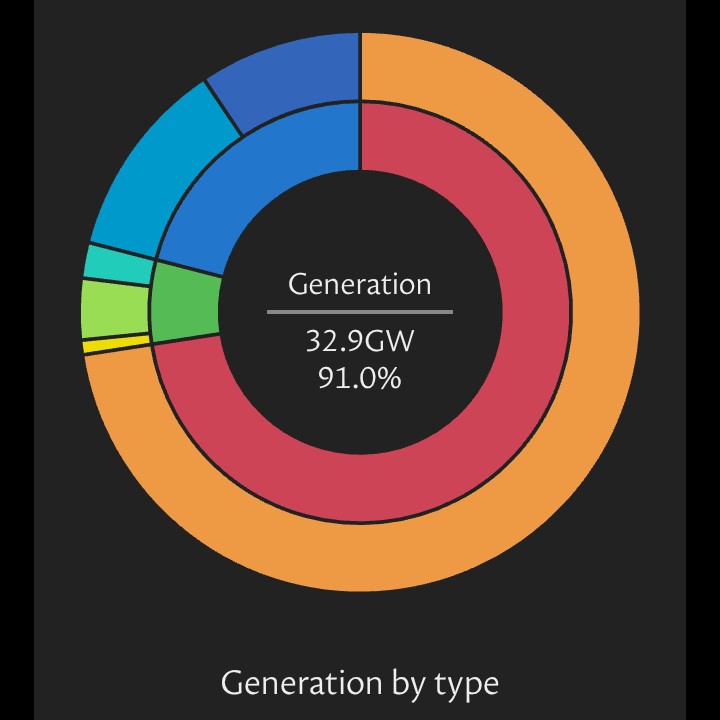
Across Britain this evening the numbers tell a story that few politicians are willing to admit. Beneath the slogans of “clean power” and “net zero progress”, the electricity system is operating on a knife edge. With wind output collapsing and gas reserves at critically low levels, the uncomfortable truth is this: Britain could be only hours away from serious power shortages if conditions worsen.
At the time of writing, national electricity demand sits at roughly 37 gigawatts. Domestic generation is producing around 29 gigawatts, with the remaining electricity , more than eight gigawatts , being imported through interconnectors from Europe. In other words, more than one fifth of the electricity keeping British homes and businesses running is coming from outside the country.
That dependence might be manageable under normal conditions. But these are not normal conditions.
Wind generation, which policymakers increasingly rely upon as the backbone of the future energy system, is producing very little power today. Across large parts of northern Europe a high-pressure weather system has suppressed wind speeds. When this happens , a phenomenon known in Germany as Dunkelflaute, or “dark wind lull” wind turbines across multiple countries slow almost simultaneously.
When the wind stops, the UK grid rapidly becomes dependent on gas.
This evening gas-fired power stations are supplying roughly 17 gigawatts of electricity , close to half of Britain’s total power generation. Without them, the grid would immediately lose a vast portion of its supply.
Yet at the same time, Britain’s gas storage levels have fallen to extremely low levels. Current storage stands at approximately 6,700 gigawatt hours , enough to meet barely a day and a half of national demand.
To put that into perspective, many European countries maintain gas reserves capable of covering months of winter consumption. Britain, by contrast, now operates on a “just-in-time” energy model. Gas flows in from the North Sea, pipelines from Norway, or LNG shipments arriving at import terminals. If those flows slow or stop, the system has almost no strategic buffer.
This is not a theoretical concern. The UK once possessed a large strategic storage facility in the North Sea known as the Rough gas storage site. When that facility was closed in 2017, the country lost around 70 percent of its gas storage capacity. Successive governments have failed to replace it.
The result is an electricity system that depends on several fragile assumptions at the same time: that the wind will blow, that gas imports will continue uninterrupted, and that neighbouring countries will always have spare electricity to export.
If two of those assumptions fail simultaneously, the consequences could be severe.
Consider the situation we are in tonight. Wind generation is weak. The grid is leaning heavily on gas plants and imports. Electricity prices have surged to over £150 per megawatt hour, a clear sign that the system is under strain and relying on expensive marginal generation to meet demand.
Now imagine a further disruption , a major interconnector failure, an unexpected power station outage, or an interruption in gas supply. The margin between supply and demand could shrink very quickly.
Power systems must always maintain spare capacity to survive sudden shocks. Engineers call this the “operating margin”. If the margin becomes too thin, the grid operator must take emergency action: calling up reserve generators, paying large users to reduce demand, or in extreme circumstances disconnecting parts of the network to prevent a nationwide collapse.
Blackouts rarely arrive dramatically. Instead, they emerge when multiple small stresses combine , low wind output, tight fuel supply, high demand, and unexpected technical faults.
Britain has already experienced how fragile the system can be. In August 2019, a sequence of generation failures triggered a nationwide blackout that affected more than a million people and shut down parts of the rail network. Since then the grid has become even more dependent on weather-driven generation.
Supporters of the current energy strategy argue that expanding renewable capacity will solve the problem. But the reality visible in today’s grid data tells a different story.
Despite billions invested in wind and solar, the system still falls back on gas whenever weather conditions change. Renewables reduce gas consumption when the wind is strong, but they cannot eliminate the need for reliable backup generation.
In practice, Britain now operates a hybrid system: wind when it is available, gas when it is not, and imports when domestic generation falls short.
That arrangement may function during mild conditions. But during cold winter periods, when demand rises sharply and wind speeds can remain low for days or even weeks, the risks grow much larger.
Energy security is not simply about how much generation capacity exists on paper. It is about whether reliable power can be delivered when it is needed most.
Tonight’s grid data offers a clear warning. The system is holding , but only just.
Shane Oxer. Campaigner for fairer and affordable energy
 SAY NO TO THE DESTRUCTION OF OUR LAND
Leave a comment