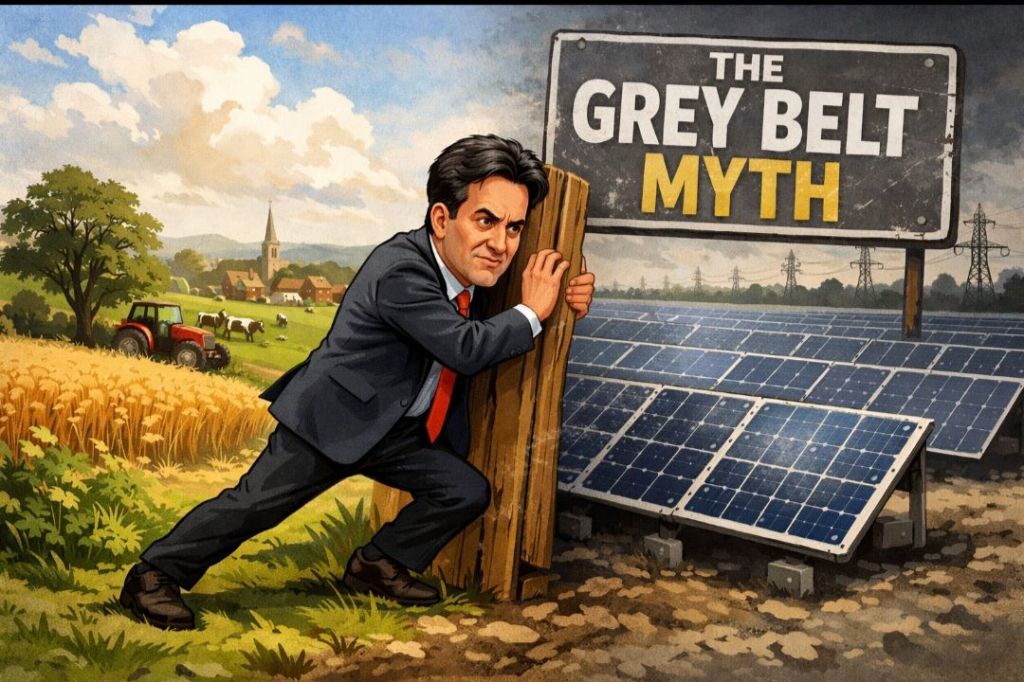
The debate over the proposed Marr Solar Farm has entered a new phase. Following a recent High Court judgment on the interpretation of so-called “grey belt”,
Doncaster Council has been advised that it may need to remove Green Belt harm as a reason for defending its refusal at appeal.
Some will try to present this as a turning point. It isn’t.
The reality is that the planning case against Marr Solar Farm never rested on one argument alone. Even if the Green Belt issue becomes more complicated in legal terms, the proposal still fails on several fundamental planning tests. These include the loss of productive agricultural land, the evidence of high crop yields from the site, and serious doubts about whether the electricity the scheme claims to generate could realistically reach the grid in the foreseeable future.
In other words, the core problems with the proposal remain exactly where they always were.
A decision based on evidence
When Doncaster’s planning committee rejected the Marr proposal in December 2025, it did so after considering the evidence presented to it.
The councillors were not rejecting renewable energy. They were applying planning policy to a specific site and concluding that the harms were not clearly outweighed by the claimed benefits.
That is exactly what the planning system is supposed to do.
The appeal process will now revisit that judgement. But the underlying facts remain the same.
Productive farmland still matters.
Deliverable energy infrastructure still matters.
And planning decisions must still be based on evidence rather than convenient re-labelling.
Whether one calls it “grey belt” or something else entirely, the real question has never changed:
Does this development genuinely meet the planning test?
On the evidence available so far, that remains very much in doubt.
What “grey belt” actually means
Much of the public debate has centred on the idea of “grey belt”. The term has been used loosely to suggest land that is somehow poor quality, unattractive, or no longer worthy of protection.
That interpretation is misleading.
“Grey belt” is not a formal planning designation in the way that Green Belt is. It has emerged as a policy interpretation used in some planning decisions to describe land within the Green Belt that may contribute less strongly to certain Green Belt purposes.
But planning decisions are not made on labels or slogans. They must still apply the legal tests within national policy and local plans. Even where the interpretation of Green Belt policy becomes contested, the wider planning balance still has to be assessed properly.
And in the case of Marr, that wider planning balance is where the proposal begins to unravel.
Productive farmland is not expendable
One of the most important facts in the Marr case has received far less attention than it deserves: the land proposed for the solar farm is highly productive agricultural land.
Independent evidence presented during the planning process indicated that the site falls within the category of Best and Most Versatile (BMV) agricultural land, typically defined as Grades 1, 2, and 3a under the Agricultural Land Classification system.
National planning policy is clear that such land should be protected wherever possible.
The reason is simple. BMV land represents the most productive and versatile farmland in the country. Once removed from agricultural use, it cannot easily be replaced elsewhere.
In the Marr case, agricultural data submitted during the process showed crop yields significantly above national averages. Some harvests were reported to be 40–60% higher than typical UK yields. This is not marginal land. It is productive farmland that contributes directly to food production.
Turning such land into a solar installation lasting several decades raises serious questions about whether the development can genuinely be justified under national planning policy.
Renewable energy must still follow planning rules
Supporters of the project have repeatedly argued that the need for renewable energy should outweigh local planning concerns.
But the planning system does not operate on that basis.
National policy supports renewable energy development, but it also recognises that projects must be located appropriately. Solar farms are expected to prioritise brownfield land, previously developed sites, and lower-quality agricultural land where possible.
The UK Government has made this clear in ministerial statements on solar development, emphasising that high-quality agricultural land should be avoided wherever possible.
The Marr proposal therefore presents a direct planning dilemma: should productive farmland be sacrificed when alternative locations could exist elsewhere?
Doncaster’s planning committee concluded that the balance did not justify that loss.
The grid connection problem
Another issue that received attention during the planning debate was the question of grid connectivity.
Large solar farms are only useful if the electricity they generate can actually be exported into the national electricity network. If the grid cannot accommodate that power for many years, the claimed public benefits become far more uncertain.
Evidence presented during the process suggested that the relevant transmission corridor around Thorpe Marsh and West Melton is already experiencing significant constraints. Major reinforcement works may be required before additional generation can be connected.
In practical terms, that means the Marr scheme could face delays before it could operate fully. If grid capacity is not available until the mid-2030s, communities could be asked to accept permanent changes to the landscape long before the promised energy benefits materialise.
Planning decisions must consider deliverability, not just theoretical generation figures.
The cumulative question
The Marr proposal is also part of a wider pattern of large-scale solar applications across the region.
Each project may appear manageable in isolation. But when considered collectively, the cumulative impact becomes far more significant. Large areas of agricultural land could gradually disappear from food production, replaced by energy infrastructure.
National planning guidance recognises this risk and requires decision-makers to consider cumulative impacts carefully.
Doncaster’s councillors were clearly aware of this wider context when they assessed the Marr proposal.
The planning balance still matters
At the end of the day, planning decisions are not about whether renewable energy is desirable. They are about whether a particular proposal represents the right development in the right place.
The Marr Solar Farm case raises several legitimate planning concerns:
The loss of productive agricultural land.
Evidence that the site is high-yield farmland.
Uncertainty over grid capacity and deliverability.
The cumulative impact of multiple solar developments in the region.
Even if the legal interpretation of “grey belt” evolves, those concerns remain unchanged.
And that means the fundamental planning balance still needs to be tested.
Shane Oxer. Campaigner for fairer and affordable energy
 SAY NO TO THE DESTRUCTION OF OUR LAND
Leave a comment