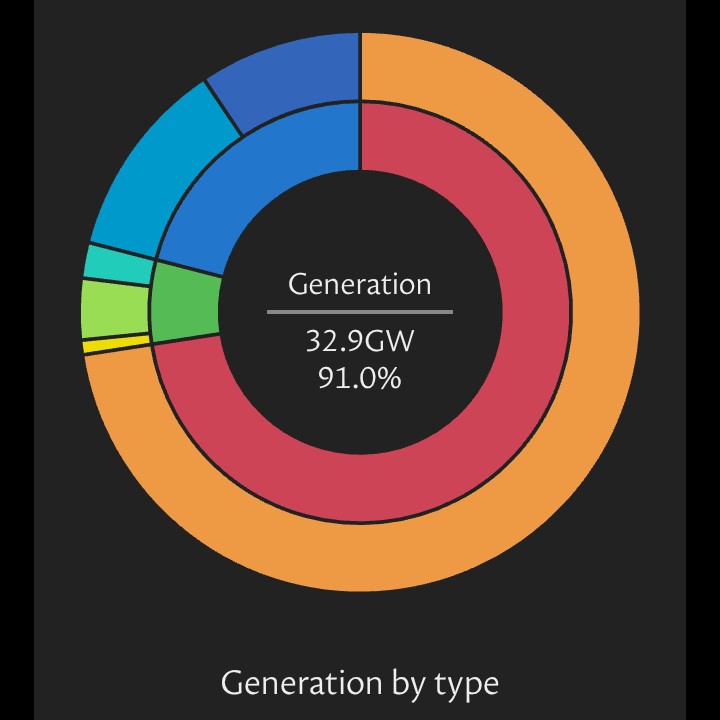
The Coming Electricity Crunch: AI, Net Zero and the Grid Britain Forgot to BuildBritain now faces a fundamental question:
how will it provide reliable and affordable electricity for households, industry and emerging technologies while simultaneously electrifying the economy and pursuing legally binding climate targets?
The uncomfortable truth is that the country no longer has a coherent electricity system capable of answering that question.
Over the past fifteen years Britain dismantled much of the generating structure that once powered its industrial economy. Coal disappeared, nuclear replacement stalled and gas generation became politically constrained.
In their place the system was reshaped around intermittent wind and solar generation, supported by increasingly complex balancing mechanisms and an expanding transmission network.
The assumption behind this transformation was that infrastructure would evolve alongside policy.
In reality the opposite occurred.
Generation projects were approved faster than the grid could connect them, renewable capacity was deployed in locations far from demand centres, and transmission reinforcement fell years behind schedule.
The result is a power system increasingly defined not by supply, but by constraint.
Across large parts of the country the electricity network is approaching its physical limits.
Substations in major industrial corridors are already under pressure.
Connection queues for new projects stretch years into the future as infrastructure struggles to keep pace with policy ambition.[1]
Into this fragile system arrives a new and rapidly expanding demand:
artificial intelligence computing.
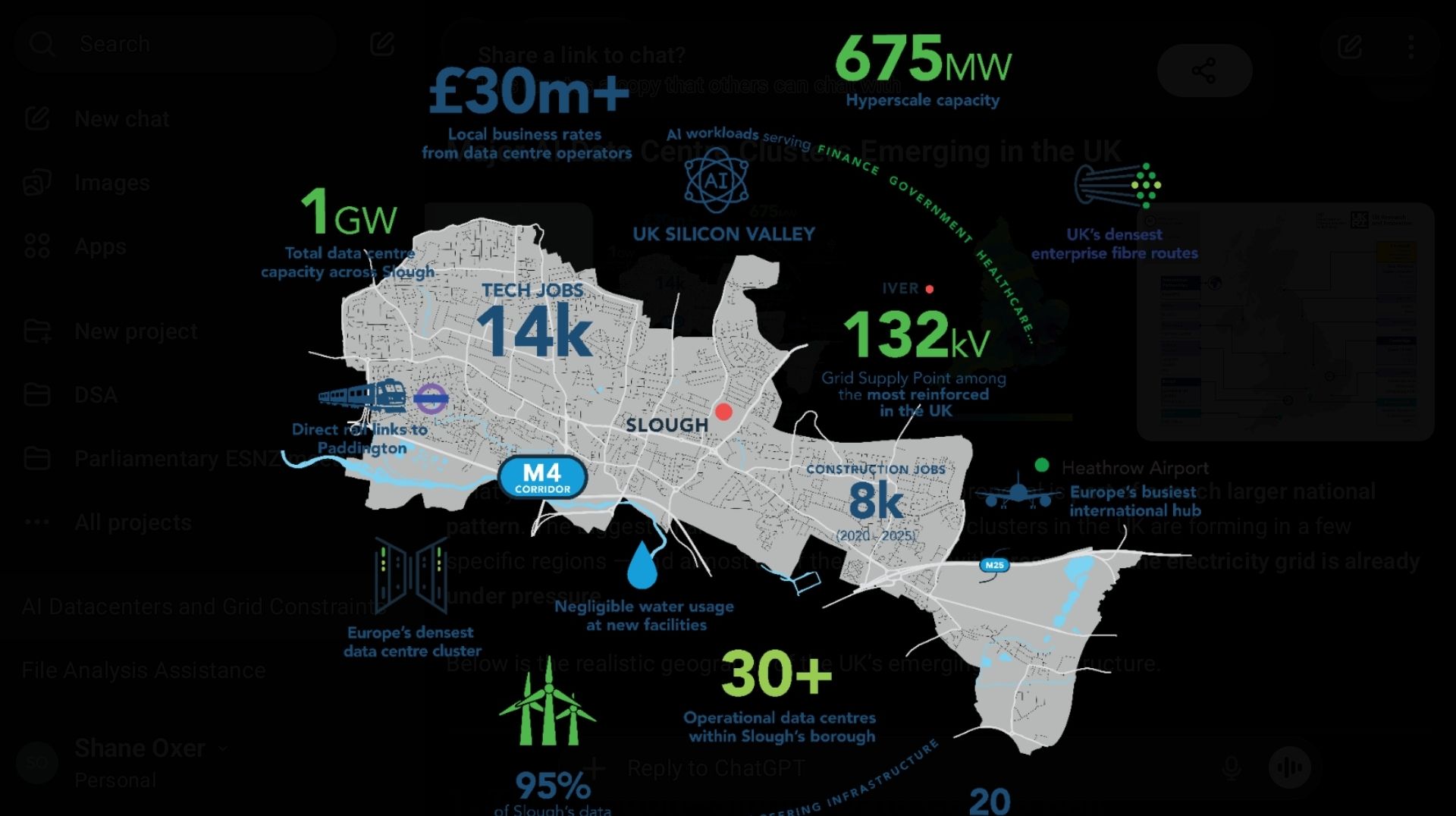
AI datacentres require vast and continuous electricity supplies to power specialised processors and cooling systems.
A single hyperscale facility can demand hundreds of megawatts of electricity.
The largest proposed campuses approach one gigawatt of demand – comparable to the electricity consumption of a large city.[2]
Developers are now racing to build these facilities across the United Kingdom.
One example is the proposed Elsham Tech Park in North Lincolnshire.
The project would occupy roughly 435 acres of farmland and eventually host up to 15 datacentre buildings, with total investment estimated at £10 billion.
If built to full scale, the campus could deliver around 1 GW of computing capacity, placing it among the largest AI datacentre developments proposed in Europe.[3]
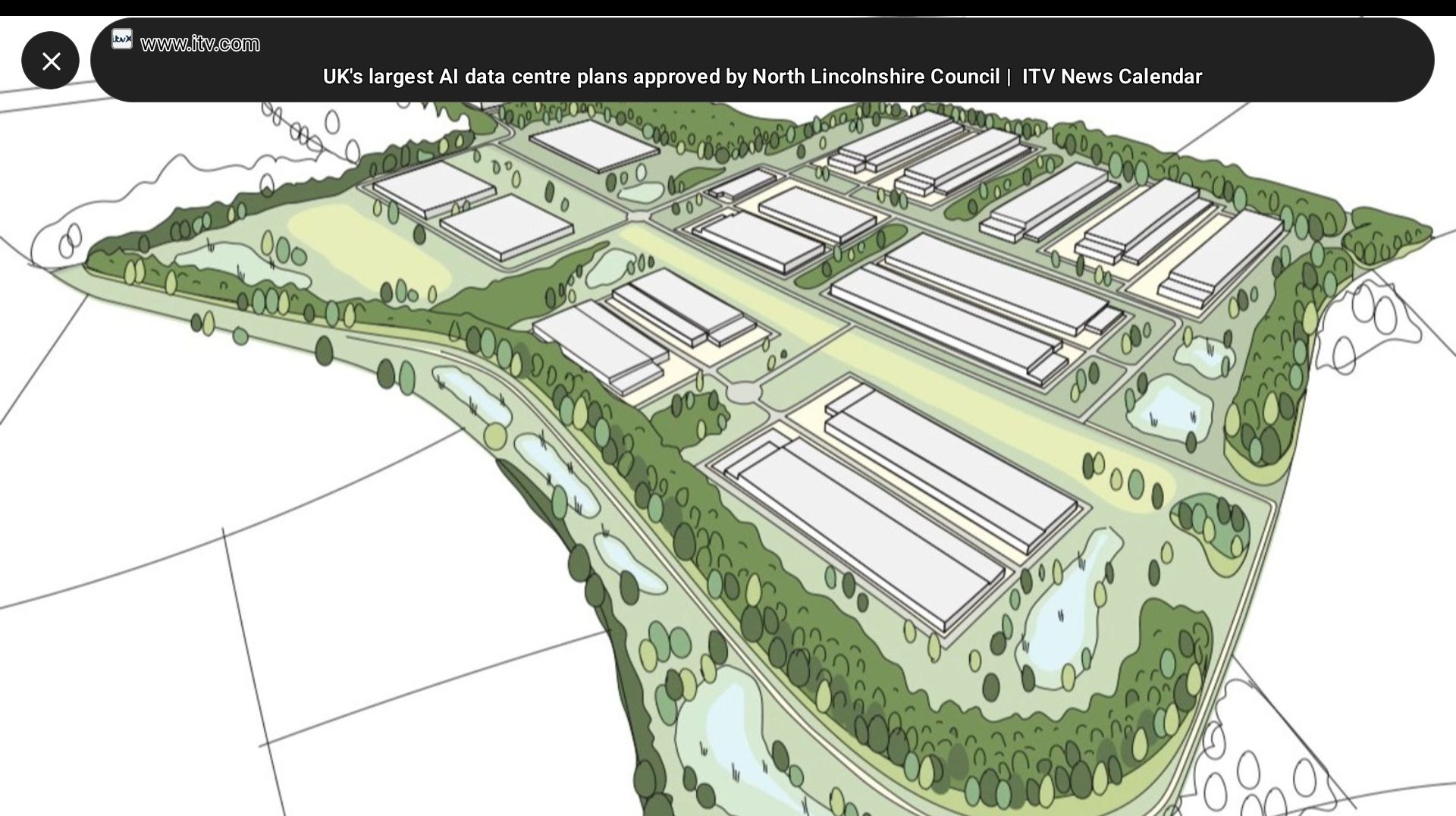
Yet the energy infrastructure included within the plans tells a revealing story. The site proposes an on-site energy centre of 49.9 MW, a figure that conveniently sits just below the threshold triggering more stringent national infrastructure planning scrutiny.
In practice, the overwhelming majority of the electricity required would need to come from the national grid , And that grid is already under strain.
Developers increasingly seek sites near high-voltage transmission corridors where connections might be possible. As a result, many datacentre proposals are appearing in the same regions where renewable generation, battery storage projects and industrial electrification are already competing for capacity.
The Humber and South Yorkshire corridor provides a striking example. Substations such as Thorpe Marsh, West Melton and surrounding grid nodes are already experiencing significant connection pressure from solar farms, battery storage facilities and other large electricity users.
Adding hyperscale datacentres into this environment risks pushing an already congested system closer to its limits.
Nor can intermittent renewable generation alone meet the requirements of AI infrastructure.
Wind and solar output fluctuate with weather conditions and daylight hours, while datacentres require continuous, stable electricity around the clock.
Even brief interruptions can disrupt computing workloads and damage sensitive equipment.
For this reason hyperscale computing facilities depend heavily on reliable baseload generation and grid stability , resources that Britain has steadily reduced over the past two decades.
The consequence is an increasingly complex and expensive system. When renewable generation exceeds what the network can transport, operators must curtail production. Wind farms are paid to switch off while gas plants elsewhere in the system may be paid to generate electricity to maintain grid stability.
These balancing costs ultimately appear on consumer energy bills.[4]
All of this points to a deeper structural problem.
Britain is simultaneously attempting to electrify transport, heating and industry while welcoming new energy-intensive sectors such as AI computing.
Yet the infrastructure required to support this transformation – high-voltage transmission lines, substations, transformers and dependable generation capacity – has not been built at the scale required.
The result is a system pulled in multiple directions:
An industrial grid designed for the twentieth century, reshaped around intermittent generation in the twenty-first, and now confronted by the immense power demands of the digital economy.
In short, Britain is entering the AI age with an electricity system that was never properly rebuilt after the industrial one it replaced , And unless that reality is confronted, the warning signs already appearing – grid congestion, rising system costs and increasingly desperate infrastructure planning – may represent only the early stages of a much larger electricity crunch.
References
- National Grid ESO / Ofgem grid connection queue and network constraint data.
2. International Energy Agency, electricity demand of hyperscale datacentres and AI infrastructure.
3. North Lincolnshire Council planning documents for Elsham Tech Park development.
4. National Grid ESO balancing mechanism and curtailment payment data.
 SAY NO TO THE DESTRUCTION OF OUR LAND
Leave a comment