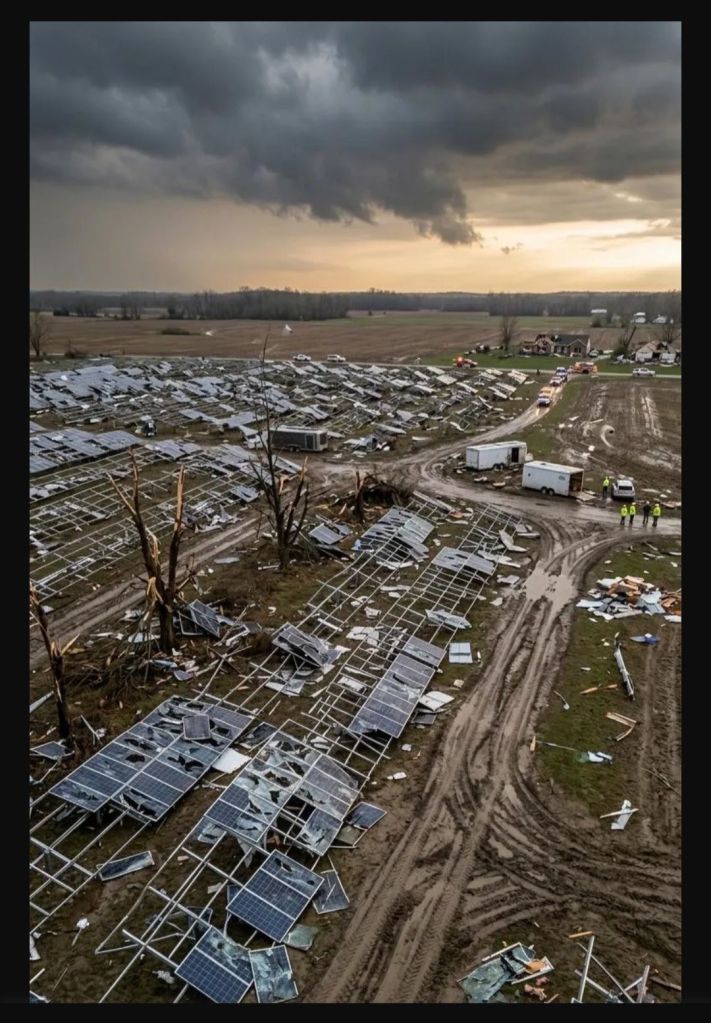
The images above show what happens when extreme weather meets weather-dependent energy infrastructure.
Rows of solar panels lie twisted across muddy farmland. Glass is shattered. Aluminium frames are bent or ripped apart. Electrical equipment is scattered across the ground.
This was the scene after a tornado struck a major solar installation in the United States.
In March 2024, an EF-1 tornado tore through the Dunns Bridge Solar I and II facilities near Wheatfield, Indiana, destroying large sections of the solar farm owned by the Northern Indiana Public Service Company (NIPSCO). With wind speeds estimated between 86 and 110 mph, the storm ripped solar panels from their mounts and scattered debris across the site.
What had been promoted as a modern source of clean electricity was reduced to wreckage in minutes.
For the thousands of homes that depended on the power produced there, generation stopped instantly.
Repairs to large solar installations can take months, and replacing damaged panels, electrical wiring, and support frames can cost millions.
But this was not an isolated example.
The Welsh Storm That Tore Solar Panels Apart
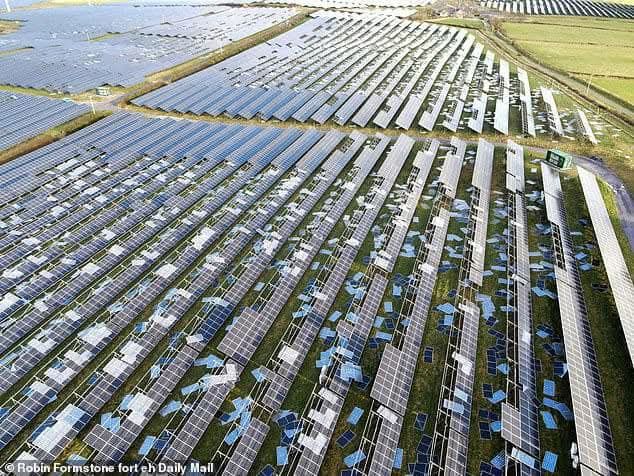
A similar incident occurred much closer to home.
During severe storms in North Wales, powerful winds struck the Porth Wen Solar Farm on Anglesey, ripping panels from their mountings and leaving smashed glass and twisted frames scattered across the site.
Photographs from the aftermath showed rows of damaged solar panels strewn across the land after wind gusts battered the exposed installation.
The site sits on open coastal terrain — exactly the type of location where solar farms are often built because the land is flat and unobstructed.
But that also means these installations are fully exposed to powerful weather systems moving across the Irish Sea and Atlantic.
When storms hit, the flat surfaces of solar panels can behave like sails, transferring enormous wind loads into the metal support structures.
If those structures fail, entire rows of panels can collapse.
Weather as Both Fuel and Threat
Modern renewable energy policy increasingly depends on technologies driven entirely by weather conditions.
Solar generation depends on sunshine.
Wind turbines depend on wind.
But the same weather that powers these systems can also destroy them.
Severe winds, hail, tornadoes, and violent storms can damage large exposed installations with surprising speed.
This creates a fundamental contradiction.
The electricity system becomes dependent on infrastructure that is both powered by the weather and vulnerable to it.
When Power Generation Suddenly Disappears
When a large generating facility is suddenly knocked offline, the consequences are not limited to physical damage.
The electricity grid must immediately compensate for the lost power.
This can involve:
emergency generation from gas power stations
imports of electricity from neighbouring regions
rapid grid balancing measures
higher electricity prices
In extreme circumstances, sudden losses of generation can contribute to grid instability and power outages.
Modern electricity networks require reliable, controllable generation to maintain stability.
Infrastructure that can be destroyed or disabled by severe weather events introduces another layer of risk into the system.
A Growing National Issue
Across Britain, solar development is expanding rapidly.
Thousands of acres of countryside are being targeted for large-scale solar installations.
Projects covering hundreds — and sometimes thousands — of acres are being proposed across:
Yorkshire
Lincolnshire
Nottinghamshire
East Anglia
the Midlands
These projects are often presented as reliable long-term infrastructure.
Yet the events in Indiana and North Wales show that extreme weather can destroy large sections of solar generation capacity in a matter of minutes.
The Question Nobody Wants to Ask
As Britain moves towards a power system increasingly dependent on weather-driven technologies, an uncomfortable question arises.
What happens when the weather turns hostile?
The images from Indiana and the damage in North Wales provide a glimpse of the answer.
Solar farms can fail.
Infrastructure can be destroyed.
Power generation can disappear overnight.
Energy policy should be built on engineering reality, not optimistic assumptions.
Because when the weather turns against weather power, the consequences can be far more serious than policymakers are willing to admit.
Shane Oxer. Campaigner for fairer and affordable energy
 SAY NO TO THE DESTRUCTION OF OUR LAND
Leave a comment