The numbers are so large they barely feel real.
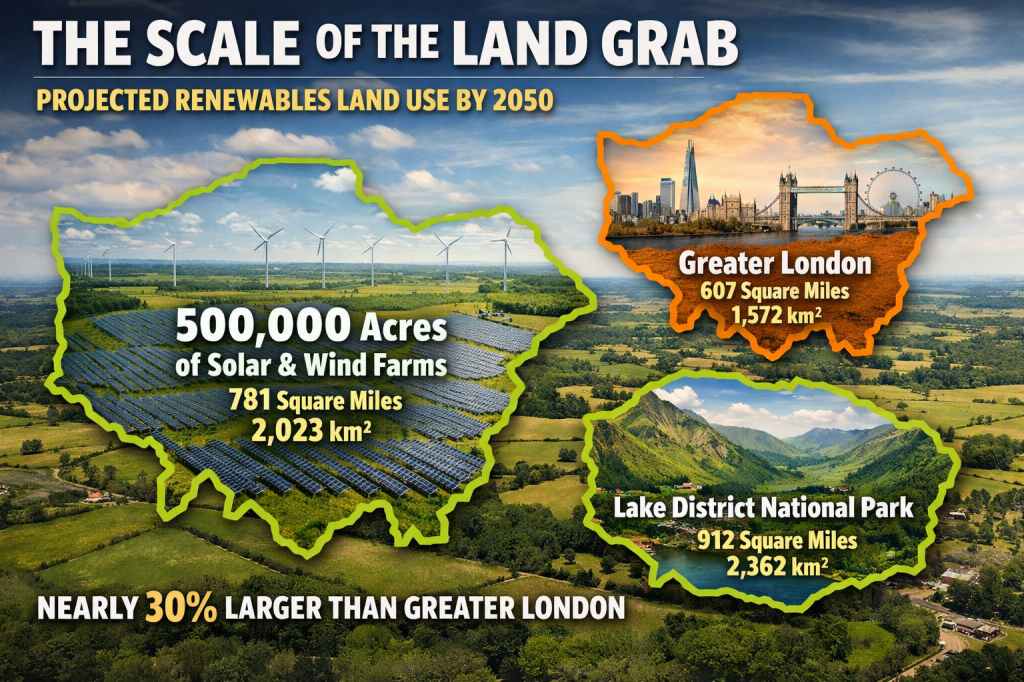
Half a million acres of land is equivalent to around 781 square miles or 2,023 square kilometres. That is an area larger than Greater London. It is not a field here or a small development there. It is the slow industrialisation of the English landscape on a national scale.
And this is the direction of travel we are now being asked to accept in the name of Net Zero.
The Government’s newly published Land Use Framework for England says land used for solar and wind could reach 155,000 hectares by 2050 , around 383,000 acres , and it explicitly warns that the amount of land required for energy objectives beyond 2035 may be more than 2% of England’s land area. That matters, because once ministers admit the figure may rise further, the public has every right to ask where this ends.
For campaigners, farmers and rural communities, the concern is obvious. Once land is reclassified as “needed” for energy infrastructure, it becomes easier for Whitehall, developers and planning bodies to present vast solar fields and onshore wind schemes as inevitable. The language may be clean and technocratic, but the effect on the ground is brutal: open countryside is turned into fenced compounds, productive farmland is subordinated to intermittent generation, and the rural environment is recast as an industrial utility zone.
This is not some abstract future concern. It is already happening across Yorkshire, Lincolnshire, Nottinghamshire and beyond. The 2050 projection simply tells us the pressure is not easing. It is intensifying.
Bigger than London , and still presented as harmless
One of the most dishonest tricks in the Net Zero debate is the use of percentages to make massive land take sound trivial.
“Only 1% of land,” they say.
But 1% of England is not small. It is immense. It represents hundreds of thousands of acres. Once translated into physical space, roads, substations, inverter cabins, fencing, battery compounds and cabling corridors, the true scale becomes visible. What sounds modest in a briefing note becomes overwhelming when imposed on actual places.
The Government’s own framework says renewables would account for 1% of England’s land by 2050 in its table, while acknowledging the true figure could be higher as future plans evolve. That means the official number itself may be an under-statement.
This is how countryside loss is normalised: not through one dramatic decision, but through a thousand incremental permissions, each defended as necessary, temporary or proportionate.
The countryside is becoming a sacrifice zone
The public was never asked whether they wanted England’s fields and rural skylines re-engineered at scale to meet centrally driven carbon targets. Yet that is exactly what is unfolding.
Under the new framework, renewables sit alongside urban expansion, woodland creation, habitat restoration and agricultural change as competing demands on a finite land base. Ministers insist there is enough land to do everything. But that reassurance depends on optimistic modelling, future productivity gains, and assumptions about “multifunctional” land use that often look neat on paper and fail in reality.
A field is not truly multifunctional just because a policy paper says sheep might graze beneath panels. A landscape is not protected simply because a planning document promises biodiversity uplift. And farmland is not preserved in any serious sense when it is ringed by security fencing, cut by cable routes, overshadowed by energy infrastructure and removed from flexible food use for decades.
This is the reality many communities now understand all too well. Once large-scale energy development arrives, the character of a place changes. Permanently.
Food security is being treated as secondary
The framework says most changes are meant to happen without reducing domestic food production and that the most productive Best and Most Versatile land should generally be avoided. But it also admits that development and habitat restoration may still be proposed on such land, and that it is ultimately for landowners to decide how to use their land.
That is hardly a safeguard.
At a time of geopolitical instability, rising food costs and growing concern about resilience, Britain should be protecting productive agricultural land, not creating policy conditions that make it easier to convert it into long-term energy infrastructure. Yet this is exactly what current Net Zero policy encourages.
The argument is always framed as balance. But somehow the balance nearly always falls against farming communities, against rural residents, and against the long-term strategic value of keeping land available for food.
The hidden question: power for what, and when?
There is another issue the public is encouraged not to examine too closely.
Even if huge areas of land are handed over to solar and wind, does this actually solve Britain’s energy problem?
Solar produces least when Britain needs power most: in winter, in low-light conditions, during periods of peak heating demand. Wind output varies with weather systems and can collapse during cold, still conditions. That means the land take is only one part of the story. The rest of the story is grid reinforcement, balancing costs, backup generation, curtailment, storage limits and rising system complexity.
In other words, the countryside is being asked to carry the burden of an energy model that still depends on other technologies, vast infrastructure upgrades and expensive system management to remain viable.
So the question is not just how much land is being used.
It is whether England is being industrialised for an energy strategy that still cannot stand securely on its own.
A democratic issue as much as an environmental one
This is not only an argument about landscape. It is about consent.
People can see what is happening: mile after mile of panels, substations in the fields, battery compounds near villages, cable routes across farmland, and the steady erosion of the countryside they were told would be protected. Yet they are repeatedly informed that this is necessary, strategic and nationally significant.
That is not democratic persuasion. It is managed inevitability.
And the deeper frustration is that alternatives are rarely given equal weight. Rooftop solar, brownfield-first development, gas-backed resilience, new nuclear, SMRs, and serious grid-first planning all deserve a much stronger hearing than they receive. Instead, the easiest political route has been to externalise the burden onto rural land.
England cannot afford to get this wrong
Once prime land is industrialised, it is not easily restored. Once rural trust in the planning system is broken, it is hard to rebuild. And once a country starts treating its landscape as expendable infrastructure space, it risks losing far more than views.
It loses resilience. It loses food capacity. It loses local character. It loses public consent.
That is why these numbers matter.
Whether the eventual figure is 383,000 acres, 500,000 acres, or even more if the Government’s own warning proves correct, the direction is unmistakable: Net Zero is no longer just changing the power system. It is changing the map of England.
The public should be told plainly what that means.
Not in percentages. Not in euphemisms. Not in sterile planning jargon.
But in real terms: how much land, where, for how long, at what cost, and with what consequences.
Because this is not a minor adjustment to land use.
It is a national transformation of the countryside.
And once it is done, it will be far too late to pretend nobody saw it coming.
Shane Oxer. Campaigner for fairer and affordable energy
 SAY NO TO THE DESTRUCTION OF OUR LAND
Leave a comment