Just past the spring equinox, with daylight hours growing longer and ministers still selling the fantasy that wind and solar are leading Britain towards a cheap, secure future, the National Grid’s own daily figures tell a very different story.
They expose the reality of the modern British electricity system: even in late March, when solar output should be improving and winter pressures are easing, this country is still heavily dependent on gas to keep the lights on. Not because gas is a historic leftover, but because intermittent renewables cannot be relied upon to meet demand when it matters most.
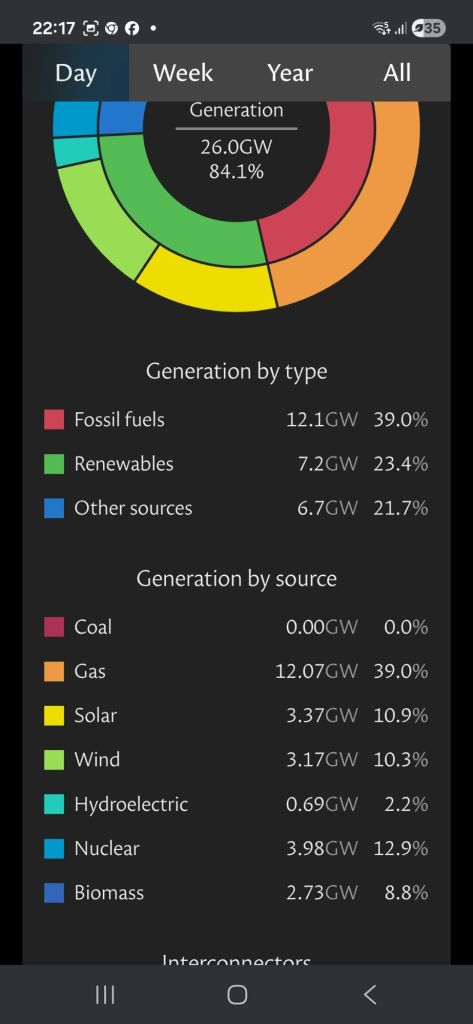
The figures are stark. Over the day, gas remained the single largest source of UK electricity generation at 12.07GW, supplying 39.0% of demand. Solar contributed 3.37GW, or 10.9%, while wind delivered 3.17GW, or 10.3%. Nuclear provided 3.98GW, or 12.9%, and biomass 2.73GW, or 8.8%.
That alone should puncture the political myth. After decades of subsidy,
infrastructure expansion, planning battles, and the industrialisation of countryside and farmland, solar and wind together still failed to match gas.
Even combined, they only just reached around a fifth of total demand over the day. Gas remained the backbone of the system.
But the evening figures are even more revealing, because they show what happens when renewable theory collides with real-world demand.
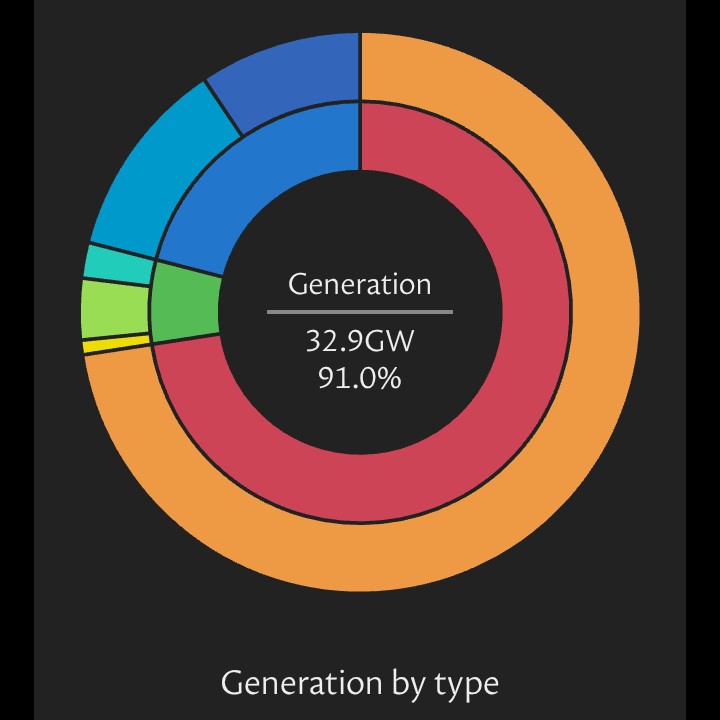
At around 10:10pm, national demand stood at 30.4GW. Domestic generation was only 25.8GW, meaning the country also needed 4.6GW of transfers or imports to bridge the gap. At that moment, gas alone was supplying 14.22GW — 46.8% of total demand. Solar had fallen to 0.0GW, exactly as anyone with common sense would expect after dark. Wind was still operating, but nowhere near strongly enough to carry the system.
That is the truth at the heart of the Net Zero deception.
Britain has not built a system in which renewables replace gas. It has built a system in which renewables are added on top, while gas remains essential as the fallback, balancing mechanism, and dependable source of controllable power. In other words, consumers are not paying for replacement. They are paying for duplication.
They are paying once for wind farms, once for solar farms, once for backup gas, once for grid reinforcement, once for balancing services, and once again through standing charges and market distortions that politicians then pretend are someone else’s fault.
This is not an efficient energy transition.
It is an expensive political construction designed to satisfy carbon targets and ministerial headlines rather than the practical needs of an industrial nation.
Ed Miliband and the architects of this strategy want the public to believe that more wind turbines, more solar panels, more battery schemes and more transmission infrastructure will somehow free Britain from fossil fuels and cut bills.
Yet the actual daily figures show the opposite problem. When demand is real and immediate, Britain still turns to gas. When renewable output weakens, Britain still turns to gas. When solar disappears entirely in the evening, Britain still turns to gas. And even then, it still sometimes needs imports as well.
So what exactly are the British people being asked to sacrifice their countryside, farmland, and energy bills for?
This is the central contradiction of the current policy. Intermittent generation can contribute power when conditions are favourable, but it cannot guarantee electricity on demand.
It cannot promise output during dark evenings, wind lulls, cold spells, or seasonal troughs. That means a parallel system of firm generation must remain in place at all times.
You do not abolish dependency by creating a weather-dependent layer on top of a system that still needs dependable power beneath it.
You simply make the whole structure more complex, more fragile, and more expensive.
That is why gas remains indispensable today. Not because Britain lacks ambition, but because physics has not changed.
A modern electricity system needs dispatchable power, voltage stability, frequency control, resilience margins, and reliable output during peak periods. Wind and solar can assist, but they do not replace those core requirements. Until that gap is filled by something genuinely dependable at scale, gas remains the main insurance policy.
The long-term answer should have been obvious years ago: serious investment in new nuclear power, coupled with rational grid planning, domestic generation security, and a recognition that affordability matters as much as emissions targets.
Instead, Britain pursued a politically fashionable route , build intermittent capacity first, worry about system reliability later, and hope that batteries, imports, and wishful thinking will fill the gap.
They will not.
The daily National Grid figures show that even just after the spring equinox, with improving seasonal conditions, the UK still leans hardest on gas. That should alarm anyone who has been told that the country is already moving beyond fossil fuels. It is not. It is merely layering instability on top of dependency.
The British people deserve honesty. They deserve an energy policy based on engineering reality, not ideological marketing. They deserve bills that reflect efficiency, not the cost of maintaining two systems at once. And they deserve a government willing to admit that without a major expansion of nuclear and truly dependable generation, Net Zero will not deliver cheap or secure power. It will deliver higher costs, greater system stress, and growing public anger.
The spring equinox should have been a moment that showcased renewable strength. Instead, it has exposed renewable weakness. Even now, Britain still runs on gas.
Shane Oxer. Campaigner for fairer and affordable energy
 SAY NO TO THE DESTRUCTION OF OUR LAND
Leave a comment