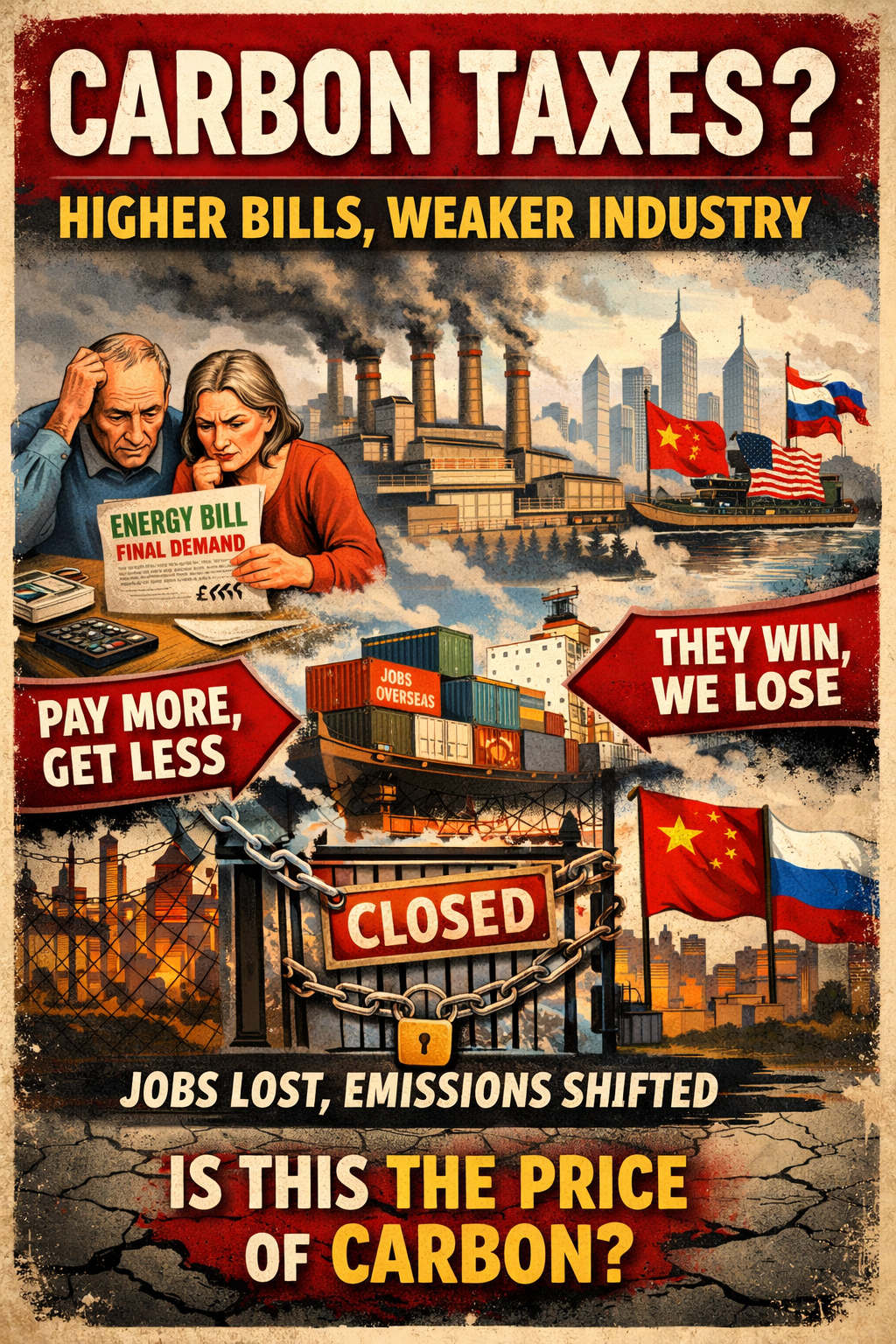
Europe is beginning to say out loud what many ordinary people have felt for years: carbon pricing pushes up costs.
This week, the EU’s carbon market came under pressure after Ursula von der Leyen signalled that Brussels was willing to consider releasing more emissions permits and adjusting parts of the system to stop energy prices rising further. Reuters reported that the benchmark EU carbon price fell sharply on that news, and that the ETS contributes around 11% of energy bills on average across Europe, rising to more than 20% in countries with dirtier energy mixes. That matters, because it shows carbon trading is not some harmless background mechanism. It is a direct cost layered into the price of power.
For years, the public has been told that carbon taxes and carbon trading are necessary, efficient and responsible. We were told they would guide the market gently toward a cleaner future. We were told they would create a rational “price signal.” But when that signal starts hurting consumers, threatening industry, and feeding political unrest, suddenly even the architects of the system want to interfere with it. That tells us something important. This is not a stable or neutral market. It is a political instrument, and like many political instruments, it works until reality gets in the way.
A sound energy policy should begin with three duties: keep energy affordable, keep supply secure, and protect national competitiveness. Carbon pricing fails all three.
It makes energy more expensive by design. That is not an unintended side effect. It is the mechanism itself. The whole purpose is to make carbon-based activity cost more so that governments can force behaviour change. But in the real world, that means factories pay more, generators pay more, transport becomes more expensive, and households feel the pressure in their bills. When politicians say they are “pricing carbon,” what they mean in practice is that they are pricing ordinary life.
This is why the present moment is so revealing. Brussels is not considering changes to the ETS because the system has been too cheap or too gentle. It is considering changes because energy prices have become politically painful. Reuters also reported that several member states want a much deeper rethink, with Italy and Hungary among those pressing for relief, while Germany has supported only limited adjustments. Even within the EU, there is no real agreement that this flagship climate instrument is economically tolerable in its current form.
Britain should take note. The UK may have left the EU, but it did not leave the logic of carbon pricing behind. The government’s own policy overview says the UK Emissions Trading Scheme covers heavy industry, power and aviation, amounting to roughly 25% of UK territorial emissions. In other words, Britain has recreated its own version of the same approach: cap emissions, create a carbon price, and let the costs flow through the system.
And this is where the public needs educating.
Most people do not wake up thinking about permit auctions, market stability reserves, free allocation pathways, or carbon caps. They think about whether they can afford to heat their homes, whether their local employer is still competitive, whether food and goods keep rising in price, and whether the country still makes anything at all. The issue has been hidden behind technical language for too long. Carbon pricing sounds abstract, even harmless. It is neither. It is a deliberate policy choice to make energy and production more expensive.
Defenders of the system often reply that “the whole world is moving this way.” That claim needs more honesty. Yes, China has a national ETS, and it is now the world’s largest by covered emissions. But that does not mean China is imposing the same economic burden in the same way Europe does, nor that it is subordinating its energy security to carbon pricing. China continues to prioritise industrial resilience and strategic control. The United States has no unified federal carbon market, relying instead on a patchwork of state schemes. Russia does not operate an EU-style economy-wide system of comparable force. So the broad picture remains clear: Europe and the UK are placing stronger and more direct carbon-cost burdens on themselves than many of their major competitors. ICAP Carbon Action +1
That matters because emissions do not disappear simply because industry relocates. If steelmaking, chemicals, fertiliser production, ceramics or manufacturing are driven abroad by high energy costs, Britain and Europe lose jobs, tax revenue and industrial capacity, while global production often continues elsewhere under weaker standards. The citizen pays more, the nation produces less, and the climate benefit may be marginal or illusory. This is not environmental realism. It is economic self-harm disguised as virtue.
There is also a democratic problem. No public movement ever swept into being on the promise of higher bills and weaker industry. These systems endure because they are wrapped in moral language and managed by technocrats. The costs are dispersed, the mechanisms are obscure, and the accountability is weak. But that veil is starting to slip. When Brussels itself starts talking about softening carbon-market rules to stop price spikes, it is effectively admitting that the policy has material consequences for ordinary people.
The public deserves plain English.
Carbon taxes and carbon trading are not abstract climate tools floating above the economy. They are charges built into the foundations of modern life. They raise costs. They weaken competitiveness. They punish citizens for using the energy system they depend on. And when those costs become politically unbearable, the same people who praised the system suddenly want to bend it.
That is not proof the policy needs a minor adjustment. It is proof the policy was flawed from the start.
Britain and Europe need energy policy built on affordability, reliability, sovereignty and industrial strength. A system that deliberately makes energy dearer in the hope of forcing economic behaviour is not a path to renewal. It is managed decline.
The population does need educating , because once people understand that higher energy costs are not just accidents of war or market fate, but the result of conscious political choices, the consent behind these policies will begin to crack.
Shane Oxer. Campaigner for fairer and affordable energy
 SAY NO TO THE DESTRUCTION OF OUR LAND
Leave a comment