The River Trent is one of England’s great working rivers.
It has carried trade, fed farmland, shaped communities, and anchored the landscape between Gainsborough and Newark for generations. It is part of the backbone of the country , not just a line on a map, but a living valley of fields, villages, heritage, and hard-won identity.
Now it is being treated as expendable.
Across this corridor, the countryside is being carved up in the name of progress. Ministers, developers and climate campaigners speak the language of ambition, targets and gigawatts. They talk as though plastering vast stretches of land with solar panels is self-evidently modern, necessary and beyond challenge. But for the people who actually live there, what is unfolding is not a green miracle. It is the industrialisation of a river landscape.
The Trent is being abused by the renewable rush.
And the biggest lie of all is this: that it will somehow replace firm power.
It will not.
A valley under siege
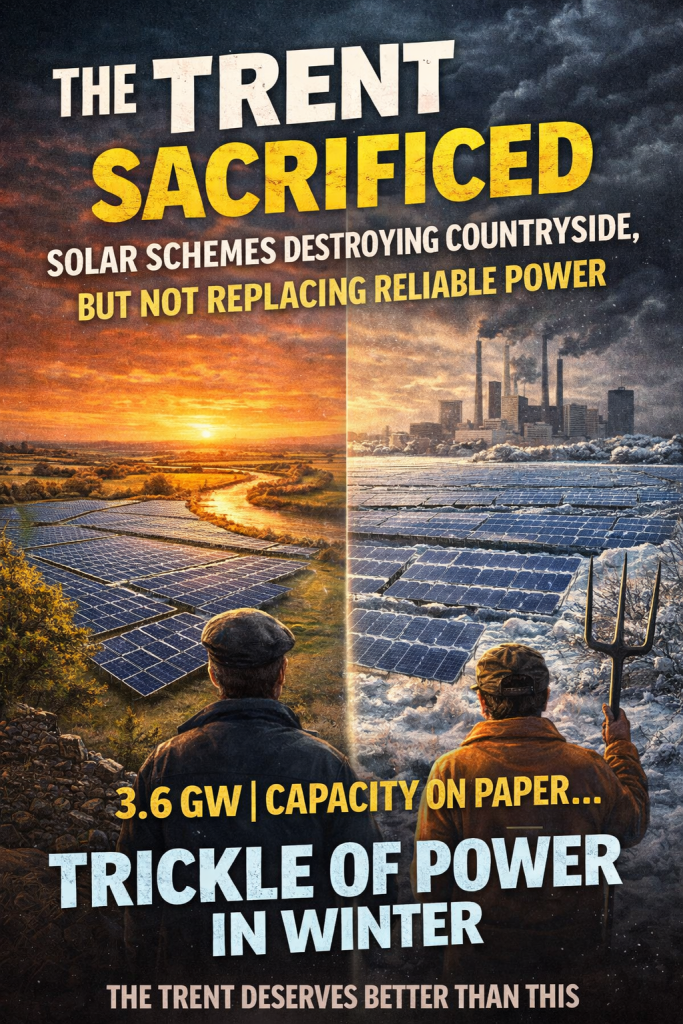
Look at what is now concentrated in this one broad corridor. Gate Burton, Cottam, West Burton, Tillbridge, One Earth, and Great North Road together amount to roughly 3.6 GW of headline capacity on paper. West Lindsey’s own summary lists Gate Burton at 500 MW, Cottam at 600 MW, West Burton at 480 MW, and Tillbridge at 500 MW export capacity, while Newark & Sherwood identifies Great North Road at up to 800 MW; One Earth is also part of that same Trent-side cluster.
That number sounds enormous. That is the point.
It is designed to sound enormous.
It is meant to silence criticism before the real questions are even asked. Three-point-six gigawatts. Clean growth. Green energy. National significance. The language is always polished, always managerial, always detached from what these schemes actually mean on the ground.
Because the truth is far less impressive.
Headline capacity is not dependable output. Installed megawatts are not the same thing as electricity you can rely on when the country most needs it. That distinction is the heart of the entire argument, and it is the part the public is too rarely told.
Britain does not face its greatest energy test on a bright afternoon in June. It faces it on freezing winter evenings, in low light, with high demand, when households need heat, light and security all at once. That is the moment that matters. That is the moment that separates real power from political theatre.
And at that moment, solar falters.
The winter reality they do not want to discuss
The government’s own solar statistics tell the story plainly. DESNZ’s published analysis showed a median annual solar load factor of 9.4% in 2023/24. More strikingly still, for October to December 2023, the quarterly solar load factor fell to 3.8%. In its newer update, DESNZ reported the median annual solar load factor at 9.2% in 2024/25.
That is the reality behind the glossy gigawatt claims.
A scheme can be advertised at hundreds of megawatts, but come winter, when the days are short and the sky is grey, output can collapse to a trickle. So when campaigners say that these giant projects may be quoted at 3.6 GW now, but in winter will barely deliver more than a 4% trickle feed, they are not speaking in fantasy. They are describing the basic weakness of solar in a northern country during the hardest quarter of the year.
This is the deception at the centre of the renewable rush.
The public is shown maximum numbers. The grid has to live with minimum reality.
The landscape pays the price for a power source that cannot stand on its own
That would be bad enough if these were harmless installations tucked neatly onto rooftops or industrial estates. But they are not. These are land-hungry, utility-scale schemes spreading across a historic river corridor. West Lindsey’s own page describes Cottam at 1,270 hectares, and the same official summary confirms very large land areas for Gate Burton, West Burton and Tillbridge as well.
So what is really happening here?
England is not gaining firm replacement power. It is losing countryside in exchange for intermittent generation that still depends on something else standing behind it.
That is the point too many politicians refuse to face. Solar can contribute to a system. It cannot anchor one. It can supplement supply in favourable conditions. It cannot guarantee supply in difficult ones. It can lower output from conventional plant on sunny days. It cannot replace conventional plant on dark winter evenings.
So the land is sacrificed, but the old system cannot be retired.
Gas still has to be there. Dispatchable generation still has to be there. Grid balancing still has to be there. Backup still has to be paid for. In other words, this is not replacement. It is duplication.
We are told we are building the future, but in practice we are building one system on top of another — scarring the land while keeping the firm backbone alive because nobody serious believes solar can carry winter demand on its own.
This is not one scheme. It is cumulative takeover
That is another part of the trick.
Each application is presented separately. Each inquiry is framed in its own administrative box. Each decision is processed through its own planning lane. But communities do not experience these projects as neat individual files. They experience them as cumulative takeover.
West Lindsey’s official page identifies Gate Burton, Cottam, West Burton and Tillbridge as major solar schemes affecting the district. Newark & Sherwood’s NSIP pages do the same for One Earth and Great North Road.
That is the real picture:
not an isolated development, but a belt of vast energy schemes pressing across the Trent corridor and neighbouring countryside.
More fencing. More substations. More transformers. More access roads. More cable routes. More habitat disruption. More farmland taken out of normal use. More villages forced to bear the visual and psychological burden of living in what becomes an infrastructure zone rather than a rural landscape.
And all of it justified by capacity numbers that vanish into weakness when winter arrives.
The mighty Trent deserves better than this
There is a moral as well as an engineering failure here.
The Trent is being treated as though it exists to absorb whatever the Net Zero era demands. Its fields are no longer seen as productive land, its landscapes no longer seen as cultural inheritance, its villages no longer seen as places with a right to continuity and dignity. Instead, they are treated as empty space between substations , available for conversion, available for “mitigation,” available for political symbolism.
But a country that despises its own landscape in pursuit of targets is not acting wisely. It is acting desperately.
And a country that destroys resilient, beautiful, productive land for power that cannot reliably perform in winter is not making itself secure. It is making itself more fragile, while pretending otherwise.
The mighty Trent should not become a sacrifice zone for a theory of energy that fails its hardest test.
Firm power is what keeps a nation alive
This is the part ministers hate saying aloud: an advanced country survives on firm power.
Firm power is what turns up when called upon. It is there in winter. It is there after sunset. It is there during long dull spells, prolonged cold snaps and system stress. It is the power that keeps hospitals functioning, industry moving, homes heated and blackouts at bay.
Solar is not firm power.
That does not mean it has no role. It does mean it has limits , limits that become brutally obvious in Britain’s climate, especially in winter. A serious energy policy would acknowledge those limits and use solar sensibly, mainly where it avoids land loss and serves local demand directly: rooftops, warehouses, commercial premises, transport depots, brownfield sites.
What it would not do is pretend that covering thousands of acres along one of England’s great river valleys somehow removes the need for dependable generation.
Because it does not.
The nation still needs gas while no equivalent firm alternative has replaced it. It needs serious nuclear. It needs engineering-led grid investment. It needs realism, not slogans.
The rush is political. The consequences are real
That is why this matters beyond the Trent itself.
What is happening here is a warning. It shows what occurs when policy is driven by optics rather than system truth. Large capacity numbers are announced. Opposition is brushed aside as backward or selfish. Landscapes are consumed. Yet the fundamental weakness remains untouched: when winter comes, solar output shrinks and the country still leans on firm power to survive.
So what, exactly, has been achieved?
Not replacement. Not resilience. Not honesty.
Only more pressure on land, more damage to countryside, more public mistrust, and a growing gap between political claims and engineering reality.
The mighty Trent is being asked to pay the price for that gap.
It should not.
England needs an energy policy that respects both physics and place. One that understands that not every open field is spare industrial land. One that values great river valleys as more than targets on a developer’s map. One that stops confusing intermittent capacity with national security.
Until that happens, the public must keep saying what officialdom refuses to admit:
You can call it 3.6 GW on paper.
But come winter, it will not replace firm power.
It will barely do more than trickle.
Shane Oxer. Campaigner for fairer and affordable energy
 SAY NO TO THE DESTRUCTION OF OUR LAND
Leave a comment