Britain is heading towards an avoidable national crisis.
The data we have uncovered points in one direction only: this country is becoming more exposed, more fragile and more vulnerable at exactly the moment the world is becoming more hostile. Global instability is growing. Fuel markets are tightening. Gas supplies are under pressure. Domestic resilience is weakening. And yet our political class continues to pursue an energy strategy that places ideology above security.
This is no longer a debate about theory or long-term ambition. It is about whether Britain can keep the lights on, keep the economy functioning and protect the public in a period of genuine international danger.
The evidence is now too serious to ignore.
Jonathan Leake’s Telegraph article, Britain’s gas imports to be cut despite energy security threat, adds to that warning in stark terms. It sets out how Norway is preparing to reduce gas flows to the UK and Europe during crucial maintenance periods this summer, at a time when international supply pressures are already rising because of instability in the Middle East. When taken together with the wider geopolitical picture and the comparative energy data attached at the bottom of the article, a grim reality comes into focus: Britain is not moving towards greater energy security. It is moving away from it.
A world growing more hostile
The world is no longer stable enough for fantasy energy policy.
As the material above makes clear, global oil and gas supplies have already been disrupted by conflict in the Middle East. David Turver’s article sets out the scale of the shock. In peacetime, around 20% of the world’s oil supply passes through the Strait of Hormuz. He argues that traffic through the Strait has plunged dramatically since the outbreak of war, causing major disruption to global energy markets.
The consequences are not confined to crude oil. Damage to Gulf infrastructure is reported to have affected LNG, fertiliser production, helium, petrochemicals, sulphur supply and aluminium production. Turver describes damage to Qatar’s Ras Laffan LNG infrastructure, disruption in Bahrain, Iraq, Saudi Arabia, Kuwait and the UAE, and wider knock-on effects across industrial supply chains. He cites warnings of the largest oil supply disruption in history and of looming fuel shortages in Europe.
Even if one puts aside the most dramatic forecasts, the central point remains: global energy security is under pressure, and Britain is exposed.
That exposure is made worse by supply pressures much closer to home.
Jonathan Leake’s Telegraph report makes clear that Norway is set to reduce gas exports to the UK and Europe by up to a third during the summer maintenance period. This matters enormously because Britain remains heavily dependent on imported gas, and Norway is one of our most important suppliers. Leake notes that Gassco typically sends around 350 million cubic metres of gas each day to the EU and UK, representing roughly a third of need, but that these flows will now be significantly reduced during key periods.
The Nyhamna gas plant and Langeled pipeline are particularly important. The pipeline runs to Easington in Yorkshire and supplies around 20% of UK demand. Planned maintenance between August and October means output will be curtailed at precisely the point when Europe is trying to refill storage and Asia is competing for LNG cargoes.
That is not a minor inconvenience. It is a direct warning.
Britain is sleepwalking into vulnerability
The most disturbing part of all this is not that the world is unstable. The world has always been unstable. The most disturbing part is that Britain is responding by making itself weaker.
We have known for years that domestic gas production has been falling. We have known storage is limited. We have known that we are increasingly exposed to global price shocks and foreign supply decisions. Yet instead of reversing this vulnerability, Westminster has deepened it.
Leake also highlights the wider political context: Ed Miliband has imposed further delays on Rosebank and Jackdaw, two offshore fields that are close to being able to deliver gas into UK pipes. At exactly the moment when supply risk is rising, the British state is slowing domestic production.
That tells you everything.
This is not a serious governing class. It is an ideological one.
When a nation faces a hostile world, it secures essentials first. It protects food, fuel, electricity, transport, communications and industrial capacity. It does not deliberately undermine them while congratulating itself for moral virtue.
But that is exactly what Britain’s energy establishment has done.
Parliament has chosen ideology over the national interest.
David Turver’s article opens with the political reality many people now feel in their bones. On 24 March, the Conservatives forced a vote calling on the Government to remove the Energy Profits Levy, end the ban on new oil and gas licences, and approve Rosebank and Jackdaw to improve domestic energy security. The motion was defeated by 297 votes to 108.
Turver’s conclusion is blunt: Parliament chose Net Zero above the national interest.
Whether one agrees with every word of his language or not, it is difficult to escape the substance of the charge. Britain is facing a serious energy security threat, yet the political system continues to behave as though decarbonisation at any cost remains the overriding priority.
This is the madness at the centre of modern British politics. Even when evidence of danger accumulates, the policy direction does not change. There is no pause. No serious reassessment. No return to first principles. Only more slogans, more targets, more delays to domestic production, and more faith in intermittent generation that cannot guarantee security when the country most needs power.
The data attached tells its own story
What makes this even more serious is that the warning is not only political or geopolitical. It is technical.
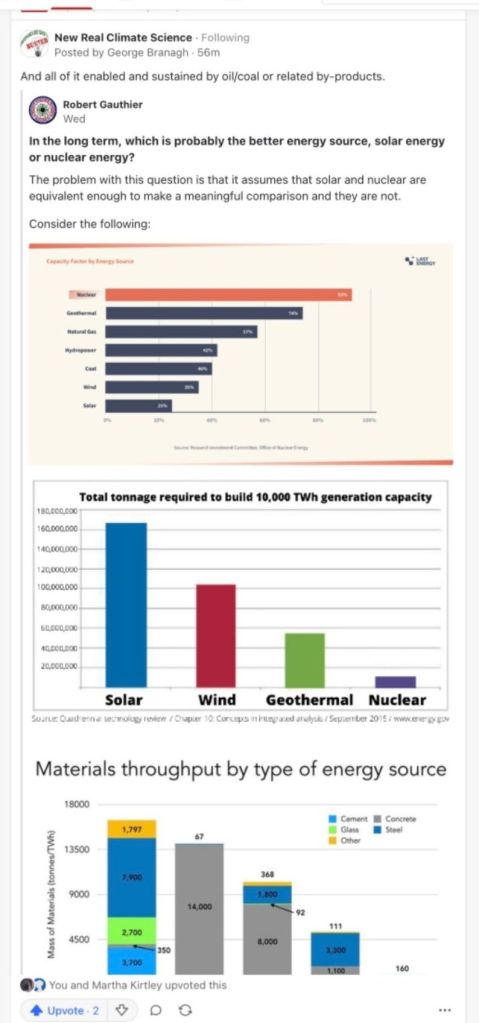
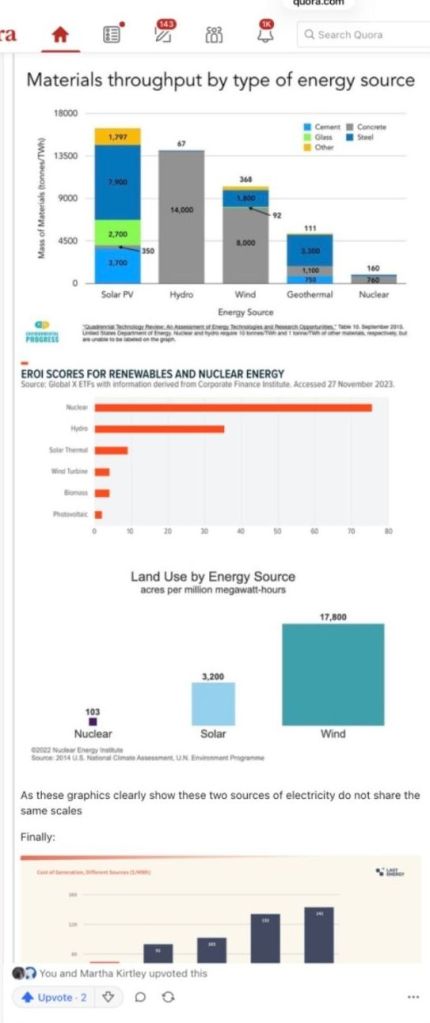
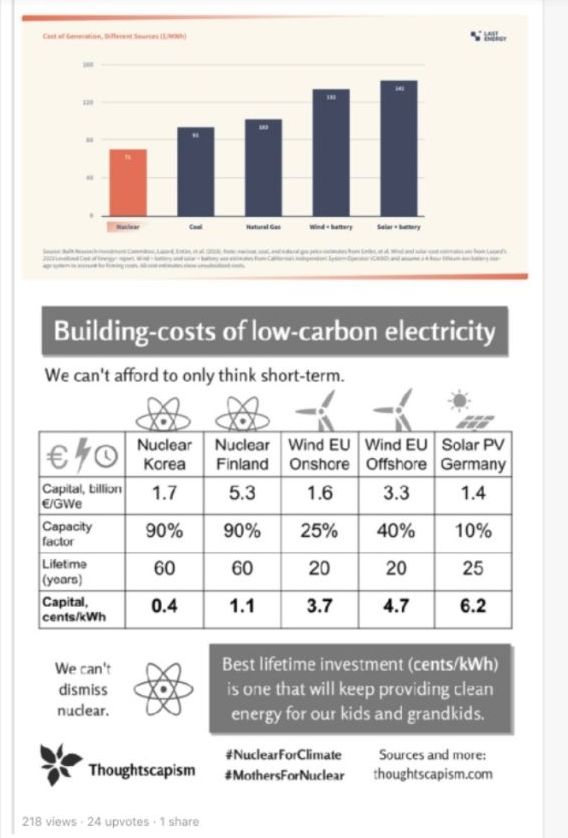
The comparative data attached at the bottom of the article underlines the scale of the mistake Britain is making by continuing to elevate solar and wind over dependable generation. Those charts draw attention to a number of critical realities: capacity factor, materials intensity, land use, lifetime economics and the overall energy return of different technologies.
The message is straightforward. These energy sources are not equal.
One chart compares capacity factors and shows nuclear operating at far higher output levels over time than solar. Another compares the total tonnage required to build equivalent generation capacity, again showing how materially intensive solar can be relative to nuclear.
Another examines materials throughput by energy source, highlighting the vastly greater physical input needed for diffuse renewable systems. The EROI comparison points in the same direction: some technologies return far more usable energy relative to the energy invested in building and maintaining them.
The land-use chart is equally revealing, showing how enormous the footprint of wind and solar becomes when compared with nuclear. The final building-cost comparison also challenges the lazy assumption that intermittent low-carbon technologies are necessarily the strongest long-term investment.
Taken together, the attached data reinforces an argument that many in Westminster refuse to confront: Britain is being pushed towards a system that is weaker, bulkier, more land-hungry, more materially intensive, and less dependable than the one it is replacing.
Solar does not solve a winter energy crisis
This is where the argument becomes absolutely critical.
We are constantly told that large-scale solar is part of the answer. But the evidence you shared points in the opposite direction. Solar is one of the least effective sources of generation for a country like Britain when judged by reliability, land use, materials throughput, energy density and seasonal usefulness.
The attached comparative charts make an important broader point. They show stark differences in capacity factor, land use, materials intensity and lifetime value. Nuclear operates at very high capacity factors and produces enormous amounts of energy from a relatively small footprint. Solar, by contrast, requires vast acreage, large material inputs, and produces power intermittently and weakly, especially during the months when Britain’s energy demand is highest.
That matters because winter is the real test of an electricity system.
Britain does not face its greatest risk on a sunny June afternoon. It faces it on a dark, cold, windless winter evening when demand surges, heating systems strain, gas stocks are tight, and imports are contested. Solar is structurally weakest at exactly that moment. It cannot carry a modern nation through a prolonged geopolitical emergency. It cannot anchor industrial civilisation. It cannot provide sovereign resilience.
This is the truth the political class does not want to face.
You cannot build a serious national energy policy around a source that performs worst when you need it most.
A modern blackout is not just “the lights going out”
Too many politicians still talk about power shortages as though they mean little more than inconvenience. That is a deeply outdated view.
In a modern, digitised society, power outages would trigger cascading failures across almost every area of life.
Banking systems could be disrupted. Card payments and electronic transactions could fail. ATMs could stop working. Communications infrastructure could come under strain. Fuel pumps may not operate. Supply chains could seize up. Warehousing, refrigeration, traffic systems, hospitals, data networks, small businesses and public services could all face serious disruption.
A prolonged or repeated winter outage would not simply be uncomfortable. It could become socially destabilising.
The public has been encouraged to believe that electricity is now something that can be endlessly managed through slogans, smart controls and wishful thinking. But the grid is still a physical system. It depends on real generation, real stability, real voltage support and real fuels. When those things are neglected, the consequences are physical too.
The fragility of modern life is precisely why energy security must come before ideology.
Net Zero has become a doctrine of managed decline
The great lie at the heart of current policy is that Britain is becoming stronger through decarbonisation. In reality, we are becoming more exposed.
We are told to shut down domestic hydrocarbons while importing more from abroad. We are told to cover farmland and countryside with solar infrastructure that produces least when demand is highest. We are told to rely on international markets for essential components and fuels while pretending this is security. We are told that transition excuses everything, even when the transition plainly leaves the country more fragile.
That is not strategic thinking. It is a doctrine of managed decline dressed up as moral progress.
And it comes with a profound democratic insult. Ordinary people did not vote to become poorer, colder, more dependent and more vulnerable to external shocks. They did not vote to put national resilience behind abstract climate posturing. They did not vote to hollow out domestic energy strength while hostile powers and unstable regions continue to shape the world’s fuel markets.
Yet this is what has been done in their name.
The real alternative: security, realism and resilience
Britain needs to recover the ability to think and act like a serious country.
That means beginning with the essentials.
We should be expanding secure domestic supply, not obstructing it. We should be backing reliable generation, not pretending intermittency can replace firmness. We should be hardening the grid, increasing resilience and planning for hostile-world scenarios, not doubling down on vulnerability. We should be investing in generation that works in all seasons, not just in ideal weather.
A credible strategy would place national security, affordability and continuity of supply at the centre of policy. It would recognise the obvious: gas still matters, nuclear matters, grid stability matters, and domestic production matters. It would stop treating criticism of Net Zero orthodoxy as heresy and start treating it as common sense.
Because common sense tells us this: no country should willingly dismantle reliable energy capacity while the world around it becomes more volatile.
Cromwell’s words ring true again
David Turver opened his article with Oliver Cromwell’s famous denunciation of the Rump Parliament:
“You have sat too long for any good you have been doing lately. Depart, I say, and let us have done with you. In the name of God, go!”
Harsh words, yes. But look at the condition of modern Britain and ask yourself honestly whether they still resonate.
We have a Parliament that has been warned about energy insecurity and still refuses to change course. A Parliament that sees international conflict disrupting fuel markets and still blocks domestic strength. A Parliament that clings to Net Zero dogma while exposing the public to higher prices, tighter supply and greater risk of disruption. A Parliament that seems incapable of understanding that the first duty of government is to keep the country functioning.
In that light, Cromwell’s rebuke feels less like theatre and more like national necessity.
Britain cannot afford complacency any longer. The stakes are too high. In a hostile world, energy security is not optional. It is the foundation of sovereignty, prosperity and civil order.
Our MPs were elected to defend that foundation.
Instead, too many of them are helping to dismantle it.
In the name of God, go.
Shane Oxer. Campaigner for fairer and affordable energy
 SAY NO TO THE DESTRUCTION OF OUR LAND
Leave a comment