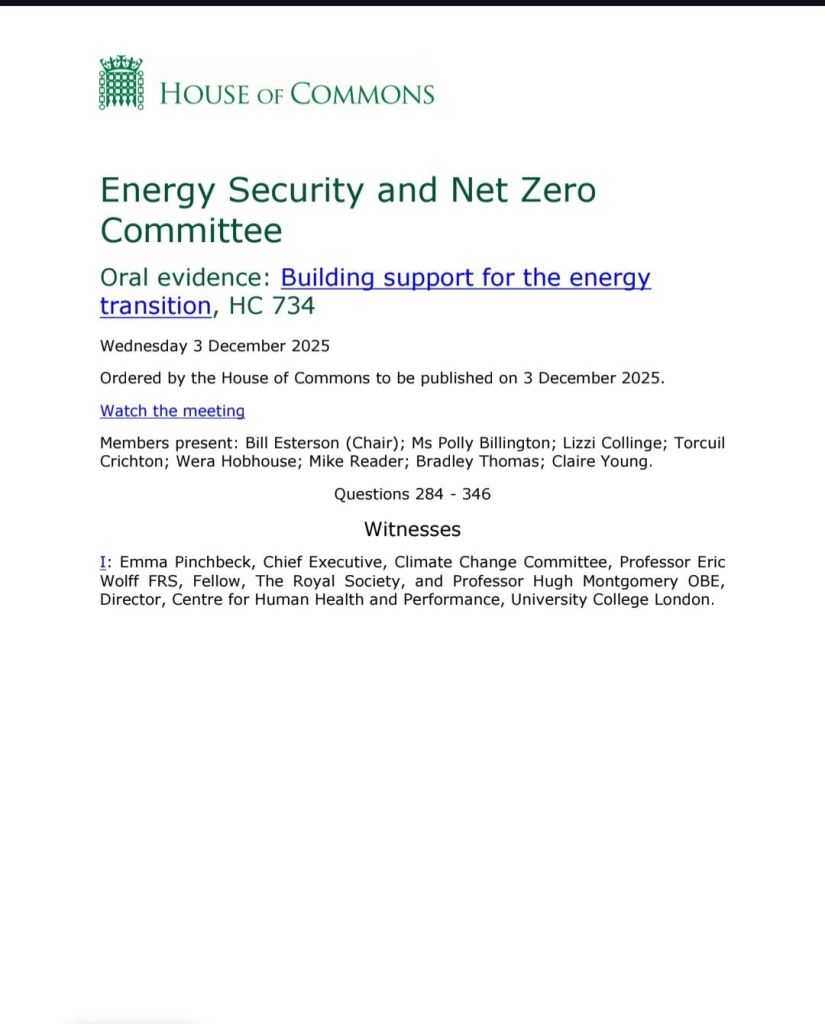
I attended the December 2025 session of the Energy Security and Net Zero Committee hoping to hear a serious examination of the evidence, the uncertainties, the trade-offs, and the real public concerns surrounding the so-called energy transition. Instead, what I witnessed felt far narrower than that. It was not an open forum in which competing views were tested honestly and rigorously. It was, in essence, a discussion about how to build public support for a transition that the political and institutional class appears already to have decided must happen. That was not my impression alone; it is there in the framing of the session itself. The inquiry was explicitly titled “Building support for the energy transition”, and the Committee opened by saying the session would explore how public institutions should communicate the transition, counter misinformation, and tie the message to co-benefits such as health and nature.
That framing is the key to everything that followed.
Because once the central question becomes “how do we build support?”, the debate has already moved on from the more fundamental democratic question: do the public actually support this transition in the form being proposed? Not in slogans. Not in abstract polling. Not in carefully worded survey questions about “clean energy” or “action on climate change”. I mean the real transition, the one people are now beginning to see on the ground and in their bills: heat pumps, electric vehicle mandates, battery storage sites, solar farms across farmland, grid expansion, pylons across the countryside, substations, land-use change, higher system costs, and an ever-growing sense that ordinary people are being steered into technologies and sacrifices they never directly chose.
That question. The question of consent , barely exists in these official conversations.
The panel itself reflected the narrowness of the session.
It consisted of Emma Pinchbeck of the Climate Change Committee, Professor Eric Wolff speaking for the Royal Society, and Professor Hugh Montgomery of UCL. All are well-established voices from institutions that sit firmly within the current climate-policy consensus. Whatever their expertise, there was no balancing voice from outside that framework. There was no grid engineer there to challenge whether the infrastructure assumptions are deliverable. There was no energy economist there to question whether the pace and model of transition are affordable. There was no land-use specialist there to defend rural communities facing industrial-scale solar and transmission build-out. There was no scientist there to stress uncertainty ranges or challenge the more dramatic claims about imminent tipping points and cascading collapse. There was no representative of ordinary bill-payers, householders, or communities expected to absorb the consequences.
That matters because evidence is strongest when it is tested under pressure. Science advances through challenge, not through insulation. Public trust grows when people can see competing claims examined openly. But what the Committee assembled was not an adversarial panel designed to test the evidence from several angles. It was a largely like-minded panel designed to discuss how to communicate one broad direction of travel more effectively.
That is why the whole thing felt so limited.
Again and again, the emphasis was on how better communication could “bring the public along”, how Government should be clearer about the technologies it wants households to adopt, and how misinformation should be countered more aggressively. Emma Pinchbeck said people wanted proactive information from Government and clearer guidance on choices such as heat pumps and EVs. Professor Montgomery spoke of the need to get ahead of disinformation and “inoculate” the public with information first. Professor Wolff likewise stressed the need to counter misinformation and simplify the message around net zero.
That may all sound reasonable on the surface, but the political implication is serious. Once scepticism is treated mainly as the result of poor communication, ignorance, or malign influence, genuine disagreement starts to be reclassified as a messaging problem. Concern becomes something to manage. Doubt becomes something to neutralise. Citizens are no longer regarded as people who may have rational objections to cost, coercion, engineering practicality, visual damage, land loss, or democratic overreach. Instead, they risk being cast as misinformed people who simply need the right panel, the right briefing, and the right “trusted voices” to bring them into line.
That is not democratic debate. That is behavioural management.
One of the clearest examples came in the repeated praise for deliberative panels and citizens’ assemblies. Emma Pinchbeck described the Climate Change Committee’s citizen panels as valuable because people often began with doubts or uncertainty, then changed their minds after hearing the evidence and came away wanting other people to have the same experience. She also explained that such panels helped shape recommendations on matters like support for heat pumps and lowering electricity prices. Now, there is nothing inherently wrong with informed discussion. But when these exercises are used primarily to make the public more accepting of a pre-selected policy path, they cease to be open democratic consultation and start to resemble structured consent-building.
That distinction is vital.
A genuine public consultation would ask first whether people support the transition as a whole, in substance, with all its consequences.
It would ask whether they believe this is the right national priority.
It would ask what trade-offs they are willing to accept and which they are not.
It would ask whether they would prefer other routes: adaptation, resilience, more domestic gas, more nuclear, rooftop generation, energy efficiency without coercion, or slower change tied to infrastructure readiness.
It would ask whether the social licence for widespread countryside industrialisation actually exists.
But that is not what happens.
Instead, people are often asked soft, abstract questions that naturally produce broad support.
Do you care about the environment?
Do you support cleaner energy?
Do you want lower emissions?
Do you want warmer homes and cleaner air? Most decent people will say yes to those things. But those are not the real questions, are they?
The real questions are much harder.
Do you want your local farmland turned into a solar complex?
Do you want battery storage units near homes and villages?
Do you want new pylons dominating the landscape?
Do you want substations and grid compounds pushed into rural areas?
Do you want to be priced out of your existing heating system and forced toward an alternative you may not trust or afford?
Do you want the hidden costs of balancing, reinforcement, curtailment, subsidies, and backup passed through bills and taxes for decades?
Do you want legally binding carbon targets to dictate national infrastructure and household technology choices, regardless of whether the public ever gave explicit consent?
That is the real conversation. And it is the one official bodies seem most reluctant to have.
The December session made this reluctance painfully obvious. The discussion revolved around how to strengthen support, how to improve public understanding, and how to make the transition more acceptable. But hardly anyone stopped to ask the prior democratic question: what if the public do not support this transition in its current form? What if the problem is not simply communication? What if the resistance arises because people understand perfectly well what is being proposed and do not like it?
That possibility is rarely taken seriously enough.
And yet we can already see signs of it across the country. Support in principle collapses into anger when projects become concrete. People are told the transition is popular, but opposition grows the moment it reaches their village, their bill, their home, their road, or their landscape. They are told it is cheaper, but their costs rise. They are told it is cleaner, but they see countryside industrialised. They are told it is modern, but they worry about fragility, dependence, and declining resilience. They are told it is democratic, but most of the key decisions appear to be made by a web of Government departments, regulators, advisory bodies, planning frameworks, and carbon obligations that ordinary voters never directly endorsed.
This is why trust has begun to erode so badly.
People can sense when the argument is no longer open. They can sense when the witnesses are there to reinforce rather than challenge. They can sense when uncertainty is acknowledged only at the margins while the broad policy direction is treated as unquestionable. They can sense when public engagement means being shown how to agree, not being asked whether they agree in the first place.
That is what made the December session feel so unsatisfactory.
It did not feel like Parliament interrogating a national project on behalf of the people. It felt more like an institution asking other institutions how best to persuade the people to accept what had already been settled elsewhere.
That is not healthy in a democracy.
Because even where science is strong on broad trends, policy is still a matter of judgment. The fact that the climate changes does not, by itself, dictate one single political programme. It does not automatically settle how fast the transition should happen, who should pay, what technologies should dominate, what land should be sacrificed, what level of risk is acceptable, what role adaptation should play, or how much democratic consent should be required before remaking the country’s physical infrastructure. Those are political and moral questions as much as scientific ones. They involve affordability, reliability, sovereignty, aesthetics, fairness, engineering, and public legitimacy
To pretend otherwise is dishonest.
And this is where the official narrative becomes most dangerous. By treating the transition as inevitable and debate merely as a matter of communication strategy, institutions risk destroying the very public trust they claim to be building. People do not like being managed. They do not like being nudged toward conclusions they have not been allowed to test. They do not like being told that only one side of a major national transformation is responsible, modern, or moral. Most of all, they do not like the feeling that consent is being assumed rather than sought.
If Parliament wants to rebuild trust, it must stop staging one-sided sessions about how to “build support” and start asking the country harder, more honest questions.
Do the public want this transition?
Do they want it at this speed?
Do they want it in this form?
Do they want the landscape impacts?
Do they want the system costs?
Do they want the household disruption?
Do they want the trade-offs being made in their name?
Until those questions are asked plainly, there will be a democratic hole at the centre of the whole project.
The public are not children to be educated into compliance. They are not a behavioural problem to be solved by better messaging. They are not obstacles in the path of technocratic ambition. They are citizens. And before a country’s homes, cars, heating, land, infrastructure, and bills are transformed on this scale, citizens should be asked honestly whether that is a transition they truly want.
The Public Were Never Truly Asked.
download.pdf https://share.google/JA3bcmFhWR3tSGi5L
 SAY NO TO THE DESTRUCTION OF OUR LAND
Leave a comment