“Texas shows what happens when the green promise ends in broken blades and broken promises. Scotland and the North Sea are heading toward the same reckoning unless decommissioning, recycling, and financial liability are dealt with before expansion goes any further.”
The disturbing scenes from Sweetwater, Texas, should be read in Britain not as a distant American oddity, but as a warning. Bloomberg’s report describes thousands of discarded wind-turbine blades left piled across large sites near the town after a company promised recycling and failed to deliver. Residents complained of blight, stagnant water, vermin and safety risks, while the authorities were left trying to work out who should be held responsible.
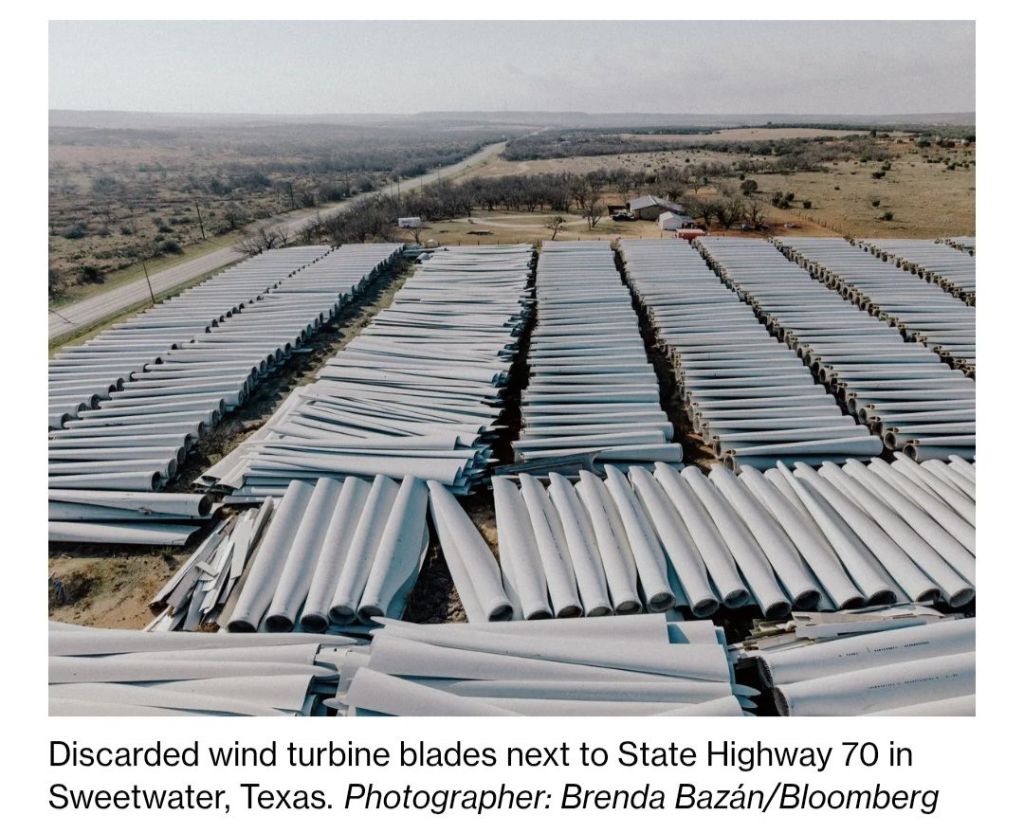
That is the part the glossy wind-energy brochures never show. They show elegant white towers on a clean horizon. They do not show what happens when those blades reach the end of their life, when operators change, when business models collapse, when recycling claims turn out to be weaker than advertised, or when the final clean-up bill becomes somebody else’s problem. Texas is showing us the end of the story. Scotland and the North Sea should pay very close attention.
This matters because Britain is not at the beginning of the offshore wind era anymore. The UK’s own marine planning system now openly recognises that many of the earliest offshore wind farms are reaching the end of their operational lives. A 2025 government marine planning blog states that the UK has 14.7GW of installed offshore wind, that some of the earliest sites are now approaching end-of-life, and that the UK could lose over 1GW of capacity in the next decade, rising to more than 10GW by 2050 unless assets are extended, repowered or decommissioned. �
That means the disposal problem is no longer theoretical. It is arriving.
And in Scotland, the scale of future material arisings is immense. The Scottish Government’s 2025 waste reprocessing infrastructure report says Scotland faces a decommissioning timeline for offshore wind turbines stretching from 2025 to 2065 and refers to a total of 26 million tonnes of materials from offshore wind decommissioning over that period. Zero Waste Scotland separately says that, onshore alone, more than 5,600 turbines could be decommissioned in Scotland between 2025 and 2050, with up to 1 million tonnes of steel reclaimed. �
Steel can be reused. Some metals can be recovered. But blades are the real trouble. They are large, awkward composite structures built to survive punishing conditions, which is precisely what makes them difficult and expensive to process at end-of-life. ORE Catapult’s blade recycling work states plainly that there is a general lack of detail in offshore wind decommissioning programmes regarding waste management operations, and that there is a high likelihood costs have been significantly underestimated. It also notes that decommissioning responsibilities for relevant offshore renewables transferred to the Scottish Government in 2017. �
That is where the Texas story becomes so relevant. Sweetwater shows what happens when policymakers and developers push the expansion phase without having a mature and bankable end-of-life system already in place. The political class celebrates capacity targets, lease rounds and ribbon-cutting moments. Yet the waste stream, dismantling logistics, specialist infrastructure and legal liabilities are often left vague, delayed or hidden behind future promises of innovation.
In Scotland and the North Sea, the risks are even greater than they are in inland Texas. Offshore decommissioning is not simply a case of clearing a storage yard. It means vessels, ports, cranes, weather windows, towage, subsea works, cable treatment, foundation decisions and long supply chains. RenewableUK warned in 2025 that over one-third of the UK’s offshore wind farms will reach the end of their originally anticipated operational design life by 2035 if lifetime extension is not pursued. It also says that under current decommissioning guidelines for England, Wales and Scotland, developers are expected to present a base case for full removal of all offshore wind farm installations and structures at the point of project inception, while also warning that existing guidance lacks the flexibility and clarity needed for the complexity of offshore wind decommissioning. �
So the question is simple: where exactly will all this material go, who will process it, and who pays if the numbers do not add up?
That is not a fringe question. It is the central question. Crown Estate Scotland’s own published memorandum says that where offshore renewable installations are covered by the statutory decommissioning process, Crown Estate Scotland will not require additional financial security for decommissioning itself beyond that statutory framework. � This may sound tidy on paper, but it also underlines why the strength, realism and enforcement of that framework matter so much. If developers over-promise, under-cost, restructure, or fail, the burden can quickly shift onto regulators, public bodies, landowners, ports, supply chains and, ultimately, taxpayers and communities.
That is why Texas should be seen as a political warning as much as an environmental one. The Sweetwater scandal is not just about dumped blades. It is about a broken promise. Local people were told the waste would be dealt with. It was not. They were told there was a plan. There was not a workable one. They were told industry and regulators had control. In reality, a mess was allowed to grow until it became impossible to ignore. �
Scotland must not sleepwalk into the same trap. Before another round of offshore expansion, ministers and agencies should be forced to answer some basic questions in public. Where is the proven large-scale blade recycling capacity? Which ports will handle end-of-life flows? What financial bonds are genuinely ringfenced? What happens if an owner disappears or sells on ageing assets? What infrastructure must be fully removed, and what may be left in place? And what communities will be expected to live beside the scrapyards of the “green transition”?
Texas has shown the ugly truth behind the marketing. Scotland and the North Sea should take the hint now, not when the blades start piling up.
Shane Oxer. Campaigner for fairer and affordable energy
 SAY NO TO THE DESTRUCTION OF OUR LAND
Leave a comment