Cambridgeshire County Council presented North Angle Solar Park near Soham as a modern public investment: a major solar scheme that would cut emissions, bring in long-term revenue, and support frontline services such as adult social care.[1] The council’s own project page says the site was intended as a 30MW solar farm, built on council land, with electricity sales helping fund services.[1]
That is the glossy version.
The deeper story is far less comfortable.
Once you follow the paperwork, North Angle starts to look less like a straightforward success and more like a case study in public-sector optimism: a large solar scheme sold on strong projections, built around a constrained grid connection, tied to a much more complex private-wire network, then hit by delays, weaker revenues, and a striking lack of public performance data.[1][2][3]
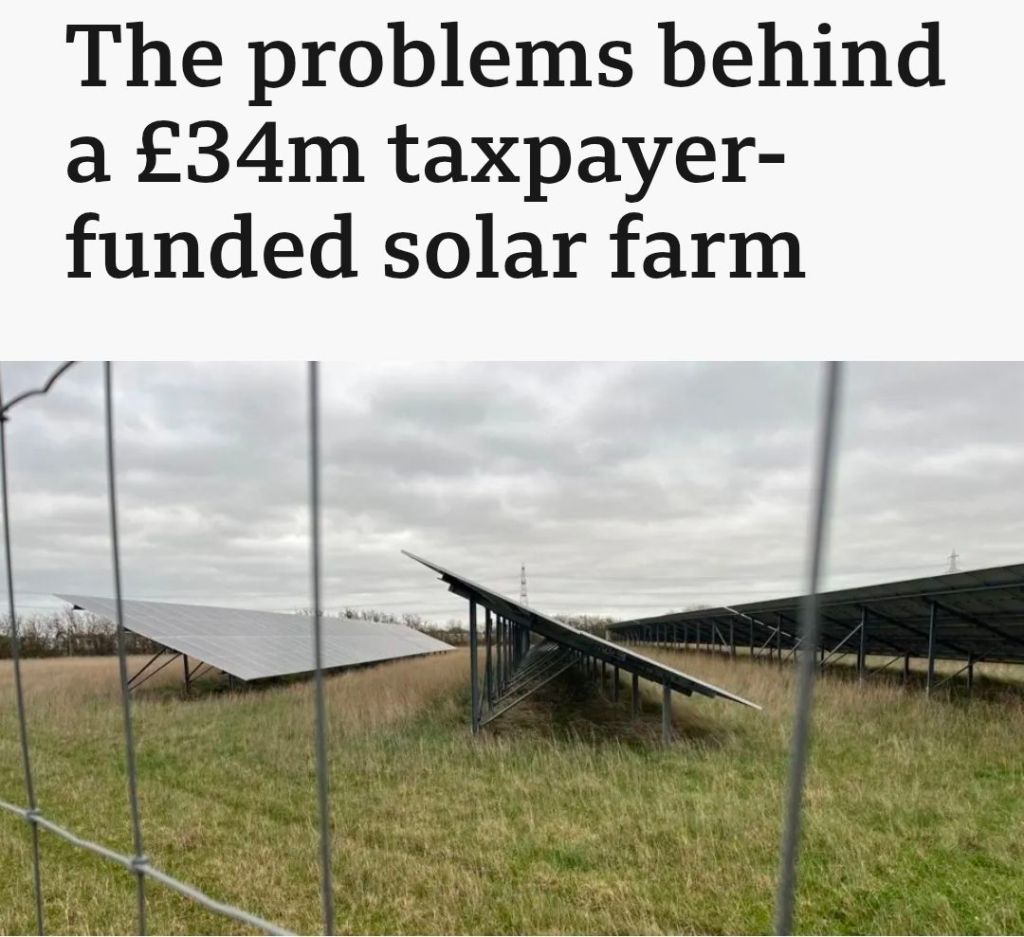
Sold as a major revenue asset
From the beginning, this was not pitched as a token environmental gesture. The council made clear that renewable generation from its land and assets was part of a wider strategy to create long-term revenue streams for services.[1] The project page explicitly links energy generation to income for essential services, while also pointing to the earlier Triangle Farm solar park as proof that this model could work.[1][4]
That earlier success mattered politically. Triangle Farm is described by the council as a successful 12MW project generating around 13 million kWh per year based on its recent average.[4] That record helped create confidence around North Angle as the next, much larger step.[1][4]
But there is a major difference between pointing to one apparently successful project and proving that a much larger one, with a more complex delivery model, will perform in the same way.
The first weakness was built in from the start
The public-facing language focused on capacity, carbon savings and household-equivalent power. The project page says the site could generate electricity equivalent to around 12,000 homes annually and prevent more than 90,000 tonnes of carbon dioxide over its lifetime.[1] It also says the outline business case was based on a 37MW solar park on a 76-hectare site.[1]
But even the council’s own description quietly shows the first weakness: North Angle was attractive in part because it was close to “grid connection options.”[1] That sounds reassuring until you realise that the whole value of a solar farm depends not on what it could produce in theory, but on what it can actually export or use in practice.
That is where the real problem lies. North Angle was not just about installing panels on open land. It depended on connection arrangements and delivery assumptions that were always more fragile than the headline sales pitch suggested.[2][3]
It was never “just” a solar farm
One of the most important points often missed in public discussion is that North Angle was tied to a broader private-wire scheme connecting the solar farm to other infrastructure, including the Swaffham Prior heat network.[2][5] The committee record shows a formal decision on the development and construction of the private wire connecting North Angle Solar Farm and Swaffham Prior Community Heat Network.[5]
That matters enormously.
A normal solar farm is already dependent on grid access, weather, performance guarantees and electricity prices. Once you add a private-wire network, easements, land access, contractor coordination and linked infrastructure, the risk profile changes. The project is no longer just a generation asset. It becomes a more complicated infrastructure scheme, with more points of failure and more chances for cost, time and governance problems to creep in.[2][5]
That complexity helps explain why later papers refer not to a neat, on-time delivery, but to connection issues, commissioning delays and phased export ramp-up.[3][6]
The figures stopped looking impressive
This is where the financial story becomes difficult for the council.
The strongest publicly available evidence from later monitoring is not a triumphant operating report but a red-flag finance entry. A council finance monitoring document recorded North Angle Solar Farm income generation with planned income of £3.943 million, forecast income of only £150,000, and a variance of £3.793 million, marked Red.[3] The same entry states that wholesale electricity price forecasts for exported power fell at the end of 2023, hitting income forecasts by almost 50 percent.[3] It also says there was an initial delay connecting the private wire and the solar farm to the distribution network, followed by two further contractor commissioning delays.[3]
That is a devastating contrast with the original tone of confidence.
It means the council did not simply face a minor operational hiccup. It faced a combination of weaker export economics, delayed connection, and delayed commissioning on a project that had been framed as a long-term income generator.[3]
Now, the council can fairly say that one poor year does not settle the fate of a 25- or 30-year investment. That is true. But it is also true that a project promoted as a strong commercial proposition should not produce such a dramatic early gap between planned and forecast returns without serious questions being asked.
The output promise is still unproven in public
This is perhaps the most important issue of all.
The council has published the promise. It has published the narrative. It has published the broad financial problem. What it has not clearly published is the hard operating dataset that would allow the public to judge performance properly.
The project page says North Angle could generate power equivalent to around 12,000 homes a year.[1] It also says the EPC contract guarantees generation and that Bouygues would be liable if the agreed output is not achieved.[1]
That is a significant public claim. But I have not found a public monthly generation and export dataset that lets taxpayers test whether the promised output is actually being delivered.[1][3][6]
That missing dataset matters more than any press release.
If a solar project is sold on guaranteed output, long-term income and public benefit, then the public should be able to see the monthly metered generation, the exported volume, any curtailed energy, and how actual performance compares with the guaranteed profile.[1] Without those numbers, people are being asked to trust the sales pitch while being denied the evidence needed to verify it.
This is where governance comes in
The real issue here is not just technology. It is governance.
Good governance means risks are understood early, openly discussed, and tracked honestly once a project is underway. It means that if a project depends on complex infrastructure, constrained export, or linked private-wire delivery, those dependencies are treated as central risks, not brushed aside by optimistic assumptions.[2][5]
What the North Angle story suggests instead is a familiar public-sector pattern: enthusiasm at the front end, weaker scrutiny around delivery risk, then broad reassurance once the numbers stop matching the original optimism.[1][3]
The project may yet recover over the long run, but that is not a defence against criticism now. The question is whether it was governed and presented honestly enough in the first place.
And from the public record so far, that answer looks uncomfortable.
The wider lesson
North Angle is not only a story about one solar farm near Soham. It is a story about how too many public renewable schemes are now discussed.
Capacity gets the headline. Carbon gets the applause. Household-equivalent numbers get repeated. But the awkward questions are pushed to the side: what is the real grid position, how often will export be constrained, what happens when prices fall, what linked infrastructure must be finished before the asset earns properly, and where is the public performance data once the ribbon-cutting language ends?[1][2][3]
That is the true weakness in this whole model.
A solar scheme can look impressive in a brochure while still being financially weaker, operationally slower and more commercially fragile than advertised. North Angle appears to fit that pattern all too well.[1][3]
Conclusion
My view is simple.
This looks like a project driven by optimism first and hard reality second. The council clearly believed it had found a way to turn public land into green power and easy revenue.
But the public record now points to something very different: a scheme with more complexity than admitted, more delivery risk than advertised, weaker early returns than promised, and still no clear public release of the operating figures that would settle the argument.[1][2][3][5]
That is not strong leadership. That is not strong governance. That is what happens when institutions become too invested in the idea of a project to challenge the assumptions behind it properly.
If North Angle is genuinely a sound public investment, then Cambridgeshire County Council should publish the monthly metered generation, export and curtailment data and let the figures speak for themselves.[1][3]
Until then, the public is being asked to accept a story built on promises, while the evidence needed to test those promises remains out of sight.
And that, in the end, is the real scandal. Not simply that a renewable project hit problems, but that a council willing to sell the upside has still not provided the full data needed to judge the truth.
Shane Oxer. Campaigner for fairer and affordable energy
Footnotes
[1] Cambridgeshire County Council, “North Angle Solar Park” project page. Covers project purpose, site description, capacity claims, household-equivalent claim, EPC guarantee language, and links to council services funding. Available via Cambridgeshire County Council website.
[2] Cambridgeshire County Council committee/business case materials for North Angle Solar Farm. These papers describe the project scope, 37MW outline business case, 76-hectare site, financial assumptions, and the role of grid connection options and the private-wire concept.
[3] Cambridgeshire County Council finance monitoring reports for 2024–25. These record North Angle’s planned versus forecast income, note the near-50% hit from reduced wholesale price forecasts, and explain delays relating to connection and commissioning.
[4] Cambridgeshire County Council, “Triangle Solar Park” page. Gives the council’s presentation of the earlier project and its reported annual output.
[5] Cambridgeshire County Council Environment and Green Investment Committee records on the private wire linking North Angle Solar Farm and the Swaffham Prior Community Heat Network.
[6] Cambridgeshire County Council monitoring/progress reporting stating that North Angle export ramped from 20% to 100% over time and recording the later energisation and connection stages.
 SAY NO TO THE DESTRUCTION OF OUR LAND
Leave a comment