For years, Britain’s energy debate has been conducted in the language of targets, pledges and transition pathways. Ministers spoke of “clean power”, campaigners spoke of “decarbonisation”, and Ed Miliband built his political identity around the belief that Britain could move steadily away from oil and gas without exposing itself to unacceptable risks.
That argument is now colliding with reality.
The immediate trigger is obvious. The conflict involving Iran and the disruption to shipping through the Strait of Hormuz have sent another shock through global energy markets. Britain is not physically running out of gas, and the Government insists supply is secure, but that is only half the story.
The real issue is price, exposure and vulnerability.
Even the Department for Energy Security and Net Zero acknowledges that the biggest driver of household and business energy costs is wholesale gas set on international markets. It also confirms that the UK remains linked to those markets, even while arguing that the long-term answer is more domestic clean power.
That leaves the country in a politically dangerous position. Ministers say the system is secure. Households and businesses look at their bills and see the opposite.
The Temporary Relief Is About to End
Ofgem’s cap for a typical dual-fuel household fell to £1,641 for April to June 2026, down from £1,758 in the first quarter. On paper, that looked like relief. But even in the same official explanation, Ofgem showed how exposed the system remains: the cap still includes hundreds of pounds of wholesale costs, alongside sharply rising network charges. In other words, the underlying fragility never went away.
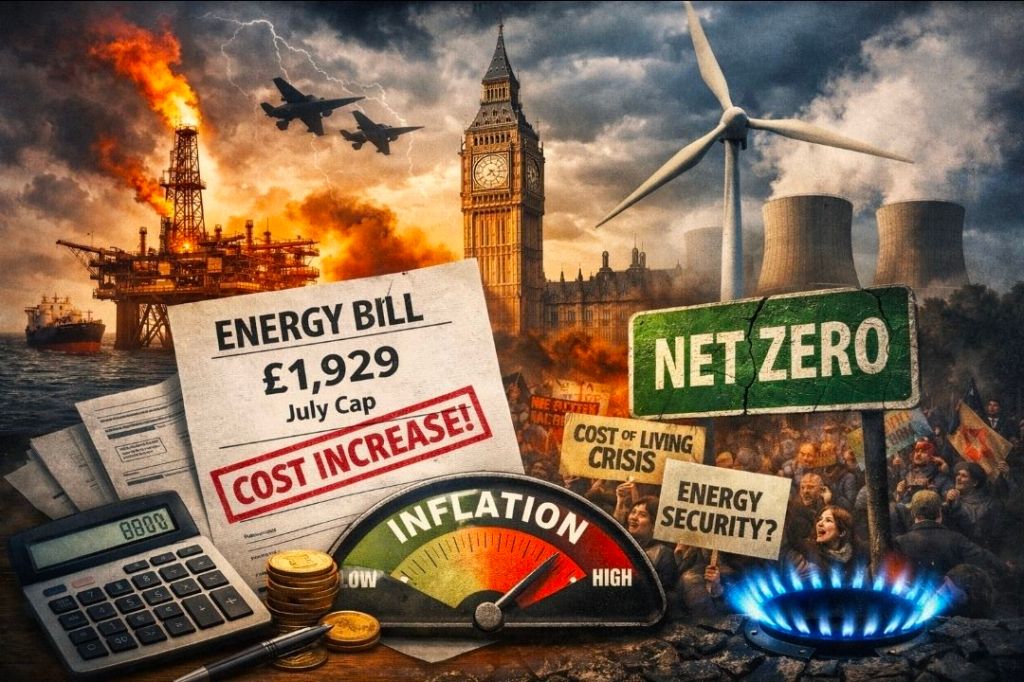
Now Cornwall Insight has warned that the relief will be short-lived. Its latest forecast puts the July to September 2026 price cap at £1,929 for a typical household, a rise of £288, or 18%, from the current April level. More importantly, Cornwall says that with the Ofgem observation window already at its midpoint, much of March’s wholesale spike is effectively “locked into” the next cap. Its conclusion is stark: a rise in July is “pretty much unavoidable”.
That matters enormously, because July is not winter.
If prices are jumping like this in summer, when household energy demand is relatively low, the real danger lies beyond July. Cornwall Insight says plainly that if wholesale prices stay elevated, the bigger issue will be the October cap, when households begin to feel higher consumption and the cold-weather burden returns.
That is the point at which the pressure on ministers could become intense, and the entire net zero sales pitch may start to buckle under public anger.
“A rise in July is pretty much unavoidable , and if prices stay elevated, the bigger danger comes in October.”
This Is How an Energy Shock Spreads
This is the part too many politicians still do not seem to grasp. Energy crises are not just about physical shortages. They are about affordability, resilience and the ability of a country to absorb geopolitical shocks without seeing its domestic economy start to seize up.
That process has already begun. Bank of England survey data released this week showed firms now expect to raise prices by 3.7% over the next year, up from 3.4% in February, marking the biggest monthly jump in price expectations in nearly two years. The direct cause was rising energy costs linked to the Iran war and Hormuz disruption.
Consumer inflation expectations have also climbed.
This is how an energy shock spreads: first into bills, then into transport, food, packaging, retail prices and finally into the wider cost of living.
That spillover is already visible.
The Food and Drink Federation has warned food inflation could hit 9% this year because of rising energy, transport and packaging costs. Retailers are pressing the Government for support.
Domestic growers are warning of shortages and business failure. Once again, energy is not a niche policy issue. It is becoming the mechanism through which the whole inflation problem is renewed.
The Crunch Is No Longer Theoretical
So the crunch is not theoretical. It is imminent.
This is why the politics around Ed Miliband are becoming more dangerous by the day. His argument has always been that North Sea output cannot materially change global prices and that Britain, as a price-taker, cannot drill its way to cheap energy. The Government repeats that line explicitly. It says future North Sea exploration is too marginal to move international markets, and that the only true protection is to get off the fossil-fuel “rollercoaster”.
There is truth in that, but it is not the whole truth.
A serious country does not maintain domestic production only because it expects to undercut the global market tomorrow morning. It does so because domestic production supports jobs, tax revenue, supply chains, industrial capability and strategic resilience. It keeps options open. It reduces dependence. It gives a government leverage in hard times.
Britain has been steadily surrendering all of that while pretending the only relevant question is whether one extra licence would shave a few pounds off the average bill.
That is far too narrow a test.
“Energy policy is not just about tomorrow’s bill. It is about jobs, resilience, tax revenue, supply chains and national survival.”
The Cabinet Pressure Is Now Showing
Even inside government, the pressure is starting to show.
Reporting this week indicates Rachel Reeves has signalled support for new North Sea drilling because of the value of jobs and tax revenues, a position widely seen as a challenge to Miliband’s harder-line refusal to grant further licences.
Whether that becomes an outright Cabinet rupture remains to be seen, but the underlying conflict is now obvious:
growth, jobs and resilience on one side; ideological rigidity on the other.
And the timing could hardly be worse for Miliband.
Britain is being told to trust a transition that has not yet delivered insulation from shocks, while the old system is being dismantled before the new one is fully capable of carrying the load. Ministers say wind, solar and nuclear are the route to long-term security. But long term is not the same as now. The public is not being asked to vote on the energy system of 2035. It is being asked to survive the bills of July and, potentially, October 2026.
That is the heart of the political danger.
July May Be the Turning Point
Once the July cap rise lands, the public conversation changes.
The Government will no longer be able to point to the April reduction as evidence that things are easing. Families will see another rise. Businesses will see another squeeze. Inflation fears will harden. And if wholesale conditions stay hostile into late summer, the October cap could turn what is currently a serious warning into a full political emergency.
The defenders of the current policy line will say this only proves the need to accelerate the transition. In one sense, they are right: Britain is too exposed to gas markets. But that does not automatically vindicate the way net zero has been implemented. A transition that leaves the country vulnerable during the transition is not a serious security doctrine.
It is a gamble.
And it is a gamble being made with other people’s money.
Voters Are Beginning to See Through It
That is why voters in places like Doncaster are growing angrier. They do not live inside policy papers. They live inside budgets. They hear the language of “energy security” from Westminster while watching diesel prices rise, shop overheads climb and food costs edge up again. They are being told Britain is moving toward stability at the precise moment when instability is returning.
That contradiction is politically toxic.
It is also why the coming months may prove decisive for the whole net zero settlement.
If the July increase arrives as forecast, and if markets remain under pressure into autumn, the argument that Britain can glide smoothly through this transition will become much harder to sustain.
The country may then face a stark choice. Either it rebalances policy toward genuine resilience, keeping domestic production, grid realism, nuclear build-out and affordability at the centre, or it continues to prioritise headline targets while households and industry carry the risk.
This Is the Test Net Zero Cannot Avoid
That is the real meaning of the present crisis.
It is not simply another spike in oil and gas. It is a stress test of the governing philosophy behind British energy policy. And that philosophy now looks dangerously exposed.
July may be the month when the public sees it clearly.
October may be the month when ministers can no longer avoid it.
The crunch is becoming imminent. Net zero is no longer being judged in the abstract. It is being judged against bills, wages, inflation and national resilience.
And on that test, reality is beginning to bite.
The Government Must Change Course , Now
Britain cannot afford to drift deeper into an energy policy built on wishful thinking, import dependence and political slogans.
The country needs a strategy rooted in reality: secure domestic supply, serious grid reform, reliable generation, affordability for households, and protection for businesses already on the edge.
That means ending the pretence that energy security can be built while domestic options are closed off.
It means recognising that resilience matters just as much as emissions targets. And it means putting the needs of the British public above the ideological vanity of ministers who still behave as though the real-world consequences can be postponed indefinitely.
They cannot.
The warning signs are here. The July increase is approaching. The autumn risk is already visible.
If ministers do not face reality now, the public will do it for them.
Shane Oxer. Campaigner for fairer and affordable energy
 SAY NO TO THE DESTRUCTION OF OUR LAND
Leave a comment