For nearly twenty years, An Inconvenient Truth has been treated as one of the defining texts of modern climate politics. Al Gore’s 2006 film was not presented as one man’s interpretation of a developing scientific debate. It was presented as a warning, a moral indictment, and, in effect, a settled verdict. The message was clear: the science was in, the danger was immediate, and only political cowardice stood in the way of salvation.
That film shaped classrooms, media coverage, public assumptions, and government policy. It helped create a culture in which questioning the framing of climate claims became almost as unacceptable as questioning the existence of the climate itself.
But nearly two decades later, the obvious question must finally be asked.
Was Gore right?
The honest answer is no ,not in the way he presented it. Not in the certainty, not in the timescales, and not in the repeated use of dramatic examples that were far weaker, more conditional, and more complex than viewers were led to believe. The deeper problem is not simply that Gore exaggerated. It is that his style of exaggeration became the template for much of the climate movement that followed, including the wider public treatment of IPCC assessments.
The problem was never “all climate science is false”
Let us begin with the point that serious critics should concede.
The climate changes. Temperatures have risen. Oceans have accumulated heat. Sea levels have gone up. The IPCC’s AR6 synthesis states that global surface temperature in 2011–2020 was around 1.1°C above 1850–1900, and that human influence was the principal driver of that warming. AR6 also assesses continued ocean heat uptake and ongoing global sea-level rise.
So this is not an argument for childish denialism. It is something more serious.
The real case against Gore and the wider climate establishment is that they took real physical trends and wrapped them in exaggerated certainty, compressed timescales, oversimplified causation, and moral theatre. That is not science at its best. That is persuasion dressed up as inevitability.
Gore’s film sold drama, not precision
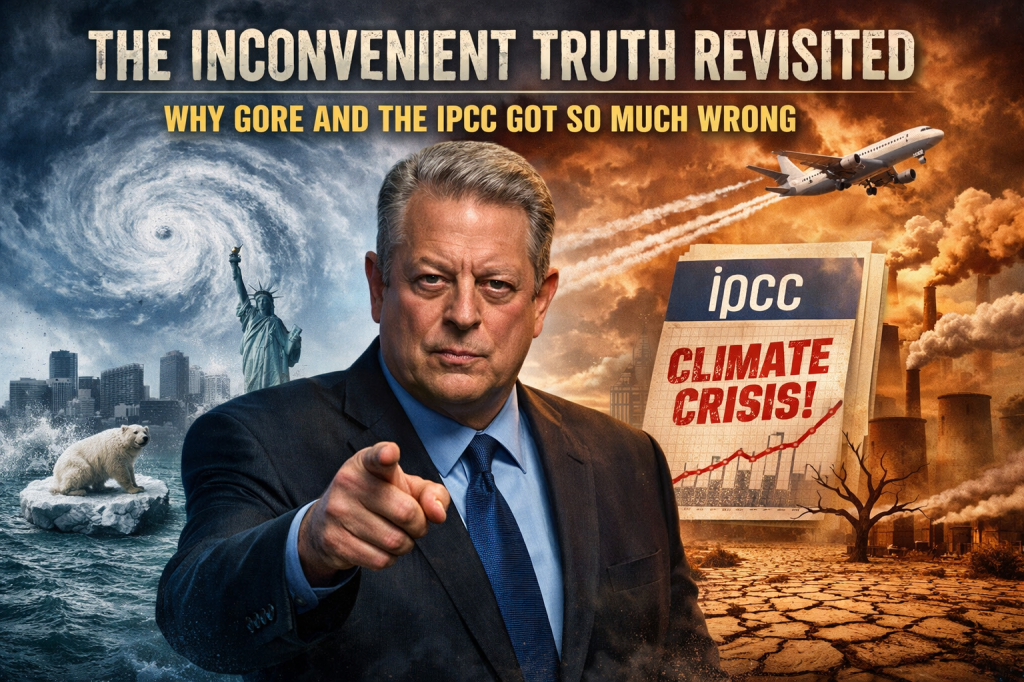
The most memorable image in An Inconvenient Truth was not a graph. It was the implication that seas could rise by around 20 feet and swallow whole regions. That was one of the film’s most effective emotional devices. It was also one of its most misleading in practical terms.
Yes, enough land ice exists to raise sea levels dramatically over very long timescales. But that is not the same as saying such a rise was a credible near-term public expectation. Today’s IPCC AR6 likely range for sea-level rise by 2100 is far lower: about 0.32–0.62 metres under low emissions and 0.63–1.01 metres under very high emissions, relative to 1995–2014. That is serious. But it is not the cinematic near-horizon catastrophe that Gore’s presentation encouraged people to imagine.
This was Gore’s method throughout. He took outcomes that might occur over very long periods or under extreme assumptions and presented them in a way designed to create a sense of imminent crisis.
That is not a minor stylistic flaw. It changes how people think, vote, legislate, and spend.
The film blurred correlation, attribution, and proof
Another recurring weakness in the film was its treatment of complex events as though they were straightforward climate exhibits.
Hurricane Katrina became part of the moral case. Lake Chad became a climate parable. Kilimanjaro’s glaciers became a symbol of man-made warming. Pacific Island vulnerability became proof of ongoing climate displacement.
But many of these examples were far messier than Gore allowed.
Lake Chad is a good example. NASA’s own Earth Observatory material describes its shrinkage as the result of both a drying regional climate and increased human water demand. In other words, it is not a clean one-cause story. Yet Gore presented it as though the lesson were obvious and singular.
Kilimanjaro is similar. The loss of ice is real, but research has shown that local moisture changes, cloud conditions, and sublimation are central to understanding the retreat. That makes it a weak symbol for simplistic “temperature alone did this” messaging.
Hurricanes are even more revealing. Modern attribution science does not usually say that one specific storm was simply “caused by climate change.” The more defensible scientific question is whether warming altered the probability or intensity of some part of the event, such as rainfall or the odds of very intense storms. NOAA’s own explanations make that distinction clear. Gore did not. He preferred the simpler political version: disaster equals proof.
That habit , taking multi-causal events and reducing them to one approved explanation , did tremendous damage to public trust.
Even some of the film’s famous examples were weak when they were used
One reason the 2007 UK court dispute over the film mattered was that it exposed how some of these claims were being presented to children as though they were unqualified fact. Contemporary reporting of the judgment highlighted several points needing balance or qualification.
Take the famous polar bear example. The image was powerful: bears drowning because melting ice forced them to swim farther. But the evidence behind that claim came from limited regional observations, not from a strong global population-wide demonstration. It was an emotionally effective anecdote, not a solid foundation for sweeping public instruction.
That was the recurring pattern. Gore did not invent every concern. He selected the most emotionally potent versions of them, then presented them more strongly than the evidence justified.
The IPCC is more careful than Gore , but not nearly as neutral in public effect as people pretend
Defenders of the climate establishment often reply that whatever Gore got wrong, the IPCC is different. Formally, that is true. The IPCC writes in a cautious style, uses ranges, assigns confidence levels, and documents uncertainty. But the public and political role of the IPCC is far less neutral than its defenders claim.
In practice, the IPCC functions as both scientific assessor and political signal generator. Its reports are used to underpin regulations, subsidy systems, planning frameworks, international bargaining, public spending priorities, and media narratives of urgency. The scientific caveats remain in the chapters; the political message escapes into headlines stripped of ambiguity.
That matters, because the strongest critique of the IPCC is not that it has fabricated warming out of thin air. It is that it has helped create an atmosphere in which uncertainty is continually narrowed in public communication, worst cases are elevated for effect, and institutions behave as though probabilistic assessments are marching orders.
The science is real , but the uncertainty is bigger than campaigners admit
One of the best examples is Earth’s energy imbalance. This is a critical concept in climate science because it refers to the difference between energy entering and leaving the planet. If more energy is retained than emitted, the Earth system warms. That is real physics.
But our best high-quality satellite record for this starts only in 2000 with CERES. The record matters enormously, but it is still short. CERES EBAF is also not simply a magical eternal meter floating above Earth for centuries; product documentation explains that the net TOA flux is constrained to be consistent with Earth heat-storage estimates. That does not make it invalid, but it does mean people should speak with more humility than they often do when presenting modern energy-budget numbers as though the entire system has been pinned down for all time.
The same is true of aerosol-cloud interactions. AR6 assesses total anthropogenic effective radiative forcing in 2019 at 2.72 W/m², but it also makes clear that aerosols remain one of the major sources of uncertainty in the forcing picture. That matters because it affects how warming is partitioned, how much past warming may have been masked, and how tightly models can constrain sensitivity.
Again, the point is not “therefore the IPCC is false.” The point is that uncertainty remains materially important in some of the very areas used to justify sweeping policy certainty.
Climate sensitivity is not a magic number handed down from heaven
AR6 narrowed the likely equilibrium climate sensitivity range to 2.5°C to 4°C, with a best estimate of 3°C. That sounds reassuringly precise. But the public often hears this as though it were a fixed constant rather than an assessed range built from multiple lines of evidence, all of which carry assumptions, model structures, and limits.
Cloud feedbacks remain difficult. Aerosol effects remain difficult. The partition between internal variability and forced response remains difficult in some contexts. These are not side notes. They are core parts of the climate system.
So when campaigners speak as though uncertainty only exists at the margins, they are not being scientifically honest. They are doing what Gore did: collapsing what is known, what is likely, and what is speculative into one seamless political story.
Aviation and contrails show how easy it is to go too far in both directions
A useful way to test climate claims is to look at aviation and contrails. Aircraft do create contrails. Contrail cirrus can trap outgoing longwave radiation and contribute to warming. This is real, measurable, and scientifically important.
But scale matters. The best available assessments put 2018 net aviation forcing at about 0.1009 W/m², with contrail cirrus around 0.0574 W/m². That is meaningful, especially within the aviation sector, but it is still much smaller than the total anthropogenic forcing assessed by AR6. More recent work suggests some contrail forcing estimates may even be lower than earlier central estimates.
This is a useful lesson because it cuts both ways. Climate activists often overstate selected climate examples. Critics sometimes do the same in reverse, By promoting a hidden single cause that supposedly explains everything the mainstream missed.
The serious position is harder and more disciplined. Contrails matter. They do not explain the whole climate story.
The real damage was political
The greatest legacy of An Inconvenient Truth was not scientific. It was cultural and political.
It taught the public to treat climate debate as a morality play. It taught institutions to present dissent as irresponsibility. It trained journalists to prefer dramatic single-cause narratives over complex evidence. And it helped create a world in which institutions like the IPCC are treated not merely as scientific bodies, but as moral arbiters of what responsible politics must look like.
Once that happens, the quality of public reasoning declines. Questions about timescale become taboo. Questions about magnitude become suspect. Questions about uncertainty are rebranded as obstruction.
That is why revisiting Gore matters. Not because he was wrong about every trend. But because he helped entrench a style of climate politics in which emotional force outran evidential care.
The real inconvenient truth
The real inconvenient truth is not that there is no warming.
It is that one of the most influential climate campaigns in modern history built its authority partly on exaggeration.
It used images more dramatic than the likely outcomes being discussed.
It used examples more certain than the evidence allowed.
It used complexity only when convenient and certainty when useful.
And the institutions that followed, including the IPCC’s wider public ecosystem, too often benefited from that same one-way ratchet:
Every uncertainty became urgency, every caveat became a footnote, and every question became a moral failing.
A mature society should be able to say two things at once.
Yes, the climate changes and human influence matters.
And yes, Gore and the broader climate establishment have repeatedly overstated, oversimplified, and politicised that reality.
That is not denial. That is honesty.
And honesty is exactly what this debate has lacked.
Shane Oxer. Campaigner for fairer and affordable energy
 SAY NO TO THE DESTRUCTION OF OUR LAND
Leave a comment