For the past two years, I have followed Britain’s energy system with growing alarm. What began as concern over local solar farms, substations, and battery schemes soon turned into something much bigger. The more I looked, the clearer it became that we are not witnessing a smooth, rational transition from one sound energy system to another. We are watching the dismantling of a system that worked and its replacement with one that is fundamentally weaker, more fragile, and far more dependent on weather, electronics, and political spin.
That is the truth at the heart of this debate.
Coal stations were removed as if they were merely sources of electricity. On paper, they were reduced to numbers. Policymakers looked at a power station and saw megawatts that could be replaced by enough wind, enough solar and enough storage. But those stations were never just about megawatts. They were sources of strength and control. They anchored the grid. They provided inertia, fault current, voltage support, and dependable generation when the country needed it most. They worked at night. They worked in winter. They worked during periods of stress. They were not simply generators. They were the backbone of a functioning system.
That is what has been lost in the modern discussion.
The political class sees figures. Engineers see problems.
That may be the single best way to describe the divide. One side sees installed capacity, annual averages, decarbonisation targets and glossy announcements. The other sees whether the system will still stand up at six o’clock on a freezing January evening when demand is high, solar output is gone, wind may be weak, and every hidden weakness in the network is suddenly exposed. One side counts nameplate megawatts. The other asks whether the grid can survive on them.
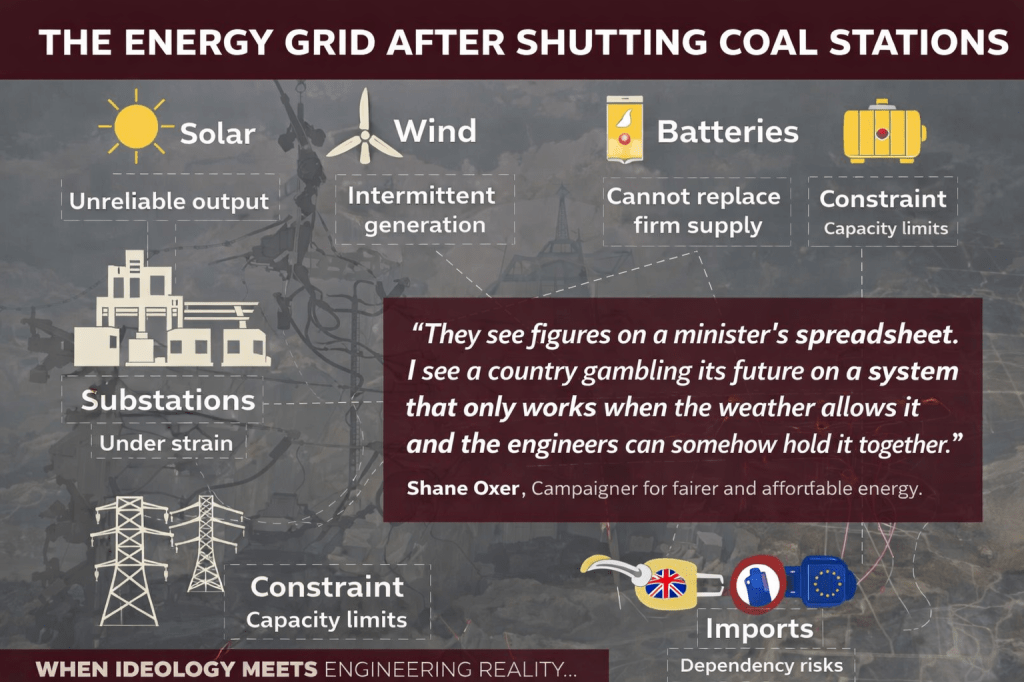
“They see figures on a minister’s spreadsheet. I see a country gambling its future on a system that only works when the weather allows it, and the engineers can somehow hold it together.”
That is how I would put it because that is exactly what this now looks like.
My journey into this issue started locally. I began examining individual schemes one by one: a solar application here, a battery site there, a new substation somewhere else. At first, they looked separate. But over time, a pattern emerged. These projects were not appearing at random. They were clustering around old coal corridors, old industrial areas, and legacy transmission routes. That was the first sign that something deeper was going on. Developers were not building a new system from first principles. They were chasing the remains of the old one.
That matters because the old grid was shaped by coal, steel, and heavy industry. It was built around large synchronous power stations such as Ferrybridge and Thorpe Marsh, which did far more than feed electricity into the wires. They gave the system stability. They gave it a controllable bulk supply. They gave it a firm foundation. When those stations shut, the grid infrastructure around them did not vanish overnight. The substations remained. The transmission corridors remained. The routes remained. What changed was the type of generation being pushed into that geography.
That is the problem. We are trying to repurpose the electrical geography of coal for a type of generation that does not behave in the same way.
Solar makes that contradiction obvious. A 49.9 MW solar farm sounds impressive in a planning statement. To the public it sounds as though something substantial is being added to the system. But the headline number conceals the truth. Solar output is not firm, not constant and not available on demand. It is strongest in the middle of brighter months and weakest when Britain actually needs reliable electricity the most. It does not replace dark winter evening generation. It does not replace dispatchable plant. It does not replace the system support once provided naturally by big thermal stations. Wind has similar limitations, though in a different pattern. It can produce a great deal, but not because the system commands it to. It produces when weather permits.
This is why so much of the present energy debate feels dishonest. Too many people speak as if all megawatts are equal. They are not. A megawatt of available, controllable generation is not the same as a megawatt of intermittent generation that may or may not appear when the grid most needs it. Yet modern policy is built on blurring that distinction because the entire case for rapid replacement starts to wobble the moment that truth is admitted.
As I kept digging, the same contradiction appeared everywhere. New substations are needed because the old network was not designed to absorb large volumes of intermittent power in these locations and patterns. New inverters are needed because inverter-based generation does not naturally provide the same strength as synchronous machines. New reactive compensation is needed because the old sources of voltage support have been stripped away. New lines, new transformers and new balancing services are needed because power now has to be moved from where the weather happens to generate it, rather than from where reliable plant was once intentionally placed.
Then come the batteries, sold as the great answer to intermittency. But they are not a true substitute for what has been lost. They can help smooth short-term fluctuations. They can assist with balancing. But they do not solve the winter problem. They do not replace prolonged firm generation. They do not recreate the deep resilience of a system once anchored by controllable plant. They are an add-on, not a foundation.
That is why, despite all the money being spent, the system feels less secure rather than more secure.
The old system had weaknesses, but it had coherence. It was built around engineering logic. The new system increasingly appears to be built around ideological targets, with the engineering forced to follow behind and somehow make it work afterwards. First, the political decision is taken. Then, the infrastructure is expected to adapt. First, the coal is closed. Then, the reinforcements, converters, compensators, and balancing mechanisms have to be invented to patch over what has been removed. This is not strategic engineering. It is policy-driven improvisation on a national scale.
And that is why I believe we could be in serious trouble.
Not because renewable energy contributes nothing. It clearly adds energy. Not because every project is without value. That would not be true either. The danger lies somewhere else. It lies in pretending that adding intermittent generation is the same thing as replacing a robust power system. It lies in confusing volume with reliability, appearance with strength, and ideology with engineering reality.
What I have seen over the last two years convinces me that Britain is being led into a false sense of security. We are told capacity is rising, but that tells us less than people think. We are told the transition is modern and inevitable, but modern does not automatically mean stronger. We are told more renewables mean more independence, while the system becomes more dependent on weather, imports, electronics, and constant intervention. We are told all of this is progress, while the grid itself is being pushed into ever more complicated forms of compensation just to preserve the basic stability that older stations once gave automatically.
That is not a sign of success. It is a sign that the replacement is not equivalent.
My conclusion after two years is simple. Britain has not replaced one robust system with another. It has begun replacing a controllable, synchronous, resilient system with one that is weather-dependent, electrically weaker, and far more demanding of the network around it. That is why we keep seeing contradictions in planning applications, grid maps, and reinforcement schemes. That is why headroom disappears, substations multiply, and battery projects cluster around the same strained corridors. That is why the story never quite adds up.
A country does not keep building emergency supports around a system that is inherently strong. It does that when the foundations are no longer secure.
And that is the warning. If we continue to remove firm generation faster than we replace its real functions, the problem will eventually move beyond planning disputes and policy papers. It will become a national vulnerability. Power systems do not fail because targets looked impressive in Westminster. They fail because reality arrives in bad weather, in darkness, under strain, and exposes what the figures were hiding all along.
Britain needs to remember a simple truth before it is too late: electricity is not just about producing units of power. It is about producing power that is available, stable, controllable, and secure when the nation actually needs it. Forget that, and no amount of ideology will keep the lights on.
Shane Oxer. Campaigner for fairer and affordable energy
 SAY NO TO THE DESTRUCTION OF OUR LAND
Leave a comment