When Al Gore made An Inconvenient Truth, he presented climate change as a moral drama of carbon, politics and denial. It was persuasive, cinematic and emotionally powerful. But it also missed something fundamental.
It largely treated the climate problem as though it were mainly about emissions choices within an otherwise unquestioned system. Change the fuels, change the policies, change the politicians — and the crisis can be solved.
But that leaves out the deeper engines of environmental pressure: human numbers and a growth-based economic model that depends on constant expansion.
If we are serious about climate, those are the fundamentals.
That matters because population is not an abstract number. More people means more houses, more roads, more electricity demand, more transport, more food production, more cement, more steel, more cooling, more waste and more land conversion. When that rising human load is channelled through an economic system that depends on ever-rising production and consumption, the environmental burden compounds.
That is the argument Gore largely avoided.
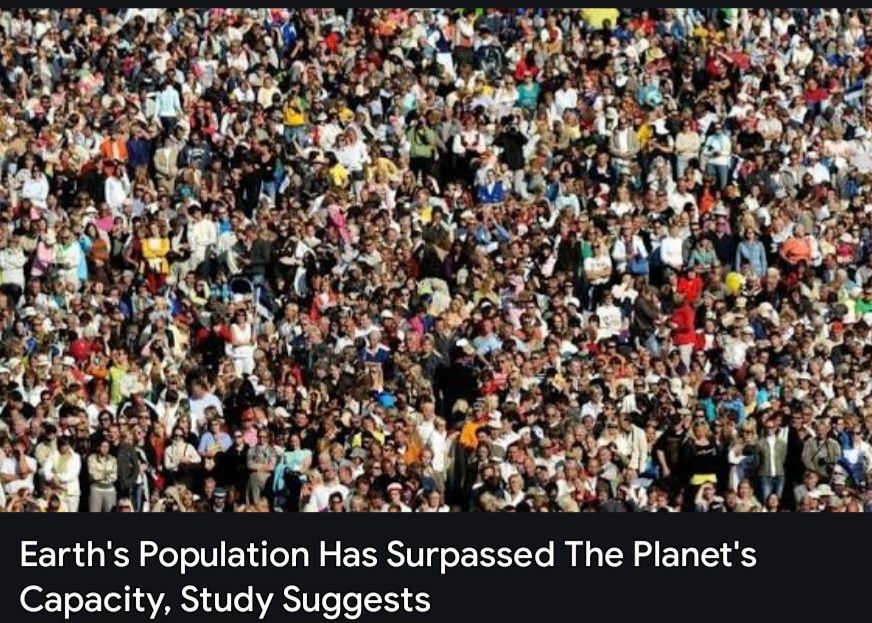
This is the point the climate debate too often ducks: even modest per-person emissions become enormous when multiplied across billions of people.
Population is not a side issue. It is a force multiplier.
Why Gore Missed the Fundamentals: The Real Drivers of Climate Change Are Population and Capitalism
When Al Gore made An Inconvenient Truth, he presented climate change as a moral drama of carbon, politics and denial. It was persuasive, cinematic and emotionally powerful. But it also missed something fundamental.
It largely treated the climate problem as though it were mainly about emissions choices within an otherwise unquestioned system. Change the fuels, change the policies, change the politicians — and the crisis can be solved.
But that leaves out the deeper engines of environmental pressure: human numbers and a growth-based economic model that depends on constant expansion.
If we are serious about climate, those are the fundamentals.
The world is now home to about 8.2 billion people, according to the UN’s latest population revision. At the same time, the world is becoming ever more urban, with cities now home to 45% of that 8.2 billion, and the UN says two-thirds of global population growth through 2050 is projected to occur in cities.
That matters because population is not an abstract number. More people means more houses, more roads, more electricity demand, more transport, more food production, more cement, more steel, more cooling, more waste and more land conversion. When that rising human load is channelled through an economic system that depends on ever-rising production and consumption, the environmental burden compounds.
That is the argument Gore largely avoided.
The arithmetic Gore did not want to confront
A simple piece of arithmetic exposes the scale of the issue.
Global average CO₂ emissions have stayed just below five tonnes per person for over a decade, according to Our World in Data.
Now compare that with population.
In 1960, the world had roughly 3 billion people. Today it has about 8.2 billion.
So even if per-person emissions had stayed around the same broad order of magnitude, the sheer multiplication of human numbers would drive the total up enormously.
A world of 3 billion people at around 5 tonnes each implies roughly 15 billion tonnes of CO₂.
A world of 8.2 billion people at around 5 tonnes each implies over 40 billion tonnes.
That is very close to today’s actual scale. Reuters reported that global CO₂ emissions were expected to reach a record 41.6 billion metric tons in 2024, including land use, with 37.4 billion tons from fossil fuels alone.
This is the point the climate debate too often ducks: even modest per-person emissions become enormous when multiplied across billions of people.
Population is not a side issue. It is a force multiplier.
More people means more urban growth, less greenery, more heat
The problem is not just how many people there are. It is also how they live.
The UN’s latest urbanisation data show that the number of people living in cities has more than doubled since 1950, and that urban growth is still accelerating. Megacities have multiplied, and future growth is expected to be concentrated heavily in towns and cities.
That means
more concrete, more asphalt, more hard surfaces, more traffic, more air-conditioning and less natural cooling.
So the climate issue is not only about smokestacks and exhaust pipes. It is also about the physical redesign of the human environment. Bigger populations mean bigger cities, and bigger cities mean more built-up land, more energy demand and more heat retention where people actually live.
In plain language: if you pack more people into ever larger, denser, harder urban environments, you are changing the heat balance whether politicians want to admit it or not.
Capitalism turns population pressure into permanent expansion
Population growth alone does not explain everything. But neither can you separate it from the economic system through which it operates.
Modern capitalism does not merely tolerate growth. It depends on it.
It depends on more workers, more consumers, more housing, more logistics, more flights, more construction, more retail, more credit, more development and more throughput. A larger population becomes economically valuable not because it is environmentally sustainable, but because it expands the market and keeps the machine turning.
That is why the climate debate so often feels dishonest.
The public is told to change its lightbulbs, boilers, vehicles and diets, while the underlying model of endless expansion remains largely untouchable. Growth is still the objective. Bigger GDP is still the political prize. More building is still treated as progress. More consumption is still the basis of prosperity.
So long as that remains true, climate policy will keep nibbling at the edges while leaving the core engine running.
Why this matters more than Gore’s moral theatre
Gore’s great success was to dramatise climate change. His great failure was to frame it too narrowly.
He focused on carbon as a political and moral scandal, but not enough on the deeper structural reality: that a planet with 8.2 billion people, still rising urban populations and an economic system built on perpetual expansion was always going to face mounting environmental strain.
That does not mean technology is irrelevant. It does not mean fuels do not matter. It does not mean policy is pointless.
It means the debate is fundamentally incomplete if it refuses to ask the deeper question:
How can you have endless population expansion, endless urban expansion, endless consumption growth and endless economic growth , and still expect a stable environmental outcome?
You cannot.
That is the real inconvenient truth.
The elephant in the room
This is the elephant in the room of modern climate politics.
If the world were truly serious about the climate crisis, it would not focus only on carbon targets, summit declarations and consumer guilt. It would also confront the two deeper drivers of pressure:
population explosion and a growth-based capitalist system that requires constant expansion.
Instead, these questions are treated as politically awkward, morally dangerous or ideologically forbidden.
But the arithmetic does not care about taboos.
More people means more energy demand.
More people means more pollution.
More people means more transport, more industry, more land conversion and more waste.
And capitalism turns all of that into a permanent growth machine.
That is not ideology. It is scale.
The blunt truth
The climate problem is not just about what we burn. It is also about how many of us there are and what kind of economic system organises our lives.
A world of 8.2 billion people, most of them increasingly urban, operating within a system that rewards perpetual expansion, was always going to produce escalating environmental pressure. Global average emissions of just under 5 tonnes per person may sound moderate when spoken about abstractly. Multiplied across billions, they become planetary in scale.
Gore made climate politics emotional.
But he missed the fundamentals.
The real drivers are not just carbon and denial.
They are population and capitalism.
And until those are confronted honestly, the rest is theatre.
Shane Oxer. Campaigner for fairer and affordable energy
 SAY NO TO THE DESTRUCTION OF OUR LAND
Leave a comment