Shanks Sells 2029 Solar as if It Solves 2026 Energy Insecurity
Energy Minister Michael Shanks wants the public to believe that approving Springwell Solar is a serious answer to the instability now shaking global energy markets. His statement sounds firm, patriotic and reassuring. It is also deeply misleading.
He says the government is driving “further and faster” for clean homegrown power to protect the British people and bring down bills for good. He says Britain must learn the lessons of the conflict in the Middle East. He says solar is one of the cheapest forms of power and the route off the rollercoaster of international fossil-fuel markets.
There is one obvious problem.
Springwell is not due to generate until 2029. Public reporting on the approval says the project is expected to begin producing electricity from 2029. That means it does not answer the crisis of 2026. It does not protect households this year. It does not shield Britain this coming winter. It is a future asset being sold as if it provides present security.
That is the trick at the heart of the government’s messaging. Ministers are taking a long-term argument and dressing it up as an immediate solution. They are using tomorrow’s solar to imply today’s protection.
That may work as a headline. It does not work as energy policy.
There is a legitimate long-term case for wanting more domestic generation. Britain has been badly exposed to international gas shocks, and governments have long argued that more domestic low-marginal-cost generation can reduce exposure to volatile global fuel markets over time. That much is fair.
But that is not what Shanks is asking the public to hear.
He is tying Springwell to the lessons of the current Middle East conflict, as though this approval materially strengthens Britain against the risks of the moment. It does not. A solar farm expected in 2029 is not a shield against turmoil in 2026. It is not a response to present market anxiety. It is certainly not a tool for getting through the next winter.
That distinction matters because winter stress in Britain is not mainly a summer solar problem. The system comes under real pressure on dark, cold evenings, when demand is high and solar output is weakest or absent altogether. Even NESO’s winter outlook made clear that resilience for winter rests on a wider mix of battery capacity, gas generation availability and interconnection, while still warning there could be tighter days within the season.
And the live grid picture proves the point.
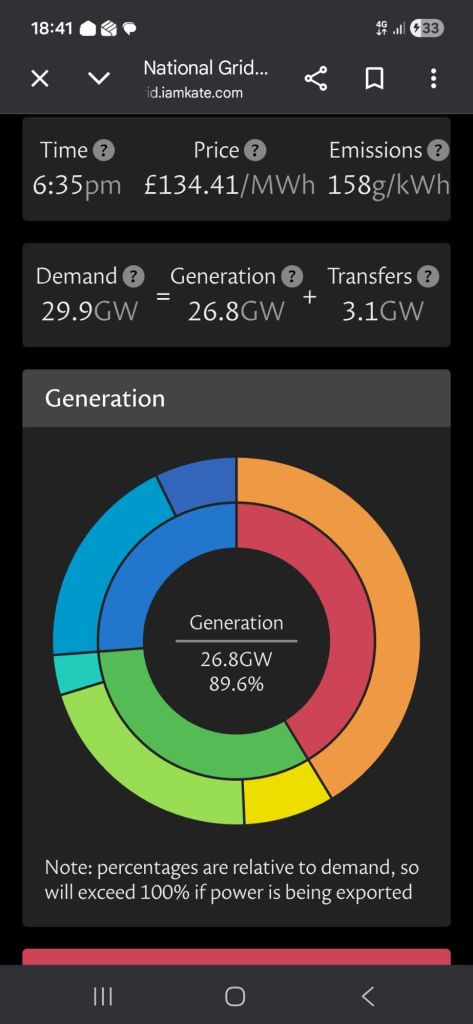
In my screenshot, taken at 6:35pm, demand was 29.9GW. Britain was meeting that with 26.8GW of generation plus 3.1GW of transfers, while the power price stood at £134.41/MWh. That is the hour that matters: the evening peak, when people are home, lights are on, kettles are boiling and demand is real. It is also the point at which solar is weakest or gone altogether. The system still has to lean on firm generation and imports to keep the country running.
That is the part ministers do not like to emphasise. Solar can contribute when conditions suit it, but it does not abolish the need for dispatchable power. It does not remove the need for gas-fired generation when the system is under pressure. It does not end dependence on balancing plant, interconnectors or reserve margins. The evening grid tells the truth far more clearly than a ministerial press release.
So when Michael Shanks claims this is how Britain gets off the rollercoaster of international fossil-fuel markets, he is blending together two very different timelines. The long run and the immediate term are not the same thing. A project due in 2029 cannot lower the geopolitical temperature in 2026. It cannot calm current markets. It cannot stop winter price pressure before it exists.
And that matters even more because the government keeps using the phrase “bring down bills for good.” That sounds final and decisive, but bills are not set by solar alone. Household costs reflect wholesale prices, network costs, balancing costs, policy costs and the cost of maintaining enough firm and flexible generation when intermittent output falls away. Cheap solar in one hour is not the same thing as cheap electricity for households across the year. Britain still pays for the rest of the system that must stand behind intermittent generation.
This is why the politics is so frustrating. The country is being asked to confuse approval with delivery, and future generation with present security.
Springwell may one day become a real generating asset. That is not the point. The point is that the government is using it now to imply a level of protection it cannot provide. It is borrowing reassurance from infrastructure that is still years away.
That is not energy security. It is message management.
It is also a way of avoiding harder questions. If ministers want to talk honestly about the coming winters, they should talk about what will actually carry Britain through them: dispatchable generation, gas availability, interconnectors, balancing tools, storage, reserve margins and weather conditions. They should talk about grid readiness. They should talk about constraints. They should talk about the fact that an electricity system cannot be judged by megawatts on paper alone.
Instead, they talk about Springwell as though it is already standing guard over the nation.
It is not.
The deeper problem is credibility. Once ministers start using projects with 2029 start dates to imply security in 2026, people are entitled to ask what else is being oversold. If the public is anxious about conflict abroad, fuel prices and whether the system will cope in winter, the answer cannot be a glossy announcement about a scheme that will not be generating for years.
Britain does need a serious energy policy. It does need resilience. It does need to reduce exposure to international shocks. But serious policy begins with honest timing. If something is part of a long-term transition, say so. If it will not help this winter, say so. If it will not protect families from today’s market turmoil, say so.
Do not pretend otherwise because the headline sounds better.
Michael Shanks is trying to sell a long-term solar approval as though it answers a short-term security crisis. That is the real issue. Not whether Springwell may one day generate power, but whether ministers are being truthful about what it can do and when it can do it.
The British public deserves better than that.
Because the Middle East crisis is now.
Winter is now.
Springwell is 2029.
Shane Oxer. Campaigner for fairer and affordable energy
 SAY NO TO THE DESTRUCTION OF OUR LAND
Leave a comment