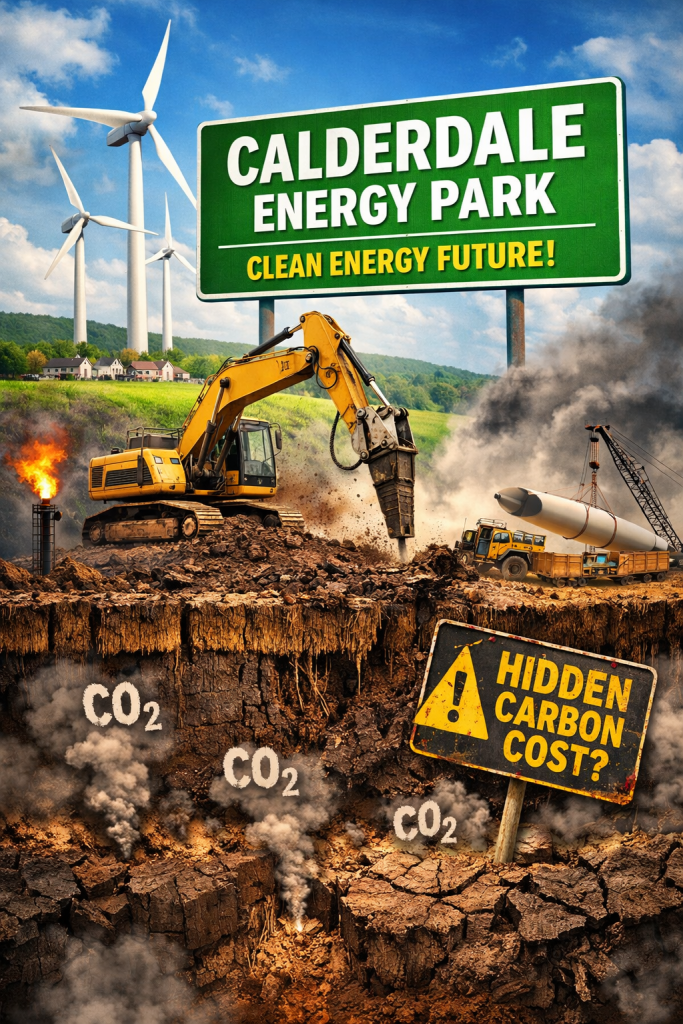
Calderdale Wind Farm Ltd wants the public to see Calderdale Energy Park as a clean, modern answer to climate change. The language is familiar. Thousands of homes powered. Millions of tonnes of carbon dioxide saved. A greener future for all.
It sounds impressive.
But the glossy headline hides the real story.
Before a single turbine turns, this development will already have produced a very large carbon bill through steel, concrete, transport, excavation, heavy machinery, and the industrialisation of open moorland. Worse still, it is proposed for Walshaw Moor, a peatland landscape that stores carbon naturally. Disturb that peat, dry it out, cut into it with tracks, crane pads, cabling, and foundations, and it begins to release carbon that has been locked away for centuries.
That is the part the public is not being told clearly enough.
This is not a minor planning detail. It goes to the heart of the entire climate claim. A project cannot honestly present itself as a major carbon saver while ignoring the carbon cost of building it and the carbon released from the landscape it damages.
That is exactly why Calderdale Energy Park deserves much closer scrutiny.
A green project with a hidden carbon debt
Developers like to talk about lifetime savings. They rarely want to talk about upfront emissions.
Yet wind turbines do not appear by magic. They are vast industrial machines made from energy-intensive materials. Each one requires major foundations, steel towers, composite blades, transport convoys, specialist cranes, and extensive supporting works. Then there are the roads, compounds, substations, trenching, and all the diesel-powered plant needed to build the site in the first place.
Taken together, that means this project is likely to create carbon emissions measured not in a few tonnes but in a large fraction of a million tonnes of carbon dioxide before the scheme is even operating properly.
That is the carbon debt.
If the public is told the project will save millions of tonnes of CO₂, then the public is entitled to know how much CO₂ will be emitted just to get it built. Without that, the headline claim is incomplete at best and misleading at worst.
Walshaw Moor is not empty land
One of the most troubling aspects of this proposal is the location.
Walshaw Moor is not a blank space on a developer’s map. It is not a convenient patch of unused ground waiting to be industrialised. It is upland peatland, part of a sensitive moorland system with major ecological and climate importance.
Peat is one of the country’s most important natural carbon stores. It works because it remains wet, stable, and largely undisturbed. Once that stability is broken, the carbon story changes. Excavation, drainage, road building, and repeated heavy access can lower water levels and begin the process of oxidation. When that happens, the peat starts giving back carbon to the atmosphere.
So, while the project is marketed as a climate solution, the land it sits on could turn into part of the climate problem.
That contradiction should concern anyone who cares about real environmental protection, not just green branding.
The numbers need honesty
The company’s public message depends on presenting the development as a clear net carbon benefit. But that only works if several awkward questions are pushed to one side.
How much carbon is released producing the steel and concrete?
How much is emitted transporting abnormal loads and operating heavy cranes and machinery on site?
How much carbon is released if peatland is disturbed, dried, or degraded?
How much is added by maintenance over the working life of the turbines?
How long does it actually take before the project has paid back the emissions caused by building it?
These are not fringe questions raised by objectors for effect. They are the central questions in any serious climate assessment.
When they are asked properly, the picture becomes much less comfortable for the developer.
Wind turbines are not “install and forget”
There is another myth that deserves challenging.
Wind turbines are often presented as though they are put up once and then quietly generate clean electricity for decades without much further intervention. That is not how these machines work in the real world.
They require ongoing servicing, inspection, access, repairs, and major maintenance. Components wear out. Blades face constant weather exposure, erosion, and fatigue. Over the life of a wind farm, major components can need repair or replacement, bringing more heavy vehicles, more cranes, more manufacturing emissions, and more industrial disruption.
In other words, the carbon cost does not stop when the ribbon is cut. It continues through the operational life of the site.
Again, that matters because the public is being asked to accept the project on climate grounds.
This is not anti-environment. It is pro-honesty.
Objecting to this proposal does not mean denying that wind can generate electricity. Of course it can.
The real issue is whether this particular scheme, in this particular location, with this particular level of peatland risk and construction impact, deserves to be sold as an unquestionable environmental good.
That is a far harder case to make.
There is a growing public frustration with large energy schemes being waved through under the banner of Net Zero while the actual environmental damage is downplayed, delayed, or buried in technical paperwork. Local people are expected to accept the industrialisation of landscapes, the loss of habitat, and the disruption of rural areas, then applaud because the brochure says “green”.
That is not good enough.
Environmental policy should be based on evidence, not slogans. If a project destroys a natural carbon store in order to claim carbon savings somewhere else on paper, then the public has every right to call out that contradiction.
Calderdale deserves the full truth
The people of Calderdale deserve more than a sales pitch. They deserve straight answers.
They deserve to know the real carbon cost of constructing this development.
They deserve to know the likely carbon impact of disturbing peatland.
They deserve to know how long the project would take to pay back its carbon debt.
They deserve to know whether the claimed savings are realistic, or simply a marketing figure built on selective accounting.
And they deserve to know whether a scheme presented as clean energy may, in reality, leave behind a damaged landscape and a far more questionable climate outcome than advertised.
That is why Calderdale Energy Park should not be judged by headline promises alone. It should be judged by the full environmental truth.
If that truth is properly examined, this project may look far less green than its promoters would like the public to believe.
Shane Oxer. Campaigner for fairer and affordable energy
 SAY NO TO THE DESTRUCTION OF OUR LAND
Leave a comment